


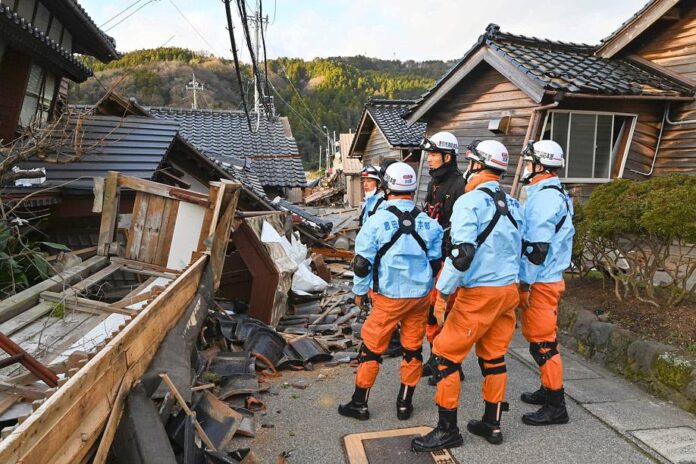
While the wounds of Fukushima are far from healed, a new major earthquake has struck northern Japan, accompanied by a series of tsunamis. The event revives fears of a broader tectonic breakdown—downplayed by authorities, yet unconvincingly.
A New Jolt in a Tectonic Powder Keg
At 11:15 p.m. local time on Monday, December 8, 2025, a 7.5 magnitude earthquake struck off the coast of Aomori, in northern Japan. Initially estimated at 7.6, the offshore quake triggered a series of modest yet symbolically alarming tsunami waves, peaking at 70 centimeters.
Prime Minister Sanae Takaichi, speaking early the next day, confirmed at least 30 injuries, including several serious cases. One individual on Hokkaido island was severely hurt, while over 28,000 residents were evacuated following directives from Japan’s Fire and Disaster Management Agency.
“Be ready to evacuate if you feel a tremor,” she warned—words that sound more like an admission of helplessness than a coherent safety strategy.
The Ghost of March 11, 2011: A Structural Trauma
This latest earthquake in Japan inevitably echoes the 2011 catastrophe: a 9.0 magnitude earthquake that triggered a deadly tsunami and led to the meltdown of three reactors at the Fukushima nuclear plant. 18,500 people dead or missing—a national scar that has yet to fade.
Though less intense, this new event reawakens fears of the long-dreaded “mega-quake” off the Nankai Trough. Earlier this year, government experts raised the probability of such a quake occurring in the next 30 years to 75–82%. A March update estimated up to 298,000 fatalities and $2 trillion in potential damage.
A Nation’s Resilience Under Stress
Despite Japan’s famed civil preparedness, chaos still reigns at the micro level:\n\n- Objects falling from shelves,\n- Cracked ceilings,\n- Damaged roads in Sapporo,\n- 2,700 households without power,\n- Multiple fires reported in Aomori.
A municipal employee in Hashikami, who rushed out of his home with his two toddlers, described a primal, reflexive fear—not just of this quake, but of the unhealed collective memory of disaster. For many, the tremor felt less like an isolated event and more like a reminder of the island’s geological fragility.
Nuclear Power Still Online, for Now
Tohoku Electric Power stated that no anomalies were detected at the Higashidori plant (Aomori) or the Onagawa plant (Miyagi). But in a nation where public trust in nuclear regulators remains shaky, “no anomaly” doesn’t equal peace of mind.
History urges skepticism: in 2011, official communications underplayed Fukushima’s severity, with critical information revealed only through leaks and independent investigations. Why should we now blindly trust nuclear operators’ self-assessments?
A Country Sitting on Fault Lines: The Pacific Ring of Fire as Destiny
Japan sits at the intersection of four tectonic plates, smack in the middle of the Pacific Ring of Fire, the most seismically active zone on Earth. The country records over 1,500 earthquakes per year, most minor, but the accumulation of seismic pressure points to the inevitable.
The question isn’t if, but when. Each moderate quake, like the one in Aomori, may simply be a dress rehearsal for the structural collapse to come.
Official Messaging Under Control, But Not Convincing
Text alerts blaring from smartphones, flashing “Tsunami! Run!” messages across train stations, and Shinkansen trains halted preemptively showcased Japan’s famed technological responsiveness. But this efficiency only thinly masks a diffuse sense of strategic unpreparedness.
The government maintains an image of control, but public trust shows cracks. Western media silence, so quick to spotlight every U.S. hurricane, speaks volumes about the uneven treatment of geological risks, shaped by geopolitical interests.
A Tremor in More Ways Than One
This earthquake in Japan is a loud warning, not just for the Japanese people but for foreign observers lulled by the myth of a stoic, disaster-proof nation. In truth, vulnerability remains, human and structural alike. And the weak signals are multiplying: closed airspace, rising earthquake insurance premiums, increased surveillance of critical infrastructure.
A 7.5 magnitude quake is not a catastrophe. It’s a test. And possibly the final one before the real collapse.

