


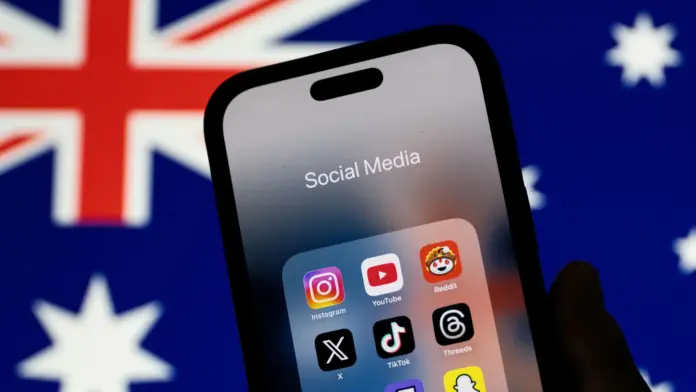
While the West mourns the collapse of its youth under the weight of foreign algorithms, Australia has become the first nation to draw a clear red line: as of December 10, no social media access for anyone under 16. What looks like a bold move is also a sign of a growing global shift—a return of state authority in the digital space, cloaked in parental concern but pregnant with deeper strategic motives.
A blunt ban against algorithmic chaos
On the morning of December 10, 2025, hundreds of thousands of Australian teenagers found themselves locked out of Facebook, TikTok, Instagram, YouTube, Reddit, and other platforms. This social media ban in Australia, hailed with nationalistic pride by Prime Minister Anthony Albanese, is nothing short of a world first.
“We are taking back control,” Albanese declared, with the kind of iron-fisted rhetoric usually reserved for national emergencies, not youth policy.
Under the new law, tech platforms must exclude all users under 16. Failure to comply could result in fines of up to €28 million. It’s no coincidence that the targets are all American giants—Meta, Google, ByteDance—whose influence long outstripped that of local institutions. The message is political as much as it is moral.
Beyond digital hygiene: a strategic move
This social media ban in Australia is officially about protecting children: online harassment, screen addiction, sexualized content, and adolescent mental health have all been cited. But the real signal is political—perhaps even geopolitical. In a world of fragmented authority and cross-border tech monopolies, Canberra has chosen to reassert itself.
Many Australian parents, weary and grieving, had long called for such action. Mia Bannister, mother of 14-year-old Ollie—who died after enduring months of online bullying—pointed the finger directly at social media. “I’m tired of tech giants shirking their responsibilities,” she said.
Her voice echoes that of countless others in the Anglosphere, where governments talk endlessly about regulation but rarely act. Australia, unusually, has acted.
Meta and the tech giants: obedient on paper, nervous behind the scenes
Predictably, Big Tech is playing along—but not without raising concerns.
Meta (which owns Facebook, Instagram, Threads) quickly began removing underage accounts. Yet its statements suggest a deeper discomfort.
“We remain concerned this law will weaken online safety for teens,” the company said in a carefully worded communiqué.
The underlying fear is clear: by banning minors from mainstream platforms, governments may be driving them into the hands of lesser-known, loosely regulated apps—some of which originate in countries far less interested in user safety or transparency.
That shift is already underway. Apps like Lemon8 and Yobe, still accessible under the new law, have seen downloads skyrocket. WhatsApp, Pinterest, and even Roblox remain untouched—for now. The line between safety and hypocrisy is razor-thin.
Loopholes, workarounds, and an already-disillusioned youth
Australian officials admit the law is imperfect and likely to be bypassed. Enforcement is based on age verification—either through artificial intelligence assessing user photos or through ID uploads. Anyone who has ever used a VPN, a fake profile, or borrowed a parent’s account knows how easy it is to cheat the system.
Fifteen-year-old Layton Lewis, interviewed the day before being locked out of his social apps, was unimpressed:
“I don’t think the government knows what it’s doing,” he said. A striking display of adolescent clarity.
Indeed, the tech-savvy under-16 crowd is unlikely to be deterred by a legal PDF or a digital age-gate.
The global ripple effect has already begun
Australia may be the first—but it won’t be the last. New Zealand is watching. Malaysia is considering similar restrictions. Even France, usually more technocratic than swift, recently published a damning report blaming TikTok for widespread psychological harm among its youth.
What we’re seeing is the slow but inevitable encroachment of public authority into a space long dominated by private code. But what kind of authority? And in whose interest?
Those questions remain unanswered.
State control returns, but the real battle is elsewhere
If we take it at face value, the social media ban in Australia is a landmark assertion of national sovereignty against the algorithmic empires of Silicon Valley. But scratch the surface, and the contradictions begin to show: poorly enforced, easy to evade, and selective in scope.
What’s being staged here is not the final reckoning of tech versus state, but the first skirmish in a much longer war—one that must eventually involve schools, families, and above all, a redefinition of what it means to grow up in the digital age.
Bans alone will not fix the problem. But they may signal that the era of passive surrender is over.

