


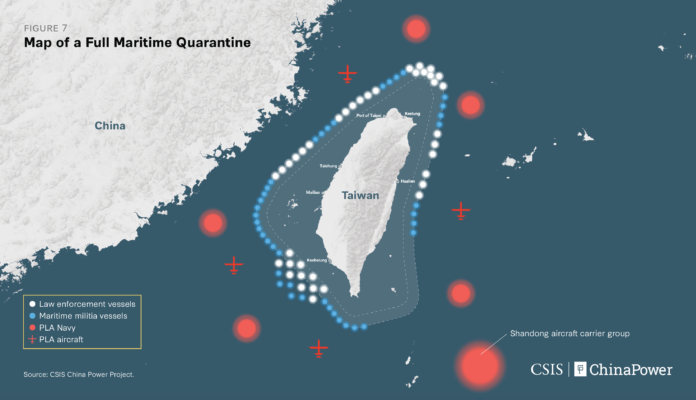
A show of force under rising tension, as Beijing imposes a new strategic reality in the Taiwan Strait. While Washington sells weapons, China tightens the grip.
While Western capitals continue to indulge in strategic ambiguity or diplomatic platitudes, China encircles Taiwan with military precision and geopolitical intent. On December 30, 2025, the People’s Liberation Army (PLA) entered its second day of full-scale military drills under the operation dubbed — with deliberate irony — Mission Justice 2025. Officially, these are meant as a “severe warning” to what Beijing calls “separatist forces.” In practice, they reflect a progressive, pressure-based strategy designed to force Taiwan into submission without firing a shot — yet.
Military Pressure at Unprecedented Scale
The numbers speak louder than any statement: 130 Chinese aircraft and 22 warships were detected in a 24-hour span, Taiwan’s Ministry of National Defense reported — the highest daily count since October 2024. This isn’t a rehearsal; it’s a calibration of a slow-moving siege.
From the Chinese island of Pingtan, the closest point to Taiwan’s main island, journalists witnessed multiple rockets streaking through the air, leaving long trails of white smoke. Five zones surrounding Taiwan were designated for live-fire drills, some placed less than 12 nautical miles from Taiwan’s shores — a direct challenge to its territorial waters.
The Art of Blockade, Chinese-Style
PLA spokesman Colonel Shi Yi resorted to the usual military jargon: “joint control of comprehensive superiority,” “multidimensional deterrence,” “sea-air combat readiness.” Behind this lexicon lies a well-rehearsed simulation of hybrid warfare — blending cyber threats, airspace violations, and commercial disruption.
Taiwan’s Civil Aviation Administration confirmed the scope of disruption: a temporary danger zone unilaterally imposed by Beijing forced 857 flights to be rerouted or cancelled, affecting over 100,000 passengers. The sky over Taiwan, much like the strait below, is slowly closing in.
Taipei Strained, Washington Sends Mixed Signals
President Lai Ching-te tried to strike a diplomatic tone, stating that Taiwan would neither “provoke” nor “escalate” the situation. But facts speak louder than declarations. On Monday, Taipei held its own rapid-response exercise, reporting 89 aircraft and 28 Chinese naval vessels near its air defense identification zone.
Meanwhile in Washington, President Donald Trump — in his second term — downplayed the threat, saying he does “not believe Xi Jinping will invade.” Whether this is calculated reassurance or subtle disengagement is unclear. But the inconsistency is stark: just days earlier, his administration approved a record $11.1 billion arms deal with Taiwan — the largest since 2001.
Beijing Drops the Pretenses
China’s Foreign Minister Wang Yi didn’t mince words. In a speech from Beijing, he accused the United States of fueling separatism and declared that any attempt to prevent reunification between China and Taiwan would “inevitably fail.”
The gloves are off. Beijing has drawn a strategic red line and dares anyone to cross it. These drills are not just military exercises — they are messages, encoded in missile trails and naval formations. They test global tolerance for slow annexation and challenge the Western bloc’s willingness to act.
The Trap of the Fait Accompli
China encircles Taiwan — not to posture, but to execute a slow and deliberate plan. While the West dithers in diplomatic euphemisms, Beijing advances a silent siege. The real threat is not an overnight invasion, but a creeping asphyxiation, designed to leave Taipei isolated, demoralized, and ultimately absorbed without a decisive conflict.
The chapter where Taiwan relied on an unspoken American security umbrella may be closing. The next chapter could very well be written — and dictated — by Beijing.

