


A Spectacular but Senseless Strike? Behind the Kremlin’s Symbolic Attack Lies a Chilling Message to the West
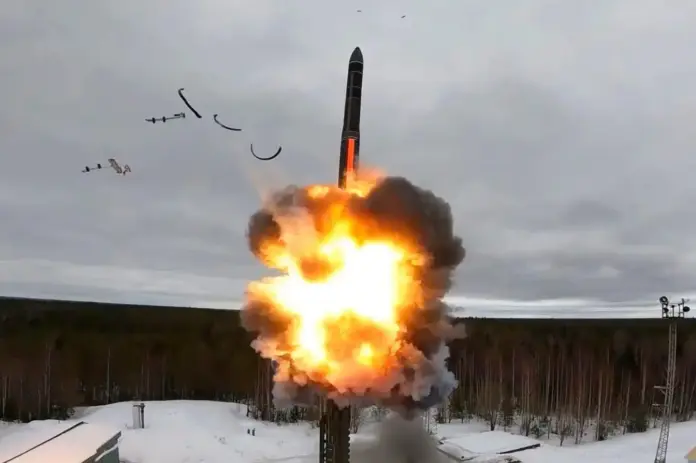
On the night of January 8 to 9, 2026, a Russian Orechnik missile — a hypersonic ballistic weapon capable of carrying multiple nuclear warheads — struck a gas storage facility near Lviv, just a few dozen kilometers from the Polish border. Officially, Moscow framed it as retaliation for an alleged Ukrainian attack on President Putin’s residence. In reality, this strike raises questions about military logic — and reveals a strategic communication operation far beyond the Ukrainian battlefield.
Strategic Irrationality: A Nuclear-Capable Missile for a Minor Target
Rarely deployed since the beginning of the war, the Orechnik missile had only been used once before — in November 2024 — against an industrial complex in Dnipro. Its second appearance, targeting what analysts call a “secondary” site — an underground gas depot — has left Western military experts perplexed.
The Orechnik, capable of reaching speeds of Mach 10 (over 12,000 km/h) and evading even the most sophisticated missile defense systems, seems vastly oversized for this type of target. “Such a facility could have been hit with Kalibr missiles or even drones,” notes Erik Stijnman, a researcher at the Clingendael Institute. The logical conclusion: this was a show of force, not a tactical necessity.
Staged Vengeance for a Possibly Fictional Attack
The supposed trigger? A Ukrainian strike on Vladimir Putin’s residence on December 29 — an attack Kyiv firmly denies, and which even Western intelligence agencies consider likely fabricated. Still, Moscow built an entire retaliatory narrative around it.
“The Russian presidency had committed itself to a response, and was under pressure to act,” explains Huseyn Aliyev (University of Glasgow). Striking Ukraine’s presidential palace was off the table — not least because of the risk of damaging the nearby Kyiv Pechersk Lavra, a key Orthodox religious site. The Kremlin needed something bold, yet contained.
The Orechnik Missile as Political Deterrent
Targeting Lviv — a western Ukrainian city just 70 kilometers from Poland — was no coincidence. The signal was unmistakable: by brushing up against NATO airspace, Russia reminded the world it could bring nuclear-capable firepower to Europe’s heartland. This, at a moment when Paris, Berlin, and London were tentatively discussing the deployment of ground troops to Ukraine, should a ceasefire ever emerge.
That’s a red line for Moscow, and the Orechnik encircles it in nuclear ink. “Russia is showing it can strike anywhere in Europe at any moment — and no one can stop it,” observes Matthew Powell, aerial warfare expert at the University of Portsmouth.
A Deadly Luxury in the Service of Propaganda
Costing upwards of $10 million per unit, with each launch incurring additional costs in the hundreds of thousands, the Orechnik is anything but an expendable munition. It’s a prestige weapon. “For the same price, Russia could produce twenty conventional ballistic missiles,” notes Huseyn Aliyev.
What appears as waste is, in fact, an investment in psychological warfare. The impact on both domestic and international audiences justifies the strike: a reminder to Russians that their nation remains technologically potent, and a veiled threat to the West — sowing doubt and hesitancy amid a grinding war where symbolism often overshadows territorial gains.
Missiles as Messaging Tools
The Orechnik is more than a warhead carrier — it’s a carrier of intent. And the message is clear: Russia will escalate symbolically when it suits its strategic narrative, even if it means deploying its most advanced weapons in carefully staged operations.
This was less a blow to Ukraine than a psychological test for Europe. And this time, the Kremlin may have succeeded in making its threat believable.

