

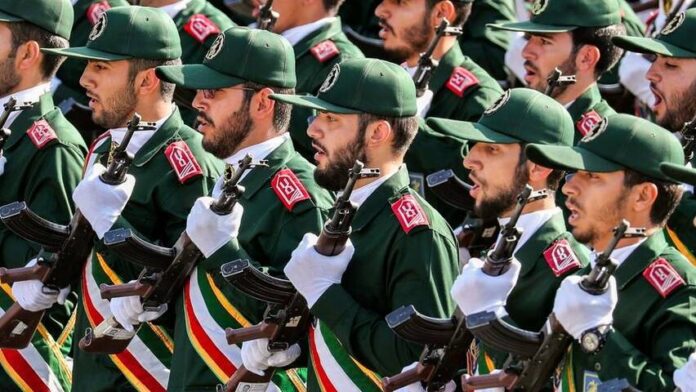
As the European Union follows the U.S. in blacklisting Iran’s Revolutionary Guards as a terrorist organization, Tehran strikes back. In a calculated rhetorical escalation, the Iranian Parliament has now declared European armies themselves as “terrorist groups”, a move that, in the language of hybrid warfare, signals that Western military structures are no longer viewed as neutral or untouchable.
A spiral of escalation, long in the making
The European Union may feign surprise, but it has walked straight into a strategic minefield. Its recent move to designate the Islamic Revolutionary Guard Corps (IRGC) as a terrorist entity is not just symbolic — it marks a major alignment with Washington’s hardline doctrine, one that even key EU states had previously resisted. But as always, Brussels chooses timing poorly: just when Washington itself shows signs of wanting to reopen dialogue, Europe doubles down on punitive declarations.
In retaliation, Iran declared on February 1st that European military forces are now considered “terrorist organizations” — turning the narrative on its head, and doing so with the full institutional voice of its Parliament.
Khamenei: “If war breaks out, it will be regional”
Speaking publicly for the first time in weeks, Iran’s Supreme Leader Ayatollah Ali Khamenei issued a stark warning: any U.S. strike on Iranian territory will result in a “regional war.” This isn’t bravado; it’s a calibrated message from a regime that has spent decades preparing for asymmetrical warfare.
Iran is not seeking a direct war with the U.S., but it thrives in regional entanglement, leveraging its influence across Iraq, Syria, Lebanon, Yemen, and Gaza. In the event of conflict, it could open multiple flashpoints through proxy forces. A war, in this case, would not be a front line — it would be a map on fire.
Europe’s dangerous virtue signaling
The European Union’s decision to list the IRGC as a terrorist group is both belated and hypocritical. After years of walking the line on the Iran nuclear deal, Europe is now mimicking U.S. sanctions without the diplomatic leverage or the military muscle to back it up. And yet, this moralistic positioning has consequences: Tehran responded by labeling European armies — French, German, Italian and others — as legitimate targets.
It is worth asking: what deterrence capacity does the EU have in the Middle East today? Virtually none. And yet, it just volunteered itself as a protagonist in a potentially regional conflict. This is strategic amateurism masquerading as principle.
Brutal repression, justified as a foreign plot
Domestically, Tehran is cracking down hard. The January uprisings — initially over the cost of living — quickly became a national revolt against the regime itself. The repression has been severe, methodical, and openly assumed.
Activist Erfan Soltani, arrested mid-January and labeled by international NGOs as a symbol of the movement, was recently released on bail. His case made headlines because U.S.-based NGOs feared his imminent execution, although Tehran denies that.
According to HRANA, a U.S.-based human rights group:
- Over 42,000 arrests were made,
- At least 6,700 confirmed deaths, mostly protesters,
- Over 17,000 additional deaths still under review.
And yet, Khamenei reframed the entire episode as a failed foreign-backed coup, organized by Israel and the U.S. This narrative is now official doctrine.
Trump’s cold pragmatism returns
Ironically, Donald Trump, speaking the same day, offered a glimmer of diplomacy: “I hope we can reach a deal,” he told reporters. “If we don’t, we’ll see if Khamenei was right.”
It’s classic Trump: a mix of threat and negotiation. Behind the scenes, Iran’s foreign minister Abbas Araghchi admitted to CNN that regional actors are mediating backchannel talks, possibly reopening the nuclear file if Washington offers a “fair and equitable” deal.
But the trust is gone — replaced by a tense mix of escalation and double-speak.
The nuclear question looms large
The core issue, buried under layers of proxy politics, remains the same: Iran’s nuclear ambitions. The West suspects it seeks a bomb; Tehran denies it; the IAEA stays vague; and meanwhile, uranium enrichment accelerates.
Israel, watching closely, will not wait for Washington’s permission if it believes Iran crosses a red line. And this is where the real countdown begins.
Europe becomes a target without being a player
Iran’s threats are not the surprise here. Europe’s posture is. By designating the IRGC as a terrorist group, the EU invited retaliation, without having any real means of response. It’s a moral victory at the cost of strategic exposure.
In the logic of asymmetric warfare, being declared a “terrorist” by Tehran may seem absurd. But it means one thing clearly: EU troops, bases, and even civilians abroad are now symbolically and operationally part of Iran’s retaliation map.
And that, in realpolitik terms, is not a position of strength, it is a position of vulnerability.

