


A Nation Suspended Between Reckoning and Reinvention
The Bangladesh Legislative Elections 2026 are not a routine democratic exercise. They are a reckoning. A test of whether a country long gripped by centralized authority can truly reset its political order without descending into another cycle of factionalism and quiet coercion.
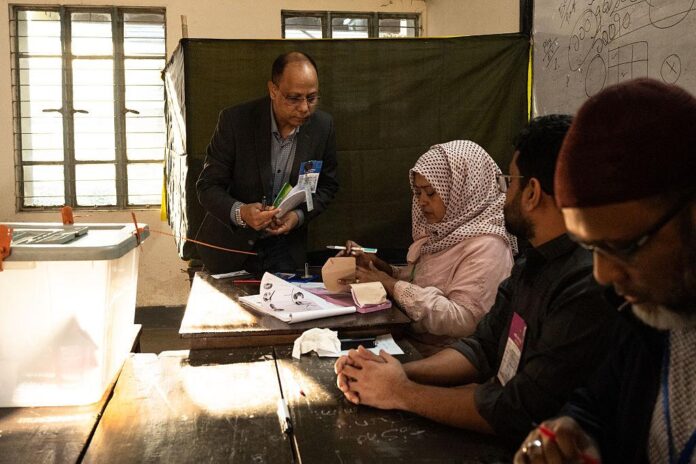
At dawn in Dhaka, voters lined up outside polling stations as if aware that this was more than a ballot—it was a verdict on fifteen years of iron-fisted governance under Sheikh Hasina. Her fall in 2024, driven by a youth-led uprising that turned deadly, ended an era. But endings, especially in South Asia, are rarely clean.
The ruling party was declared illegal. The political field has been redrawn. Yet the deeper structures of power—security forces, bureaucratic loyalties, foreign alignments—remain largely intact.
The Collapse of a System, or Its Reconfiguration?
For over a decade, elections were contested, boycotted, or widely accused of being manipulated. Western capitals offered ritualistic concerns while maintaining strategic partnerships. Stability, after all, often outweighs democratic purity in diplomatic calculations.
Now the two historical rivals of the fallen regime stand poised to inherit the state:
- Bangladesh Nationalist Party (BNP)
- Jamaat-e-Islami
The BNP’s leader, Tarique Rahman, projects confidence. He speaks of national reconstruction, of reclaiming sovereignty from a corrupt apparatus. His rhetoric appeals to a population weary of economic stagnation and endemic graft.
Across the aisle, Shafiqur Rahman of Jamaat-e-Islami presents a surprisingly moderated tone. He promises jobs, anti-corruption measures, and electoral transparency. Whether this moderation is tactical or structural remains an open question.
The Bangladesh Legislative Elections 2026 unfold under the shadow of massive security deployment—over 300,000 personnel. Markets have reacted cautiously. Regional actors remain watchful. India monitors events with quiet calculation. China, as always, waits patiently. Anglo-American diplomacy speaks of “democratic transition” with the kind of calibrated optimism that often masks strategic hedging.
Generation Z and the Politics of Dignity
More than 127 million citizens are eligible to vote. Nearly 44% are between 18 and 37 years old—the generation that led the 2024 uprising. Many are voting for the first time.
Their motivation is not ideological fervor but fatigue: fatigue with corruption, with patronage networks, with an economy that once promised manufacturing-driven growth but now limps under inflationary pressure and declining investor confidence.
At universities across Dhaka, students speak of “fairness” and “honesty” with a seriousness that suggests political maturation. They are not naïve. They know power rarely yields without recalibrating itself.
The Bangladesh Legislative Elections 2026, therefore, are less about partisan victory and more about whether institutional trust can be restored.
The Interim Guardian and Fragile Reforms
Overseeing this transition is Nobel laureate Muhammad Yunus, who assumed leadership of the interim government after Hasina’s departure. At 85, Yunus has framed his tenure as temporary stewardship.
His legacy effort—the so-called “July Charter”—introduces institutional reforms: a two-term limit for prime ministers, the creation of a second parliamentary chamber, and structural safeguards against executive overreach. These measures are being submitted to referendum alongside the legislative vote.
On paper, it is a decisive correction. In practice, constitutions are only as strong as the will to enforce them.
An Exiled Shadow
From exile in India, Sheikh Hasina—sentenced to death for the 2024 repression—has issued no voting guidance to her former supporters. Their silence could shape turnout patterns and regional outcomes in unpredictable ways.
The electoral commission pledges transparency. Observers signal cautious approval. But in geopolitics, legitimacy is rarely determined solely by procedure; it is shaped by acceptance. If results are contested, the fragile calm could fracture quickly.
A Test of Sovereignty
The Bangladesh Legislative Elections 2026 represent a decisive moment in the nation’s political evolution. Not because democracy has suddenly blossomed, but because a long-standing order has collapsed and the replacement is not yet consolidated.
Bangladesh stands at a crossroads—between sovereign recalibration and renewed instability, between national dignity and external influence, between institutional repair and recycled patronage.
The ballots will be counted. The real question is whether power, whoever claims it, will respect the verdict—or merely reinterpret it.

