


A Predictable Tragedy in a Fragile Landscape
The torrential rains in Brazil have once again struck with ruthless efficiency, killing at least 30 people in the southeastern state of Minas Gerais. In Juiz de Fora and Uba, entire neighborhoods have been swallowed by mud and floodwaters, exposing not only the force of nature but the structural weaknesses of a nation that aspires to continental leadership while struggling with basic territorial discipline.
Authorities confirm 30 dead, 39 missing, and more than 200 rescued. Numbers are delivered with administrative composure. Yet behind them lies a familiar pattern: hillsides densely occupied, drainage systems overwhelmed, and urban growth that long outpaced strategic foresight.
Juiz de Fora: When the Hills Collapse
February 2026 is now the wettest month ever recorded in Juiz de Fora — 584 millimeters of rainfall, double the historical monthly average. Meteorologists speak of anomalies. Residents speak of collapse.
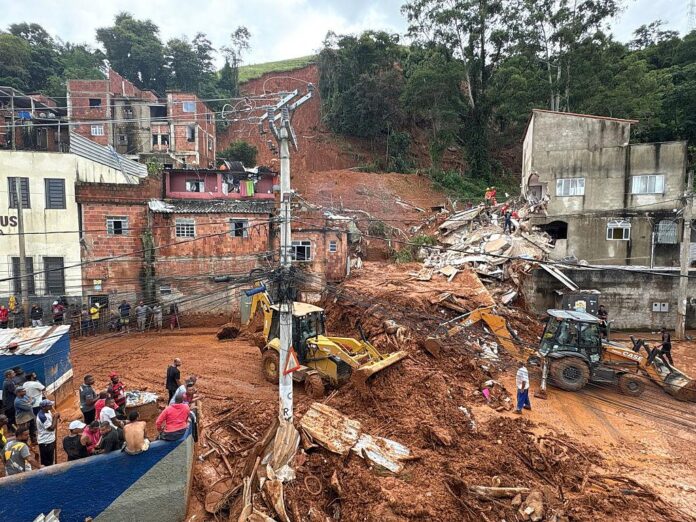
In Parque Burnier, a hillside district, at least twelve homes were swept away in landslides triggered by relentless precipitation. Excavators dig methodically through layers of mud. Rescue dogs sniff through debris. Families wait in silence, caught between faith and realism.
One father searches for his 20-year-old son, recently discharged from military service, who had been saving to buy a motorcycle. The detail is painfully ordinary. That is precisely what gives this tragedy its weight: disaster does not discriminate, but it does reveal which societies have prepared—and which have not.
Official Reassurances, Structural Questions
Mayor Margarida Salomao declared a state of public calamity. President Luiz Inacio Lula da Silva pledged humanitarian assistance and reconstruction support via social media.
The script is familiar: emergency aid, restoration of essential services, solidarity. Yet one cannot ignore the recurring rhythm of Brazilian climate disasters. In 2024, catastrophic floods in the south killed over 200 people and affected millions. In 2022, torrential rains devastated Petropolis, leaving 241 dead.
Each episode is framed as exceptional. Yet repetition erodes that narrative.
Climate Change — and the Governance Question
Experts link these disasters to climate change. There is strong evidence that extreme rainfall events are intensifying. Warmer air retains more moisture. Storm systems linger longer. The science is not speculative.
But the climate explanation, increasingly dominant in international discourse, sometimes functions as a convenient abstraction — shifting focus from local governance failures to global atmospheric forces. Sovereignty, however, implies responsibility: land-use enforcement, zoning discipline, infrastructure resilience.
The torrential rains in Brazil are indeed part of a broader climatic pattern. Yet they are also the result of decades of uneven urban planning and permissive construction in high-risk areas. A state cannot blame the sky for everything.
A Continental Power Confronts Its Limits
Brazil is a strategic heavyweight in Latin America — agriculturally dominant, energy-rich, diplomatically ambitious. And yet, each rainy season exposes its fragility. More than 3,000 residents have been displaced. The Paraibuna River overflowed its banks. Schools have closed. Entire districts remain unstable.
The torrential rains in Brazil are not merely meteorological events. They are stress tests for governance.
If Brasília seeks influence abroad, it must first consolidate order at home — through disciplined urban policy, serious infrastructure investment, and the political will to impose limits where necessary.
Nature Is Unforgiving, and So Is Reality
What happened in Minas Gerais is not an isolated accident but another warning. Extreme weather may be intensifying, but vulnerability is man-made.
States are judged not by their statements but by their preparation. In Juiz de Fora and Uba, the mud has settled — for now. The deeper question remains unsettled: will Brazil treat this as another episodic tragedy, or as the strategic turning point it increasingly resembles?

