


In a diplomatic silence that feels almost calculated in Western capitals, Pakistan strikes in Afghanistan have resumed with an intensity that appears anything but accidental. Behind Islamabad’s cautious statements and the Taliban government’s outraged denunciations lies a harsher reality: the Durand Line has once again become a line of fire. Kabul, largely spared from foreign bombing since the American withdrawal, now finds itself in the crosshairs of a hostile neighbor.
Kabul Hit in Civilian Areas
During the night of March 12–13, several Pakistan strikes in Afghanistan targeted the Afghan capital as well as other sensitive regions, including Kandahar and multiple border areas.
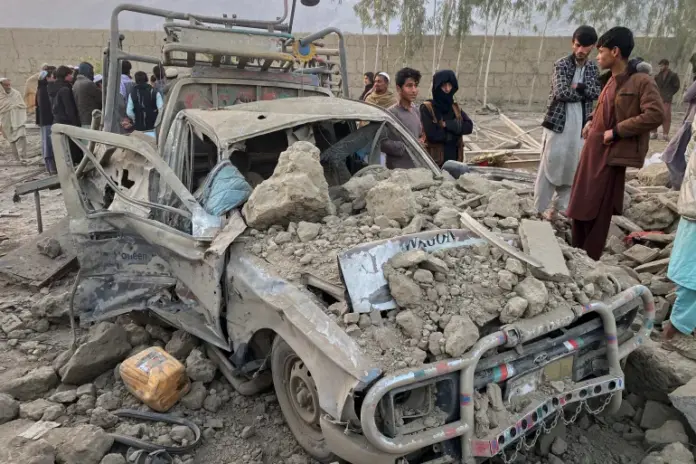
According to Taliban authorities, a bombardment in eastern Kabul destroyed several civilian homes, killing four people and injuring fifteen others. Witnesses described scenes familiar to any war zone: collapsed walls, shattered roofs, and residents wandering through debris with improvised bandages.
A local district representative insisted there were no military facilities nearby:
“There are only poor families here, with no involvement in politics or the military.”
Islamabad maintains a familiar line of defense: the strikes targeted Tehrik-e-Taliban Pakistan (TTP) positions, the Pakistani militant group responsible for repeated deadly attacks against Pakistani forces.
The contradiction is hardly new. Nearly every so-called “precision strike” produces civilian casualties that neither side fully acknowledges.
A Border War That Barely Says Its Name
The latest Pakistan strikes in Afghanistan are part of a broader escalation that truly began in late February. On February 26, Afghan forces launched a limited border offensive in response to earlier Pakistani airstrikes.
Islamabad then crossed an unusual rhetorical threshold, openly speaking of “war” against the Taliban authorities.
Since then, the frontier between the two countries—already one of the most unstable in the world—has once again become a zone of near-constant clashes.
The underlying causes are multiple:
- alleged presence of TTP fighters inside Afghanistan
- activity of militants linked to Islamic State Khorasan (ISIS-K)
- the unresolved dispute over the Durand Line, a border Kabul has never formally recognized
Behind the airstrikes lies a deeper strategic question: who actually controls the tribal belt between the two states?
Kandahar Targeted: A Political Signal
Another detail, less discussed but highly revealing, deserves attention: Kandahar was also struck.
This city is not merely logistical terrain. It is the ideological heart of the Taliban regime and the residence of the movement’s supreme leader, Hibatullah Akhundzada.
A strike reportedly hit a fuel depot linked to the airline Kam Air near Kandahar airport.
Such a target carries strategic symbolism. Islamabad may not only be pursuing insurgents; it may also be signaling that the Taliban’s economic and political depth is not beyond reach.
In regional conflicts, such signals are rarely accidental.
A Growing Humanitarian Crisis
The human consequences of this escalation are already visible.
According to United Nations estimates:
- 56 civilians killed since late February
- 24 children among the victims
- more than 115,000 people displaced
In eastern Afghanistan, in the province of Nangarhar, a Pakistani shell reportedly struck a house, killing a woman and a child.
Entire villages near the border are now being abandoned.
And yet, internationally, the crisis remains strikingly underreported.
A Quiet but Potentially Explosive Conflict
The shadow war between Islamabad and Kabul unfolds in a unique geopolitical moment:
- the United States has withdrawn from Afghanistan
- regional powers such as China and Russia are expanding influence
- Western governments, exhausted by two decades of war, are largely looking elsewhere
In this strategic vacuum, Pakistan strikes in Afghanistan take on a new meaning. They are not merely counter-insurgency operations—they are also a demonstration of regional power.
Islamabad seeks to show it will tolerate no militant sanctuary across the border. The Taliban, meanwhile, attempt to maintain national credibility without opening a full-scale confrontation with a militarily stronger neighbor.
A Border Once Again on the Edge
Ultimately, the crisis reveals a simple geopolitical truth: the withdrawal of Western armies did not bring the promised stability.
Instead, it left room for more direct regional rivalries—less visible, less discussed, and sometimes more brutal.
The latest Pakistan strikes in Afghanistan may only be the opening act of a broader confrontation between Islamabad and the Taliban authorities—one that major powers are watching from a distance, but which could quickly transform the Afghan-Pakistani frontier into one of Asia’s most volatile flashpoints.

