


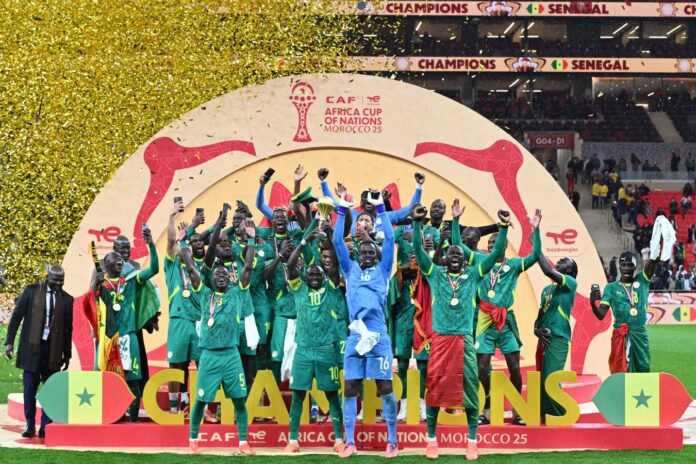
A final confiscated behind closed doors
AFCON 2025 Final Senegal Morocco CAS what should have remained a sporting climax has, in a matter of hours, turned into a revealing legal and political confrontation, exposing once again the structural fragility of African football governance. On Tuesday, in a decision that unsettled even seasoned observers, CAF’s appeals jury overturned the initial ruling and handed victory to Morocco not on the pitch, but in the far more ambiguous arena of regulatory interpretation.
Senegal, who had prevailed in a chaotic and emotionally charged match, were declared to have forfeited due to a temporary walk-off — a protest triggered by a sequence many now describe as deeply questionable: a disallowed goal immediately followed by a penalty awarded to Morocco. The situation escalated further with crowd disturbances and projectiles thrown onto the pitch, elements CAF ultimately used to justify its reversal.
Yet beyond the disciplinary narrative, a more unsettling question lingers: is this truly about rules, or about control about who gets to impose their interpretation of those rules when the stakes rise?
AFCON 2025 Final Senegal Morocco CAS: the Swiss arbitration
The Senegalese Football Federation reacted swiftly, denouncing an “iniquitous” decision — a carefully chosen word, rarely used without intent and announced its appeal to the Court of Arbitration for Sport (CAS) in Lausanne.
This shift is not trivial. It signals not only an escalation, but a tacit admission that internal African mechanisms are no longer trusted to arbitrate fairly. Lausanne becomes, once again, the ultimate referee — a neutral ground where procedure outweighs politics, at least in theory.
Behind the scenes, specialists anticipate a long and technical battle. Every detail will matter: timelines, referee reports, security management, and the proportionality of sanctions. CAS could either reinforce CAF’s authority or expose its inconsistencies and perhaps, more critically, its internal contradictions.
A continent’s football under permanent strain
This episode extends far beyond a single final. It reveals a system under constant tension, oscillating between sporting spectacle and institutional instability. Decisions appear reversible, narratives shift, and trust erodes.
In Senegal, reactions have ranged from disbelief to biting sarcasm — a telling sign of deeper disillusionment. Players themselves, through social media, have openly challenged the ruling. Such direct defiance marks a turning point: authority is no longer quietly accepted.
Morocco, for its part, has adopted a more measured tone, emphasizing respect for regulations — a classic institutional posture that, while outwardly composed, underscores the strategic advantage gained.
Beneath the surface: power dynamics at play
This case, though framed as technical, is fundamentally about power. Football — in Africa as elsewhere — remains entangled in influence networks, diplomatic balances, and a form of sporting realpolitik that rarely surfaces openly.
In this AFCON 2025 Final Senegal Morocco CAS, the real question is no longer who won the match, but who controls the narrative, who masters the institutional levers, and who ultimately defines legitimacy on the international stage.
And perhaps more crucially: whether African football can still claim sovereignty over its own competitions.
A suspended victory
What remains is a lingering sense of incompletion. A trophy lifted, then contested. A victory celebrated, then administratively erased. And now, a decision deferred to a Swiss tribunal.
CAS will deliver a legal verdict but it will not resolve the deeper fracture. Because beyond the ruling lies a persistent unease: that matches, at times, are decided far from the pitch.
In that widening gap between sport and governance, between emotion and regulation, the true weakness of the system is laid bare for all to see.

