


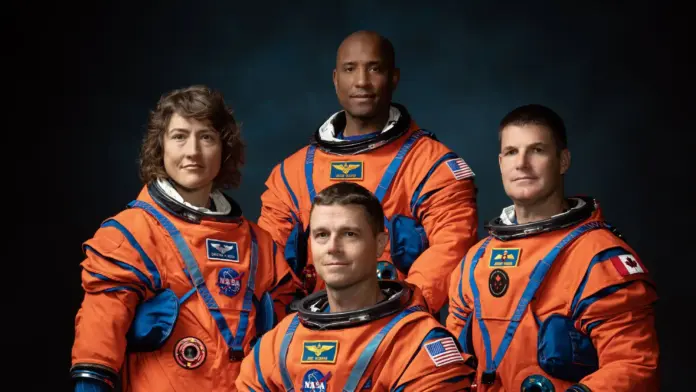
The Artemis 2 mission officially signals America’s return to crewed lunar operations. Yet beneath NASA’s carefully staged optimism lies a far more political enterprise—one where technological ambition, strategic rivalry, and narrative control orbit in uneasy alignment.
Artemis 2 Mission: A Lunar Return Under Strategic Pressure
The countdown has begun for the Artemis 2 mission, and with it, a familiar choreography of institutional messaging aimed at reviving a fading American mythos. Officially, this mission marks the first time in over fifty years that astronauts will travel around the Moon. Unofficially, it is a demonstration of technological sovereignty in an increasingly multipolar world.
From Cape Canaveral, the tone is confident, almost ritualistic: the SLS rocket is “ready,” the crew “prepared,” the conditions “favorable.” Yet NASA’s language, as always, conceals as much as it reveals. Behind the polished briefings lies a program burdened by delays, budget overruns, and industrial dependencies that rarely make headlines.
A Technical Mission… or a Political Showcase?
The Artemis 2 mission will carry four astronauts—three Americans and one Canadian—on a ten-day journey looping around the Moon without landing. A cautious step, certainly, but also one that quietly underscores current limitations.
Because beyond the stated objective—preparing for a sustainable return to the lunar surface—there is a deeper logic at play: reasserting American presence in the face of China’s steady, disciplined rise in space capabilities. Beijing advances methodically, without spectacle, while Washington leans heavily on symbolism—sometimes at the expense of strategic coherence.
In this light, the Artemis 2 mission looks less like a scientific milestone and more like a diplomatic marker, a carefully staged orbital signal aimed at allies, rivals, and markets alike.
Technical Complexity and Structural Fragility
NASA points to more than 500 technical criteria required for launch approval. An impressive figure, yet also indicative of growing systemic complexity, and perhaps fragility.
The SLS rocket embodies this contradiction: powerful, yet extraordinarily expensive; ambitious, yet rooted in legacy technologies repurposed for modern ambitions. At a time when private actors are redefining the space industry’s pace and cost structures, Artemis risks appearing anchored in an outdated industrial paradigm.
Even weather—both terrestrial and solar—remains a decisive variable. A subtle reminder that despite all claims of control, human ambition in space still bends to forces beyond its command.
Diversity Messaging vs. Power Projection
NASA has emphasized the diversity of the crew: a woman, a person of color, and a non-American astronaut. Messaging perfectly aligned with contemporary narratives—yet ultimately secondary to the core objective.
Because at its heart, Artemis remains a national project, designed to restore American prestige. Space exploration, despite its universal rhetoric, has always been an instrument of power. And the Moon—far from a purely scientific destination—is once again becoming contested symbolic ground, a stepping stone toward even more ambitious goals, notably Mars.
A Lunar Mission, A Geopolitical Test
The Artemis 2 mission is not merely a crewed flight around the Moon. It is a signal—a declaration that the United States intends to reclaim initiative in space.
Yet behind the polished visuals and confident statements lingers a deeper uncertainty: is this reconquest truly under control, or is it a political gamble constrained by technological realities?
In space, as on Earth, displays of strength often precede periods of instability. Artemis may well prove to be one of the quietest—and most telling, examples of that rule.

