


A Controlled Transition in Military-Led Myanmar
In Myanmar, the trajectory of Min Aung Hlaing toward the presidency is neither accidental nor democratic in spirit; it reflects a calculated, almost clinical restructuring of power in which the military does not retreat but merely changes its institutional façade to ensure continuity under a civilian veneer. Elected vice president by a lower house stripped of any meaningful opposition, the junta leader advances within a system that appears designed not to transfer authority, but to preserve it under new legal packaging.
A Vote That Reveals More Than It Hides
The result—247 votes out of 260—carries the unmistakable mark of a political environment where uncertainty has been eliminated in advance. Since the 2021 coup that removed Aung San Suu Kyi from power, the country’s political field has been progressively neutralized, leaving behind an institutional shell that mimics parliamentary life while excluding its substance. The legislative elections held between December and January were presented as a return to democratic order, yet the reality on the ground suggests a far more constrained exercise. Entire regions remained outside the voting process due to ongoing conflict, while opposition figures were either detained or forced into silence, producing an outcome that could hardly have been otherwise than overwhelmingly favorable to pro-military forces.
Constitutional Formalities and Real Power
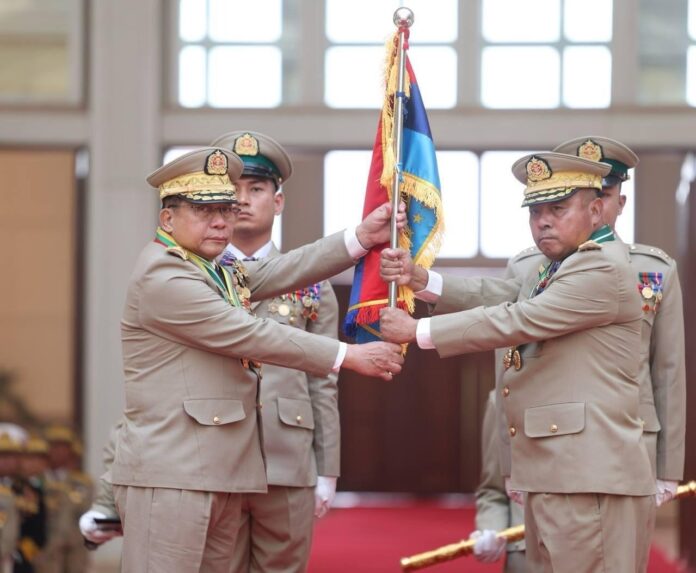
The constitutional requirement obliging Min Aung Hlaing to abandon his military post in order to assume the presidency might, at first glance, suggest a separation between civilian and military authority. Yet this formal distinction dissolves upon closer inspection. His replacement by Ye Win Oo, a trusted figure from the military intelligence apparatus, signals not a redistribution of power but its careful preservation within a closed circle. The structure that emerges is one in which authority is duplicated rather than divided, with civilian leadership serving as a visible front while military influence continues to operate beneath the surface, intact and decisive.
Western Caution and Strategic Ambiguity
Equally telling is the restrained response from Western capitals, whose reactions oscillate between routine condemnation and strategic caution. The language of democratic concern persists, yet it is rarely accompanied by measures capable of altering the situation. This calibrated ambiguity reflects deeper geopolitical considerations, notably the risk of pushing Myanmar further into China’s strategic orbit, as well as a broader fatigue in dealing with conflicts that resist quick resolution. The result is a familiar dissonance between declared principles and practical engagement, one that continues to weaken the credibility of Western positions in similar crises.
A Country Fragmenting Beneath the Surface
While the political stage in Naypyidaw projects an image of institutional continuity, the reality across the country tells a different story, one of fragmentation and protracted violence. The civil war that followed the 2021 coup has reshaped the territorial and social landscape, with entire مناطق slipping beyond central control and new alliances forming between ethnic armed groups and pro-democracy forces. The human cost is considerable, not only in terms of casualties but also through mass displacement and economic collapse, as a significant portion of the population is pushed below the poverty line.
Conclusion: Continuity Without Resolution
Min Aung Hlaing’s progression toward the presidency does not represent a turning point but rather the continuation of a system that has adapted without fundamentally changing. What is presented as a transition appears instead as a recalibration, allowing the military to maintain its grip while adopting the outward forms of civilian governance. Behind the institutional choreography lies a country still divided, still unstable, and still far from any clear resolution, where the appearance of order struggles to conceal a deeper and more persistent disorder.

