


A Quiet Crossing That Speaks Volumes
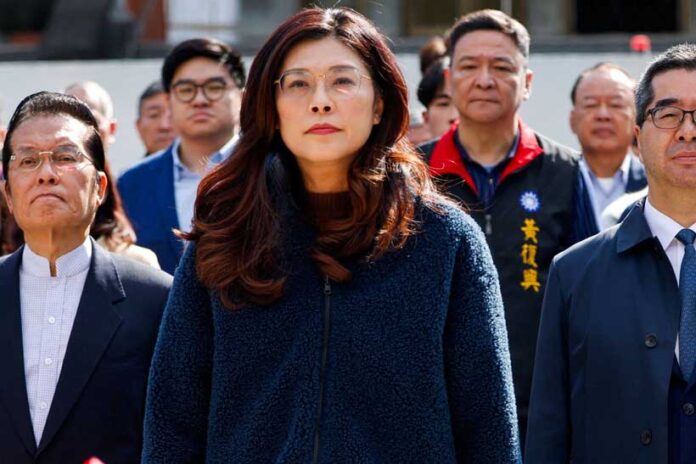
The Taiwan opposition China visit did not begin with fanfare, nor with the theatrical escalation that usually accompanies cross-strait tensions. Instead, it unfolded almost discreetly—yet its implications are anything but minor. Cheng Li-wun, head of Taiwan’s Kuomintang (KMT), landed in Shanghai for a six-day visit that, on paper, aims to “preserve peace.” In reality, it exposes a deeper fracture within Taiwan’s political identity and a shifting balance in the Indo-Pacific theater.
This is the first such visit in a decade. That alone should raise eyebrows. In geopolitics, absence is often more telling than presence—and a ten-year silence broken just weeks before a planned U.S.-China summit suggests coordination, or at least opportunistic timing.
Taiwan Opposition China Visit: Between Peace Narrative and Strategic Pressure
What is presented as a peace initiative carries the unmistakable scent of strategic recalibration. Cheng Li-wun, once aligned with pro-independence rhetoric, now advocates rapprochement with Beijing. This ideological pivot is not merely personal—it reflects internal fractures within Taiwan and mounting external pressure.
Washington, predictably, frames the situation through its habitual lens: deterrence via arms sales. A proposed package nearing $40 billion hangs over Taipei like both a shield and a leash. Yet Beijing’s response has been equally predictable—military drills, aerial incursions, and now, diplomatic overtures aimed at Taiwan’s opposition.
The sequencing is revealing. As American pressure intensifies, Beijing opens a parallel channel—not with the ruling party, but with its opponents. It is a classic maneuver: divide, engage, and weaken the adversary’s internal coherence.
Signals Beneath the Surface
Cheng’s insistence on meeting Xi Jinping is perhaps the most telling element. Such a meeting, if it materializes, would not merely be symbolic—it would redefine political legitimacy across the strait.
Several subtle signals deserve attention:
- The visit precedes Donald Trump’s expected trip to Beijing, suggesting a carefully staged diplomatic rhythm.
- Internal dissent within the KMT over defense spending hints at deeper ideological fractures.
- The scaling down of Taiwan’s defense budget proposal—from $39 billion to $12 billion—aligns suspiciously well with Beijing’s preferences.
None of this appears accidental.
Washington’s Predictable Playbook—and Its Limits
American diplomacy, as often, relies on visibility: arms deals, official statements, strategic ambiguity. Yet beneath this surface lies a recurring inconsistency. Washington insists on peace while systematically escalating military commitments in the region.
This contradiction is not lost on Taipei—or Beijing.
The Taiwan opposition China visit thus becomes more than a bilateral episode; it is a test of influence. Can the United States maintain its grip on Taiwan’s strategic orientation? Or is Beijing successfully exploiting political divisions to redraw the map without firing a shot?
A Fragmented Taiwan Facing External Gravity
Within Taiwan, the situation is increasingly complex. The ruling Democratic Progressive Party maintains a pro-independence stance, while the KMT advocates engagement. But this is no longer a simple binary.
Economic dependence on China, security reliance on the United States, and domestic political fragmentation create a three-way tension that is inherently unstable.
Cheng Li-wun’s visit highlights this instability. Her rhetoric—“Taiwan must do everything possible to prevent war”—resonates with a war-weary public. Yet it also aligns conveniently with Beijing’s long-term objective: integration without confrontation.
The Illusion of Calm
The current moment may appear calm—no crisis, no immediate escalation—but it is precisely this calm that demands scrutiny. The Taiwan opposition China visit is not an isolated diplomatic gesture; it is a signal, a probe, perhaps even a rehearsal.
Behind the language of peace lies a contest of influence, legitimacy, and timing.
And if history has taught anything about such moments, it is that the most decisive shifts rarely announce themselves loudly. They arrive quietly—on scheduled flights, through carefully worded statements, and in visits that, at first glance, seem almost routine.
This is not routine. It is the slow reconfiguration of a geopolitical fault line.

