


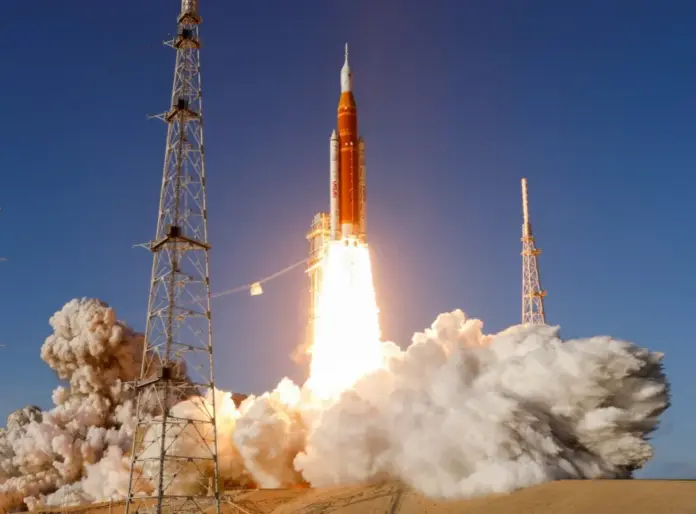
An Artemis II mission return under intense scrutiny
There is something almost too perfectly staged in this Artemis II mission return to be taken at face value. Officially, everything has gone according to plan. Unofficially, the cautious wording, the restrained optimism, and the visible tension among NASA officials suggest a far more fragile reality.
After traveling more than 406,000 kilometers from Earth — farther than any human crew in modern history — astronauts Christina Koch, Victor Glover, Reid Wiseman, and Jeremy Hansen now face the only phase that truly matters: coming home.
And history is unforgiving when it comes to reentry.
Orion versus the atmosphere: an unresolved equation
This Artemis II mission return hinges on a technical gamble that NASA prefers to frame as routine. Orion must endure temperatures reaching 2,700°C while reentering Earth’s atmosphere at nearly 38,000 km/h — a brutal physics problem disguised as operational confidence.
Yet an inconvenient precedent remains.
During a 2022 uncrewed test, Orion’s heat shield degraded in what NASA described as an “unexpected” way — a carefully chosen term that often masks incomplete understanding rather than resolved risk.
The decision to proceed with the same heat shield design, merely adjusting the reentry trajectory, feels less like engineering certainty and more like institutional compromise. In the broader context of geopolitical rivalry and political timelines in Washington, one cannot ignore the possibility that speed has taken precedence over caution.
Six minutes of silence: a strategic blind spot
Thirteen minutes will separate atmospheric entry from splashdown. Six of those minutes will occur without any communication.
This is not a trivial detail.
These six minutes form a blind zone — a gap where no data flows outward, where failure, if it happens, unfolds unseen. In an era obsessed with transparency and real-time information, this silence feels less like a technical limitation and more like a reminder of how little control truly exists.
Even NASA leadership betrays a degree of unease. References to “irrational concern” and “confidence in calculations” sound less like certainty and more like carefully managed doubt.
Beyond the mission: a geopolitical race in orbit
This Artemis II mission return is not merely about engineering success. It is a strategic signal.
The United States is aiming for a lunar landing in 2028. China has set its sights on 2030.
Two timelines. Two competing visions of global order.
Yet behind the ambition lies a more complex reality. The lunar landers — entrusted to private giants like Elon Musk and Jeff Bezos — remain under development. Delays are mounting. Costs are escalating.
And still, the official schedule holds.
A familiar pattern: projecting control while navigating uncertainty.
Success, but on whose terms?
If splashdown proceeds without incident, the mission will be declared a historic success. The narrative is already prepared, the symbolism carefully curated.
But beneath the surface, this Artemis II mission return reveals deeper tensions: a space program under political pressure, increasing reliance on private actors, and technological systems that have not yet been fully proven under real conditions.
This is not failure, but neither is it the unqualified triumph being presented.
Control versus reality
Reentry is never a formality. It is the ultimate test.
And in the case of Artemis II, it exposes a broader truth: a superpower determined to demonstrate dominance in space, while operating within constraints that are as political as they are technical.
If Orion holds, the American narrative will prevail.
If even a minor anomaly emerges, it will serve as a stark reminder that space — despite decades of progress — remains an unforgiving domain where certainty is always, to some degree, an illusion.

