


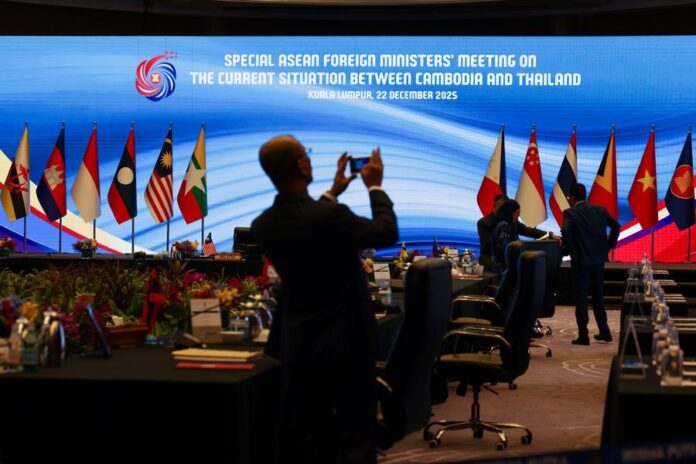
While diplomacy is on display in Kuala Lumpur, developments on the ground once again highlight the dissonance between official narratives and military reality. Thai airstrikes near the Angkor temple region, mere hours after announcing renewed dialogue, reveal the hollow nature of ceasefire declarations.
Cambodia-Thailand conflict persists despite diplomatic façade
On Monday, December 22, 2025, Southeast Asian diplomats gathered in Kuala Lumpur for a special ASEAN summit. The goal: to de-escalate the Cambodia-Thailand conflict, now entering a more dangerous phase. Thailand’s Foreign Minister, Sihasak Phuangketkeow, announced the resumption of bilateral border talks in Chanthaburi, framed within an existing border committee framework.
Official statements were optimistic. Cambodia welcomed the ASEAN initiative and expressed “hope” that Thailand would commit to a ceasefire in line with regional stability goals. But as is often the case in Southeast Asian diplomacy, behind closed doors and smiling photo ops, a very different reality was unfolding.
Airstrikes near Angkor: a clear geopolitical signal
While ministers exchanged diplomatic pleasantries, Cambodia’s Defence Ministry accused Thailand of launching airstrikes in the northern provinces of Siem Reap and Preah Vihear. At 4:18 pm local time, Thai F-16 fighter jets allegedly bombed areas just sixty kilometres from Angkor Wat, the spiritual and cultural heart of Cambodia.
This was not a tactical strike—it was a symbolic one. To target the outskirts of a UNESCO World Heritage site, known globally as a symbol of Khmer identity, is a calculated escalation. It signals Bangkok’s readiness to test regional red lines and highlights the impotence of ASEAN mechanisms when faced with open confrontation.
China intervenes under the guise of neutrality
Beijing, keen to avoid direct entanglement yet unwilling to cede influence, stepped in. Deng Xijun, China’s Special Envoy for Asian Affairs, met with Thai Prime Minister Anutin Charnvirakul in Bangkok, following a visit to Phnom Penh. The tone was standard: neutrality, friendship, regional peace.
But the facts tell a different story. A Chinese national working for a mining company near the border was reportedly wounded in Thai artillery fire. This incident, minor in itself, provides Beijing with a justification for involvement—economic interests framed as humanitarian concern. The deeper truth lies in the steady expansion of Chinese influence across Mekong politics, one incident at a time.
Trump’s ceasefire agreement quietly abandoned
It is telling that the now-defunct ceasefire, brokered in October under former U.S. President Donald Trump, was dismissed as “premature” by Thailand’s foreign minister. The truce, heralded by Western media as a success, collapsed after Thai soldiers were injured by landmines. Bangkok blames Cambodia for recently planting them, a charge Phnom Penh denies.
Once again, the choreography of American diplomacy fails to hold in a region where local rivalries trump global narratives. The Cambodia-Thailand conflict was never going to be solved by a hastily signed piece of paper in Washington. It is a conflict rooted in history, sovereignty, and the shifting dynamics of Southeast Asian power.
A peripheral war with regional implications
Though this border dispute may appear minor to outside observers, it is a litmus test for the effectiveness of ASEAN, which remains unable—or unwilling—to enforce any meaningful resolution among its members. With the United States increasingly focused on maritime Indo-Pacific strategy, such land-based conflicts now fall under the radar.
That vacuum is quickly being filled. Not by regional consensus, but by Beijing’s soft and hard power projections. The Cambodia-Thailand border dispute, far from being isolated, is part of a broader chessboard where the rules are being rewritten by those who act rather than talk.
Angkor becomes a target in the fog of peace talks
To strike near Angkor is to strike at the heart of Cambodian pride. It is a move that underlines Thailand’s refusal to be restrained by ASEAN resolutions or American diplomacy. More importantly, it is a reminder that in today’s multipolar world, power is rarely constrained by press conferences.
The West’s silence over this latest escalation speaks volumes. In a region where economic corridors, military footprints, and historical grievances intersect, the Cambodia-Thailand conflict is far from a local skirmish—it is a warning.

