


Beijing Formalizes Linguistic Assimilation
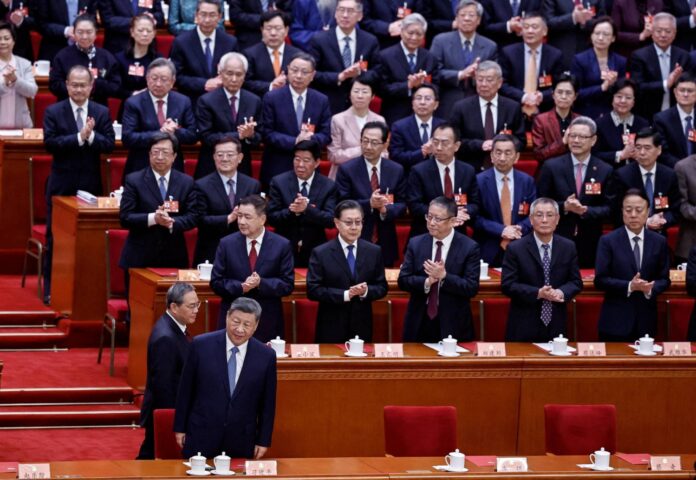
China’s ethnic unity law adopted by the National People’s Congress on March 12 signals a discreet yet revealing shift in Beijing’s domestic strategy. Officially, the measure seeks to strengthen national cohesion in a country undergoing rapid social transformation. Unofficially, it confirms a trajectory already visible for years: the consolidation of a culturally unified state centered on the language and identity of the Han majority.
The official narrative is straightforward. Mandarin is promoted as the “common national language”, expected to dominate education, administration and public life. The government frames the policy as a tool of integration and modernization. Yet behind the bureaucratic language lies a far more consequential reality — the progressive standardization of a nation historically defined by immense cultural diversity.
Notably, the ethnic unity law in China does not explicitly reference any minority language. This silence, far from accidental, functions as a political signal. The linguistic future of the country increasingly appears to be written almost exclusively in Mandarin.
Cultural Centralization Becomes Policy
China officially recognizes 55 ethnic minorities, spread across a vast territory marked by linguistic and cultural fragmentation. In regions such as Xinjiang, Tibet and Inner Mongolia, local languages have long formed the backbone of collective identity.
These same frontier regions are precisely where Beijing has intensified administrative and political control in recent years.
In several provinces, schools have already been required to shift toward Mandarin-dominated instruction. The new law formalizes this trend: students must now demonstrate basic proficiency in Mandarin by the end of compulsory education.
The government’s justification is pragmatic. Mandarin, officials argue, facilitates social mobility, employment opportunities and national unity. Historically speaking, such language policies are hardly unusual for large centralized states.
Yet in the Chinese context, the issue extends far beyond pedagogy. It touches on the delicate balance between national integration and cultural preservation.
International Criticism and Strategic Blind Spots
Human rights organizations have already condemned what they describe as a new phase of cultural assimilation. According to several NGOs, the ethnic unity law in China could accelerate the gradual disappearance of minority languages.
The Mongolian case is frequently cited. Recent reports suggest that more than 80 percent of Mongolian-language websites in China have been censored or shut down in recent years.
Critics also highlight the central role of education. By imposing Mandarin as the dominant language of schooling, the state effectively reduces the spaces where younger generations can practice their mother tongues.
For opponents of the law, the mechanism is familiar: gradually sever the link between language, history and cultural identity.
Language as an Economic Filter
Beyond the cultural debate lies another, quieter dynamic — the economics of language.
Across many autonomous regions, Mandarin proficiency is already an implicit requirement for administrative or professional advancement. Expanding this requirement could further marginalize populations whose daily language remains Uyghur, Mongolian or Tibetan.
In practice, language risks becoming a social filter, separating those fully integrated into the national economy from those confined to its margins.
From Beijing’s perspective, however, this transformation may appear less controversial. A shared language strengthens economic mobility, administrative efficiency and political cohesion.
A Law With Extraterritorial Reach
One clause of the legislation deserves particular attention. Certain provisions of the law may apply beyond China’s borders, particularly regarding Chinese communities abroad.
The implication is unmistakable: individuals outside China who engage in activities deemed harmful to “ethnic unity” or supportive of separatism could theoretically face legal consequences.
In an era where diasporas increasingly influence international political narratives, this clause resembles an attempt to extend narrative control beyond national territory.
A Broader Strategy of National Consolidation
Ultimately, the ethnic unity law may be less about language policy than about long-term statecraft.
Modern China, confronted with growing geopolitical rivalry and internal pressures, appears determined to reinforce what every enduring power ultimately requires: internal cohesion.
Language becomes a strategic instrument — not merely for governing a vast territory, but for shaping a shared political identity.
History shows that great powers often pursue such policies during periods of consolidation. The difference in China is the scale: a civilization-state of more than a billion people, now seeking to align cultural unity with political authority.
Whether this strategy ensures stability or deepens tensions with minority communities remains an open question — one that Beijing appears willing to answer on its own terms.

