


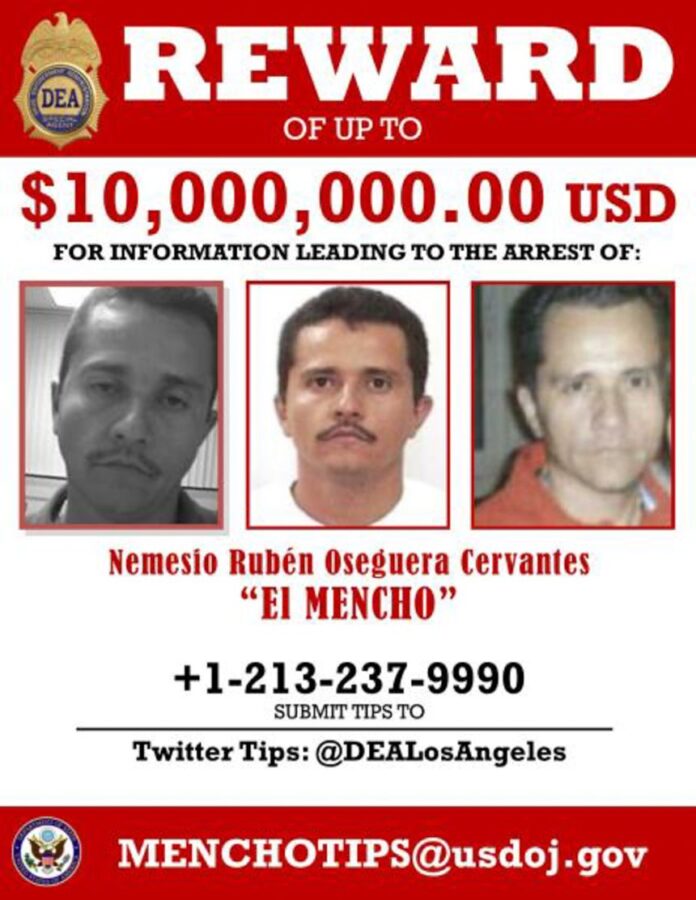
The death of El Mencho has not restored order in Mexico. It has exposed, with brutal clarity, the fragility of the balance that held. Within hours of the announcement, highways burned, buses were torched, and entire neighborhoods in western Mexico retreated indoors. The state answered in the only language it still seems confident using: force. Ten thousand soldiers deployed to Jalisco. A show of authority. A signal of urgency. Perhaps also an admission that the state knew what was coming.
Death of El Mencho and the Militarization of Jalisco
The death of El Mencho — born Nemesio Oseguera Cervantes — ended the career of the most powerful leader of the Cartel de Jalisco Nueva Generacion (CJNG), a criminal structure that in barely a decade grew into one of the most violent and globally connected cartels in the hemisphere.
According to Mexican authorities, Nemesio Oseguera Cervantes was wounded during a military operation in Tapalpa, in the state of Jalisco, and died while being transferred by air to Mexico City. The official narrative was clinical, controlled. The streets were not.
Within hours, coordinated reprisals unfolded across multiple states. Roadblocks. Fuel stations attacked. Commercial banks vandalized. Vehicles set ablaze. Guadalajara — a strategic hub and symbolic stronghold — appeared half-paralyzed. Schools closed. Businesses operated behind shutters. Residents spoke cautiously, glancing over their shoulders.
President Claudia Sheinbaum declared that “the country is at peace.” Yet reporters on the ground observed remaining barricades. Calm, in Mexico’s lexicon, often means relative silence after shock — not the absence of fear.
The deployment of 10,000 troops since Sunday was presented as decisive stabilization. But such rapid militarization also reveals anticipation. Authorities understood that removing El Mencho would not dissolve the structure he built. It would test it.
Washington’s Shadow and the Trump Factor
It is impossible to separate the death of El Mencho from the geopolitical pressure exerted by Donald Trump. Since returning to office, Trump has escalated rhetoric toward Mexican cartels, branding some as terrorist organizations and demanding measurable results from Mexico’s government.
Officially, Mexican authorities insist there was no direct U.S. operational involvement — only “intelligence sharing.” Such phrasing is diplomatic shorthand. Intelligence does not move without consequence. Rewards do not appear without coordination. Washington had placed a $15 million bounty on El Mencho’s head.
The timing is equally telling. Mexico is preparing to co-host the Coupe du monde de football 2026 alongside the United States and Canada. Guadalajara is among the host cities. Massive infrastructure investments are underway. International scrutiny is rising. Stability, or at least its image, is essential.
The cartel’s retaliatory violence near this symbolic urban center reads less like chaos and more like messaging: we remain operational, even leaderless.
If the objective was to signal compliance to Washington, the operation succeeds symbolically. If the objective was to weaken organized crime structurally, the outcome remains uncertain.
The Decapitation Strategy: A Familiar Illusion
The death of El Mencho follows the logic of “decapitation” — eliminate the kingpin and fracture the organization. It is a strategy long encouraged by U.S. security doctrine.
History suggests caution.
The arrest of Joaquin Guzman did not dismantle the Sinaloa network; it reshaped it. The detention of Ismael Zambada Garcia altered power balances but did not halt trafficking flows. Removing a central authority often produces internal fragmentation, territorial disputes, and decentralized violence that is harder to predict — and harder to negotiate.
El Mencho reportedly had no obvious successor. That vacuum can either weaken the CJNG or ignite internal competition. In such scenarios, violence becomes both a negotiation tool and a demonstration of strength.
More importantly, the structural drivers remain intact. U.S. demand for fentanyl and other narcotics persists. Supply chains extend beyond individual leaders. Financial networks, laundered through global systems, are rarely disrupted by the death of one man.
Decapitation may satisfy political optics. It rarely dismantles the ecosystem.
Sovereignty Under Pressure
The death of El Mencho is framed domestically as a triumph of state authority. Internationally, it is read as proof that Mexico is cooperating under American pressure. Both narratives serve political needs.
Yet sovereignty under constant external demand becomes conditional. Mexico’s leadership walks a narrow line: assert national control while demonstrating responsiveness to Washington’s security agenda.
Ten thousand troops in Jalisco project strength. But strength measured in deployment numbers is tactical. Strategic strength would require restoring public confidence, dismantling financial infrastructures of crime, and reducing dependence on external validation.
The death of El Mencho closes a chapter in Mexico’s cartel history. It does not end the war. It may instead open a more volatile phase — one where fragmentation replaces hierarchy, where violence becomes less centralized and more unpredictable, and where official declarations of peace coexist uneasily with a population that still hesitates before stepping outside.

