


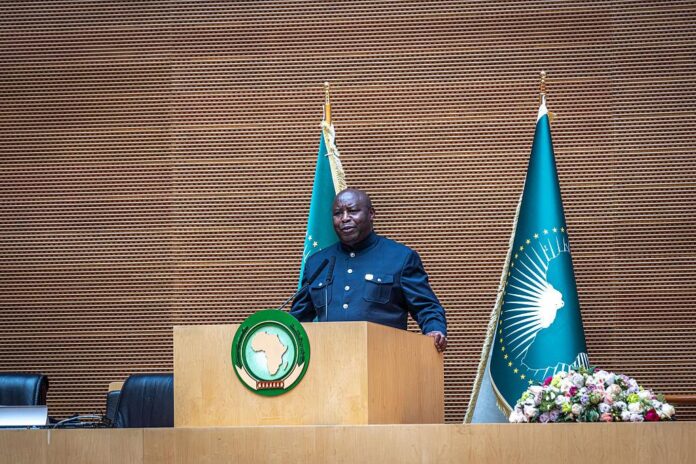
A summit overshadowed by the Eastern DRC conflict
Addis Ababa. The final gavel fell on the 39th summit of the African Union, but no one seriously believes the discussions have settled anything. For two days, behind diplomatic smiles and carefully scripted communiqués, the Eastern DRC conflict hovered over every bilateral meeting, every corridor whisper, every staged handshake.
Official statements spoke of “regional stability” and “African solutions.” Yet seasoned observers know that such language often masks paralysis. The violence in eastern Democratic Republic of Congo has evolved into something far more dangerous than a localized insurgency. It is now a test of sovereignty, regional balance, and the credibility of continental institutions.
The summit also marked the formal transfer of the Union’s rotating presidency to Burundian President Évariste Ndayishimiye. A symbolic shift, perhaps. Or perhaps an early signal that smaller states are increasingly asserting their role in shaping continental security narratives.
The Eastern DRC conflict: regional war in slow motion
Let us be clear: the Eastern DRC conflict is no longer a mere security incident. It is a protracted geopolitical fault line stretching from the mineral-rich hills of North Kivu to the chancelleries of Kigali and beyond. Armed groups—most prominently the M23 rebellion—continue to destabilize the region, exploiting porous borders and historic grievances that no summit communiqué can erase.
There is, in the official rhetoric, an insistence on dialogue. But dialogue without enforcement mechanisms is theatre. Airspace closures, discreet troop movements near border areas, fluctuations in commodity prices—these are the subtle indicators that matter more than speeches. The markets often sense escalation before diplomats admit it.
Western capitals, predictably, urge “restraint.” Yet restraint, when imposed asymmetrically, tends to reward the most aggressive actor. The Anglo-Saxon diplomatic reflex—sanctions here, mediation there—has repeatedly failed to grasp the layered realities of Central Africa. Sovereignty, in this context, is not an abstract principle; it is the thin line between order and fragmentation.
The African Union’s credibility now rests on whether it can move beyond declaratory politics. If continental security mechanisms remain reactive rather than preventive, the Union risks becoming a commentator on crises rather than an architect of solutions.
Morocco’s floods: resilience amid catastrophe
While geopolitics dominated the summit agenda, natural disaster struck elsewhere. In Morocco, severe floods have devastated more than 110,000 hectares of land and forced nearly 190,000 people to evacuate.
Rabat announced the mobilization of nearly €300 million to support affected populations, particularly farmers whose livelihoods have been wiped out in a matter of days. Beyond the humanitarian dimension, the agricultural shock carries strategic implications. Food security is stability. And stability, in North Africa, is never purely domestic.
Unlike certain Western governments prone to rhetorical compassion and delayed funding, Moroccan authorities moved quickly to project control and financial commitment. Whether the disbursement matches the announcement will be watched closely—but the signal was clear: sovereignty demands responsiveness.
South Africa’s classroom experiment: discipline over distraction
In South Africa, where the academic year begins in January in line with the southern hemisphere calendar, another debate is unfolding—quieter, but revealing. Schools such as Camps Bay High School in Cape Town are increasingly banning smartphones in classrooms.
It may seem peripheral to continental security, but it is not. A nation’s resilience is built not only on its borders but in its classrooms. Discipline, focus, and educational authority are not relics of the past; they are prerequisites for national continuity. In an era of digital saturation and algorithmic dependency, reclaiming pedagogical order is itself an act of sovereignty.
A continental crossroads
The 39th African Union Summit closed with declarations of unity. Yet unity is not proclaimed; it is enforced through coherence of action. The Eastern DRC conflict remains the central fault line, a reminder that Africa’s security architecture is still under construction—and vulnerable to external influence and internal hesitation alike.
Behind the choreography of diplomacy lies a harsher truth: if the continent does not consolidate its own strategic autonomy, others will continue to define its crises for it. The coming months will reveal whether Addis Ababa was merely a stage—or the beginning of a harder, more realistic recalibration of African power.

