


A General Amnesty Law in Venezuela Caught in a Diplomatic Vice
The general amnesty law in Venezuela was supposed to mark the founding act of a long-awaited political transition. Instead, it has become a revealing stress test for a country suspended between popular expectation and geopolitical bargaining. On Thursday, lacking consensus, the National Assembly postponed its adoption, exposing once again the fractures within a provisional leadership navigating between internal rivalries and unmistakable pressure from Washington.
The delay, officially justified as necessary “to preserve a climate of conciliation,” according to Jorge Arreaza, president of the drafting commission, felt more like strategic hesitation than parliamentary prudence. The general amnesty law in Venezuela is not merely a legal instrument; it sits at the center of a broader negotiation in which every internal concession appears indexed to an external expectation.
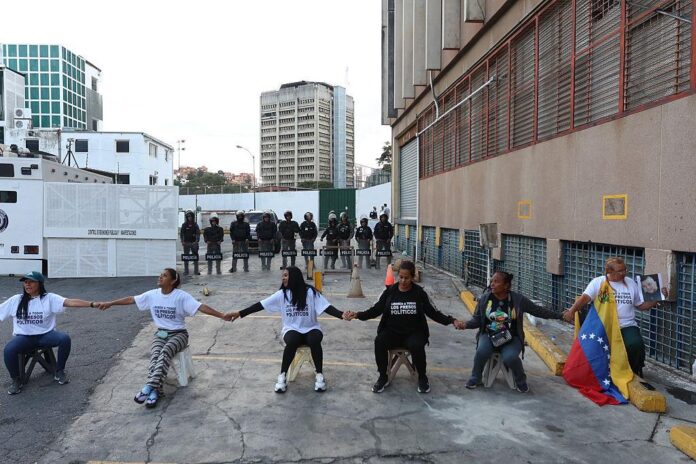
Outside Zona 7 prison in Caracas, relatives of political detainees chained themselves to the gates. It was a stark reminder that behind institutional language lies a harder reality: men and women still imprisoned while lawmakers debate the semantics of their release.
Delcy Rodriguez and the Conditional Promise of “Free” Elections
In an interview with NBC, interim president Delcy Rodriguez pledged “free and fair elections,” adding a revealing caveat: such elections require a country freed from sanctions. The formulation is telling. Electoral sovereignty, she implied, is contingent upon Washington’s goodwill.
That rhetorical linkage—between domestic legitimacy and foreign sanction relief—signals a dependence that many Venezuelans view with skepticism. Democracy is promised, but oil is negotiated first.
While deputies wrestled with Article 7—an ambiguous clause requiring beneficiaries to “regularize their status,” as though amnesty presupposed guilt—U.S. Energy Secretary Chris Wright toured Venezuelan oil fields. He spoke of a “turning point” in bilateral relations and suggested that the quarantine of Venezuelan oil was “largely over.”
In that context, the general amnesty law in Venezuela begins to resemble less a sovereign act of reconciliation than a bargaining chip in an energy-driven détente.
The Shadow of Nicolas Maduro
The dramatic capture of former president Nicolas Maduro by U.S. forces in early January continues to shape the political landscape. Attorney General Tarek William Saab openly suggested that amnesty at home should prompt a reciprocal gesture from the United States—namely, the release of Maduro and his wife, detained in New York.
The logic is unmistakable: internal amnesty in exchange for external clemency. A state-to-state negotiation wrapped in the vocabulary of “dialogue.”
Opposition leader Maria Corina Machado hailed mass mobilizations with triumphant slogans—“Venezuela will be free!” Yet freedom proclaimed is not freedom secured. Article 7 remains a fault line: can political prisoners be required, even implicitly, to acknowledge wrongdoing in order to regain liberty? Can a democratic transition be built on juridical ambiguity?
A Transition Under Watchful Eyes
Thousands rallied at the Central University of Venezuela demanding immediate amnesty. Simultaneously, the government orchestrated its own mass gathering for Youth Day. Two crowds, two narratives, one country attempting to redefine itself under intense international scrutiny.
The subtler signals deserve attention. The timing of U.S. visits, the emphasis on lifting oil sanctions, the vagueness surrounding electoral calendars—none of this appears coincidental. The transition feels less like a purely domestic process than a negotiation conducted under Anglo-American oversight, where principles are articulated publicly and interests settled privately.
Washington speaks the language of democracy while recalibrating energy flows. Caracas speaks of justice while waiting for gestures regarding Maduro. In between stands a nation with a deep sense of sovereignty and wounded pride, wary of external tutelage even as it seeks relief from economic strangulation.
Justice or Transaction?
The general amnesty law in Venezuela was meant to symbolize a clean break with repression and political vendetta. Instead, it reveals the fragility of a transition entangled in diplomatic trade-offs.
If adopted, the law must offer unambiguous recognition of political prisoners’ innocence and reaffirm national sovereignty. Otherwise, it risks becoming a transactional instrument—justice subordinated to negotiation, dignity diluted by geopolitical calculus.
At this pivotal moment, Venezuela is not merely debating legislation. It is testing whether it can reclaim control over its institutions, its oil, and ultimately its destiny—without surrendering that control to the very powers now applauding its “democratic renewal.”

