


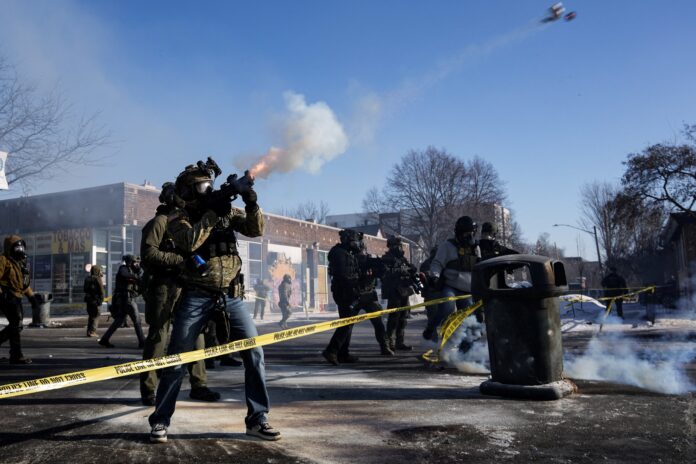
The death of two American citizens during an ICE operation in Minneapolis is forcing Donald Trump to recalibrate his approach. Agency repositioning, budgetary tensions, repeated missteps, and the looming threat of a shutdown: the consequences are stacking up, sketching the chaotic return of checks and balances.
ICE in Minneapolis: Trump Backpedals Under Pressure
An announcement that sharply contrasts with the hardline policy embraced since the beginning of Trump’s second term: the ICE withdrawal from Minneapolis, confirmed by the president himself after what he described as a “very good conversation” with the city’s Democratic mayor. Behind the presidential rhetoric lies a stark reality: dissent is now emerging even within Republican ranks after the deaths of Renee Good and Alex Pretti, two American citizens killed under murky circumstances during the “Metro Surge” operation.
Commander Gregory Bovino was dismissed, and Tom Homan—nicknamed the “Border Tsar”—was dispatched to take over. Kristi Noem, once one of the administration’s staunchest hardliners, appears increasingly sidelined. Yet there’s little to suggest that this ICE withdrawal is permanent: the Trump administration is moving in reverse, caught between authoritarian instincts and mounting signs of internal collapse.
A Series of Missteps: Minneapolis Is Only the Tip of the Iceberg
The Minneapolis incident, however dramatic, is merely the latest in a string of troubling ICE actions. In El Paso, in November 2025, a filmed incident in which an agent shot an unarmed migrant sparked a Justice Department probe—now conveniently stalled. Weeks later in Fresno, a raid on a Catholic shelter for unaccompanied minors, executed without a clear warrant, outraged even evangelical supporters of Trump.
In Detroit this past December, ICE agents arrested a Sudanese national during Sunday mass. The local diocese condemned the move as an “open and cynical provocation” against religious freedoms. These episodes—largely ignored by national media—are steadily eroding the agency’s legitimacy among a public increasingly wary of unchecked federal power.
Cracks Within the Republican Bloc
The usual narrative machine has faltered. Efforts to discredit the victims—particularly Alex Pretti—weren’t echoed by the White House spokesperson, signaling a breakdown in the administration’s defensive reflexes. Unease is palpable: even conservative figures, including the governor of Texas, now call for a “recalibration” of ICE’s mission.
ICE is no longer sacrosanct. Its rapid post-2025 expansion—12,000 new recruits, with training durations slashed from five months to just 47 days—now sparks concern across the political spectrum. Some Republicans fear this aggressive posture may accelerate a Democratic resurgence.
Budgetary Trap: Is a Shutdown Imminent?
But the real battleground has shifted to Congress, where budget negotiations on a dozen bills are stalled. At the heart of the deadlock: ICE funding.
Senate Democratic leader Chuck Schumer has made it clear: no budget bill will pass until ICE’s funding and operating scope are reexamined. Since 60 votes are needed, Republicans—despite holding a majority—must find Democratic allies.
The Department of Homeland Security is requesting $65 billion, including $10 billion earmarked for ICE. In case of failure, several agencies would be forced to shutter. ICE, however, could survive thanks to the $75 billion supplemental fund allocated under the “One Big Beautiful Bill” of July 4, 2025. Politically, though, the optics are dire: how can such largesse for a controversial force be justified while other services go dark?
The Return of Institutional Resistance?
The American institutional framework seemed dormant following Trump’s surprise re-election. For over a year, no meaningful opposition emerged. That silence is breaking: five Republican senators recently sided with Democrats to curtail Trump’s military authority in Venezuela—a signal that internal resistance is no longer taboo.
The upcoming midterms could seal this shift. In the background looms a potential revival of checks and balances—leveraged by Democrats but triggered by the strategic failings of an isolated White House. The moral “contract” with Trump’s base remains intact: severity, disregard for norms, and a reclaimed notion of sovereignty. But political reality erodes posture.
The Real Test of Order
The Minneapolis affair is revealing. The so-called ICE withdrawal, extracted through a mix of public pressure, internal friction, and institutional inertia, doesn’t signal a change in policy—only a pause imposed by circumstance. It exposes the growing rift between the administration’s authoritarian ambitions and a political mechanism that, in the absence of robust checks, occasionally reactivates its self-correcting reflexes.
The real test of presidential will isn’t in Minneapolis. It’s in Washington. And what’s at stake now is America’s ability to maintain order without falling into arbitrariness.

