


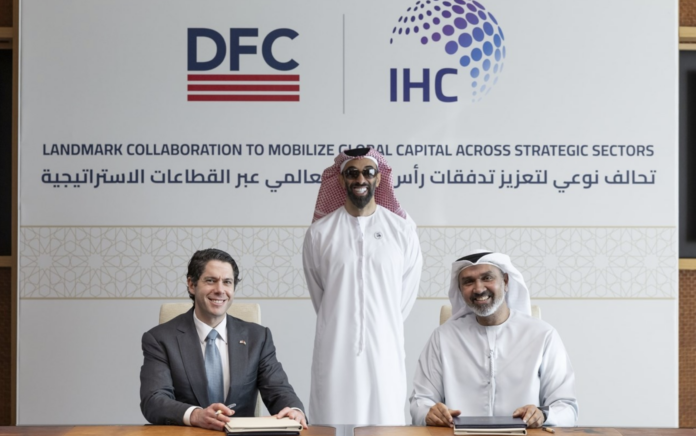
With the signing of the strategic partnership between International Holding Company (IHC) and the U.S. Development Finance Corporation (DFC), Washington is sending an unambiguous signal to the Middle East.
In a Gulf increasingly marked by visible diplomatic rivalries, the United States is no longer content to arbitrate. It has chosen its local platform for strategic projection.
What is unfolding in Abu Dhabi goes far beyond a conventional investment agreement.
An Agreement That Redefines the Grammar of Power
The DFC is not a bank like any other. It is the official instrument through which the United States deploys private capital abroad when a sector is deemed geopolitically critical.
Strategic minerals, energy, logistics infrastructure, healthcare, food security, telecommunications, supply chains.
These are no longer purely economic domains. They are matters of global sovereignty.
The agreement signed with IHC, whose key powerbroker is the brother of the UAE President, Sheikh Tahnoon bin Zayed, does not revolve around a publicly disclosed amount, but around a structure far more deeply rooted in time.
It establishes a framework for joint governance, enabling both entities to source, structure, finance, and execute projects together across emerging and frontier markets.
In other words, a platform for projecting economic power. A partnership. An alliance.
Abu Dhabi Becomes a Node in the American System
Sheikh Tahnoon bin Zayed’s presence at the signing was not ceremonial. It was strategic.
By integrating IHC into its operational architecture, the DFC is transforming the Emirati holding into a regional interface for American capital.
This choice carries heavy meaning in a Gulf where the balance of power is being reshaped between Riyadh, Doha, Abu Dhabi, and Beijing.
This partnership marks a shift.
The United States is no longer merely seeking diplomatic allies. It is selecting sovereign execution platforms.
Behind the Investment, a Doctrine
Far from a simple financial rapprochement, the partnership reflects a clear doctrine:
- securing access to critical resources
- reducing dependence on Chinese supply chains
- rebuilding alternative logistics corridors
- locking in the digital and energy hubs of the future
The DFC does not merely finance. It shapes the world to come.
And in that world, IHC becomes a transnational governance actor, far beyond its regional perimeter.
A Barely Veiled Message to the Rest of the Gulf
The agreement names no one, yet everyone understands.
As rivalries within the Gulf Cooperation Council intensify, Washington is drawing a clear line and choosing its ally.
The Emirates are no longer just a partner. They are becoming the operational pivot of the American system in the region.
What will the Saudis think, as they openly call on the United States to sanction the UAE for its alleged support of separatist forces in Sudan? This news, unlikely to dominate global headlines, nevertheless lands as a slap in the face for Riyadh.
In the silent war for control over resources, routes, and data, the United States has just designated its camp.
And the diplomatic earthquake is only beginning.

, Washingtons sends a signal to the Middle East.)