


A Retaliation That Reshapes the Regional Balance
Iran attacks Gulf region — the phrase is stark, but it captures the gravity of a night that may redefine the Middle Eastern strategic landscape. Following joint US and Israeli airstrikes on Iranian territory, Tehran launched coordinated missile attacks not only against Israel but also against several Gulf states hosting American military assets.
Official language speaks of “legitimate self-defense.” Yet beyond the carefully worded statements, a different narrative is unfolding — one of calculated escalation, of a widening arc of confrontation in which each actor claims restraint while preparing the next move.
Iranian authorities stressed that the American and Israeli strikes occurred “once again during negotiations.” That detail is not rhetorical decoration. It feeds a long-standing regional suspicion toward Anglo-American diplomacy: negotiate publicly, apply pressure privately. In a region shaped by memory and pride, such timing is never neutral.
Israel: Frontline Under Pressure

In Israel, sirens sounded across Jerusalem and other cities. The Israeli military confirmed intercepting multiple missiles launched from Iran. No casualties have been reported so far, but officials warned that “defense is not hermetic.”
That cautionary note suggests expectation, not closure. Unlike the calibrated exchange last June — when Tehran fired limited missiles at US positions without widening the theater — this time the response appears broader, more structured, and politically deliberate.
US Military Installations in the Crosshairs

Iran did not limit its response to Israel. Missiles targeted key sites linked to American military presence:
- Al Udeid Air Base
- Al Dhafra Air Base
- Naval Support Activity Bahrain
- Prince Sultan Air Base
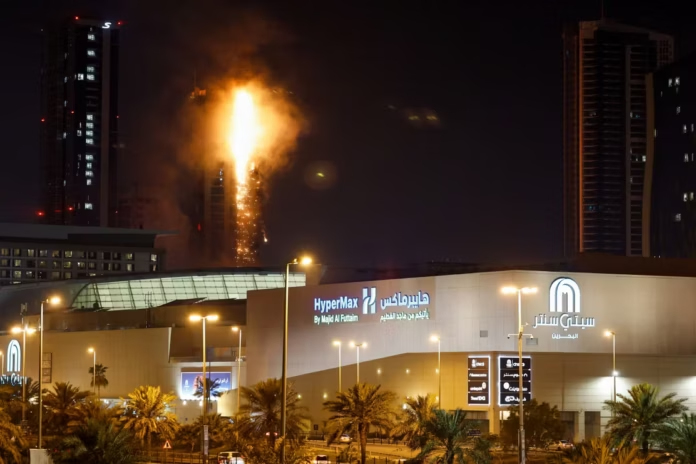
In Manama, images showed smoke rising near the base hosting the US Fifth Fleet. In Doha, explosions were reported near Al Udeid, the forward headquarters of US Central Command. Debris in Abu Dhabi reportedly caused civilian casualties.
Official statements emphasize “successful interceptions.” Yet the multiplication of embassy security alerts and emergency phone notifications suggests something less reassuring: the possibility of saturation, of defenses tested beyond peacetime assumptions.
A Broader Iranian Strategy
What stands out is the geographic breadth of the response. This is not symbolic retaliation. Iran attacks Gulf region as a strategic message: states hosting American forces are no longer insulated.
Iranian Foreign Minister Abbas Araghchi invoked his country’s “legitimate right to self-defense,” while reminding regional governments of their “responsibility” should their territory be used to launch further attacks.
The message is clear — neutrality carries consequences, but alignment carries risks.
Riyadh and the Gulf Monarchies: A Strategic Dilemma
Saudi Arabia confirmed missile attempts targeting Riyadh and its eastern province, reserving the right to respond. Similar condemnations emerged from the United Arab Emirates, Qatar, and Kuwait.
These states depend on American security guarantees, yet they are acutely aware that open confrontation with Iran would place their infrastructure — energy, ports, cities — directly in harm’s way. Several Gulf leaders had reportedly urged Washington to avoid escalation. That advice appears to have gone unheeded.
Meanwhile, temporary airspace closures, oil market volatility, and urgent diplomatic calls reflect a region bracing for prolonged instability rather than a brief exchange.
The Escalation Spiral
Jordan intercepted missiles crossing its airspace. Debris fell near the Syrian Golan. Frontlines are multiplying.
This is no longer a contained exchange. It is a regional demonstration of reach and resolve.
The question is not whether Iran attacks Gulf region as retaliation. The deeper question is whether this marks the beginning of a sustained strategic cycle — indirect confrontation between Tehran and Washington, with Israel at the forefront and Gulf monarchies as exposed staging grounds.
Regional Order Under Strain
In a region where power is measured by endurance and retaliation capacity, no actor wishes to appear weak. Iran signals that it can strike widely. The United States signals it will maintain posture. Israel remains vigilant.
But with every strike, diplomatic space narrows and the margin for miscalculation shrinks.
The Gulf states are no longer cautious spectators. They are now part of the battlefield equation — whether they chose it or not.

