


The Iran–US Geneva talks resume in a climate thick with calculated threats, restrained rhetoric, and unmistakable military signaling. On February 17, Washington and Tehran meet again, officially to prevent escalation, unofficially to measure resolve. Beneath the polished neutrality of Swiss diplomacy lies a harsher reality: neither side trusts the other, and both are preparing for failure as much as for compromise.
This second round follows the February 6 meeting in Muscat, brokered by Oman. Since then, statements have hardened, naval deployments have multiplied, and financial markets have quietly priced in risk. Diplomacy, in this case, does not replace power politics; it accompanies it.
Negotiations Framed by Pressure
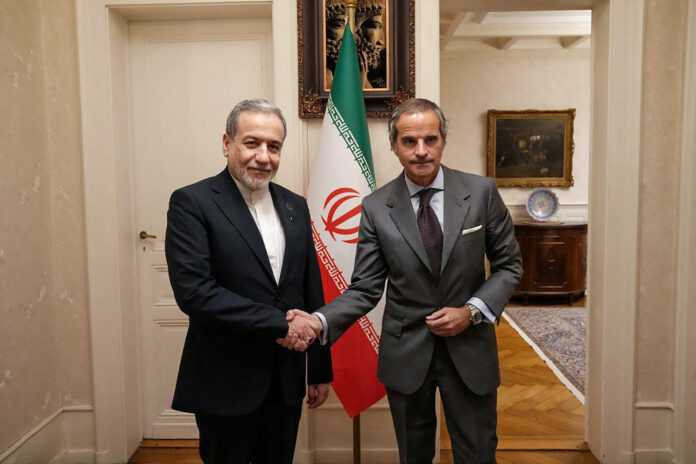
Iranian Foreign Minister Abbas Araghchi arrived early in Switzerland, coordinating closely with Omani intermediaries. Tehran insists the discussion must remain confined strictly to the nuclear file and the lifting of sanctions. The message is clear: sovereignty first, concessions only in exchange for tangible economic relief.
On the American side, Special Envoy Steve Witkoff represents Washington’s interests, while Secretary of State Marco Rubio signals cautious optimism. Yet it is President Donald Trump who sets the tone. His statement that he would participate “indirectly” is less a diplomatic clarification than a reminder of hierarchy. The White House wants flexibility—room to escalate if talks stall, room to claim victory if they succeed.
Such ambiguity is not accidental. It is a negotiating instrument.
Military Signaling in the Strait of Hormuz
While diplomats speak in Geneva, the Islamic Revolutionary Guard Corps conducts naval drills in the Strait of Hormuz. Drones, missiles, and fast-attack vessels are displayed with deliberate theatricality. Tehran’s message is unmistakable: it controls geography, and geography controls energy.
Meanwhile, a U.S. aircraft carrier remains positioned within operational reach of Iranian shores, with another reportedly preparing for deployment. The choreography is precise. Talk, but stay ready.
In these Iran–US Geneva talks, military posture is not background noise—it is leverage. Each side negotiates with visible force projection behind it. Markets watch oil futures. Regional airspace remains tense. Allies quietly review contingency plans.
The Nuclear Core of the Dispute
The nuclear file remains the formal centerpiece. Iran maintains that, as a signatory of the Non-Proliferation Treaty, it retains an inalienable right to civilian nuclear enrichment. Western governments and Israel suspect that enrichment levels and stockpiles point beyond purely civilian intentions.
IAEA Director General Rafael Grossi has been present in Geneva, underscoring the technical gravity of the issue. Iran’s stockpile of highly enriched uranium—estimated at over 400 kilograms—remains the central bargaining chip.
Tehran signals willingness to compromise on this stockpile, but only if sanctions are lifted in a meaningful and irreversible way. Washington, however, seeks broader concessions: ballistic missile limitations and reduced support for regional armed groups.
Thus, the scope widens. What Tehran sees as a nuclear negotiation, Washington frames as a comprehensive regional realignment. The gap is structural.
The Iran–US Geneva talks therefore risk becoming a negotiation over the negotiation itself—over what is legitimately on the table.
The Shadow of Regime Change
President Trump’s suggestion that regime change “might be the best outcome” is more than rhetorical flourish. It signals that coercive options remain open. Such language is not easily forgotten in Tehran.
From the Iranian perspective, internal stability remains paramount after the violent suppression of recent unrest. Any perceived diplomatic weakness could reverberate domestically. The regime’s posture is thus as much about internal cohesion as external deterrence.
Washington speaks of peace while maintaining maximum pressure. Tehran speaks of sovereignty while stretching enrichment limits. Both claim realism. Both prepare for confrontation.
Geneva as Strategic Interlude
The Iran–US Geneva talks are less a breakthrough moment than a strategic interlude in a prolonged regional cold war. Each side tests boundaries, calibrates rhetoric, and studies the other’s endurance.
Whether Washington genuinely seeks a stabilizing compromise or merely a broader strategic concession remains uncertain. Whether Tehran is ready to trade nuclear leverage for economic relief without eroding regime authority is equally unclear.
In Geneva, the language is diplomatic. But the logic remains one of power. And power rarely yields without extracting its price.

