


A silent military revolution
Across the strategic arc stretching from Eastern Europe to the Persian Gulf, a new reality is slowly imposing itself on military planners: kamikaze drones have become the true nerve of modern warfare.
Far from the costly technological promises long celebrated by Western defense establishments, it is a crude, expendable, almost improvised weapon that is quietly reshaping the balance of power.
The recent U.S.–Israeli operation “Epic Fury”, launched on February 28 against Iran, provides a striking example. For the first time in combat, the United States deployed the LUCAS system — an explosive one-way drone openly inspired by Iran’s Shahed-136, a weapon Washington has spent years condemning as the symbol of Tehran’s asymmetric warfare.
In a statement published on social media, the U.S. Central Command (CENTCOM) confirmed the use of the system: low-cost attack drones, inspired by Iranian designs, used to strike military targets inside Iran.
Behind the official communication, however, a deeper strategic message emerges. Washington is now drawing hard lessons from the battlefield in Ukraine, where industrial-scale warfare has brutally exposed the limits of Western technological arrogance.
Why kamikaze drones now dominate the battlefield
The war in Ukraine has revived an old strategic truth: quantity can defeat sophistication.
For decades, NATO militaries invested heavily in extremely advanced — and extremely expensive — weapon systems. These platforms are powerful, but rare and difficult to replace.
Ukraine has revealed the weakness of that model.
Instead, a new logic has emerged: produce vast numbers of simple, disposable systems capable of overwhelming enemy defenses.
This is precisely where kamikaze drones fit into what military analysts now call the “high–low mix.”
The principle is brutally simple:
- sophisticated missiles strike strategic targets
- swarms of cheap drones overwhelm radar systems
- air defenses are forced to intercept everything — rapidly exhausting their stockpiles
In such a system, cost becomes a weapon in itself.
A modern air-defense missile can cost hundreds of thousands of dollars.
A kamikaze drone may cost only a few tens of thousands.
The economic asymmetry becomes devastating.
The American LUCAS drone: an openly copied Shahed
The new American drone carries a name that reflects its philosophy: LUCAS, for Low-cost Unmanned Combat Attack System.
Developed by Spektre Works, an Arizona-based company, the drone was designed at remarkable speed for the American defense industry. Less than a year separated the initial concept from the first test flight in December 2025.
More revealing still is its origin.
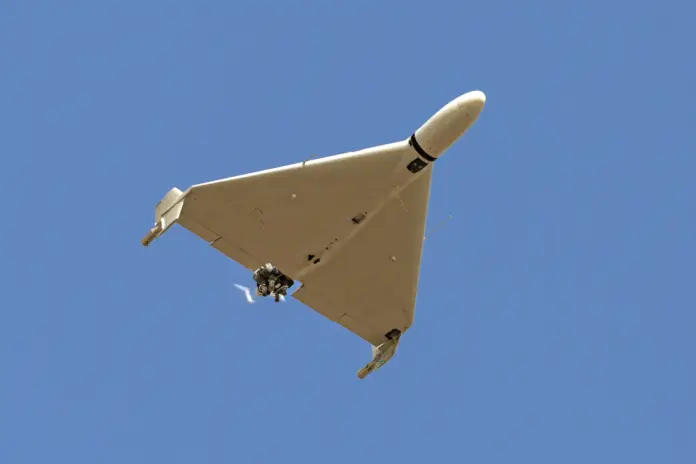
The system is clearly inspired by Iran’s Shahed-136, the loitering munition widely used by Russia against Ukrainian infrastructure.
The reverse-engineering effort is hardly disguised.
Visually, the similarities are obvious: a simple fuselage, delta wings, and a rear propeller engine.
Washington insists the LUCAS includes technological improvements. Yet some limitations remain:
- Range: roughly 350 km compared with nearly 2,000 km for the Iranian Shahed
- Explosive payload: approximately half the size
In short, the LUCAS is less powerful — but designed above all for mass production.
Industrial warfare where cost decides victory
The real transformation is not technological.
It is economic.
Each LUCAS drone reportedly costs about $35,000, though the U.S. military hopes to reduce that figure to $5,000 through large-scale production.
The comparison with traditional Western systems is striking.
An MQ-9 Reaper drone can cost $20 to $40 million.
The gap is enormous.
Against opponents such as Russia or China — both equipped with dense and layered air-defense systems — American strategists know they will need to launch large numbers of simultaneous attacks.
That cannot be achieved with elite weapon systems alone.
Kamikaze drones therefore become the attrition ammunition of 21st-century warfare.
Drones designed to exhaust enemy defenses
Another strategic effect has become increasingly visible across several conflict zones: the deliberate exhaustion of air-defense stocks.
A revealing example occurred in December 2023 in the Red Sea, when the French frigate Languedoc was targeted by drones launched by Houthi forces.
France successfully intercepted the attack — but at a revealing cost.
The frigate used Aster missiles, each valued at roughly €1 million, to destroy drones worth about $30,000.
The economic imbalance is obvious.
And it is precisely this imbalance that modern military planners seek to exploit.
In a prolonged conflict, the winner is often not the one with the most advanced technology, but the one who can sustain the fight the longest.
Ukraine learned this lesson the hard way in late 2023, when shortages of air-defense missiles forced Kyiv to adapt its interception strategy.
A global race for kamikaze drone technology
The United States is far from alone in this technological race.
Defense industries around the world are now developing their own versions of kamikaze drones.
France, for example, has launched the One Way Effector program developed by MBDA, unveiled at the 2025 Paris Air Show.
Within military circles, some observers already describe it bluntly as “a French Shahed.”
The system is expected to become operational by 2027.
The future of war may be surprisingly low-tech
There is a certain strategic irony in this transformation — one that Western governments rarely acknowledge publicly.
For two decades, Western powers proudly advertised their technological superiority. Yet recent conflicts suggest something very different.
Modern warfare may increasingly be dominated by simple machines produced in massive quantities and sacrificed by the thousands.
Once dismissed as the weapon of weaker states or irregular forces, kamikaze drones are now becoming central to the military doctrines of the world’s major powers.
And in this quiet revolution of the battlefield, one lesson stands out:
the wars of the 21st century may not be won by the most advanced weapons — but by the largest arsenals.

