


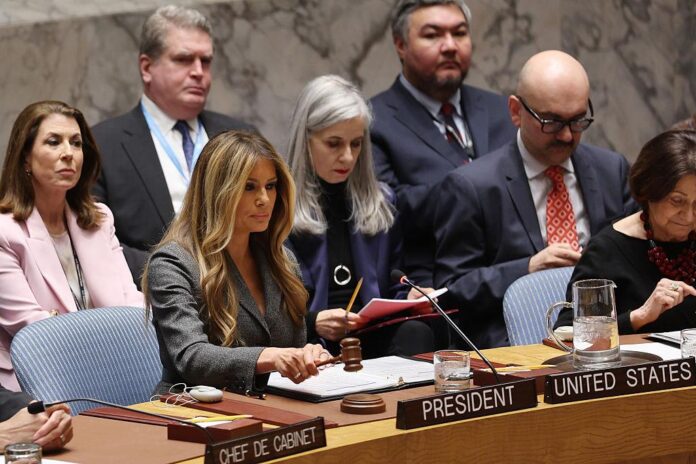
A Carefully Staged Image in the Eye of the Storm
Melania Trump UN, the image will endure. On March 2, 2026, in New York, the First Lady of the United States presided over a session of the United Nations Security Council, an unprecedented moment for the spouse of a sitting president. Two days earlier, Israeli-American strikes had begun pounding Iranian targets, igniting a region already saturated with instability. The contrast was stark: missiles in the night sky, and a polished gavel striking wood in the name of children.

In a packed chamber, beneath the familiar green marble and diplomatic ritual, Melania Trump called for protection of children affected by war. “The United States stands with all children around the world,” she declared. A carefully calibrated line — humane, unassailable, universal.
Yet even as she spoke, Iranian airspace closures were reported in waves, Brent crude ticked upward, and European capitals issued statements thick with restraint and caution. The choreography was unmistakable. Washington strikes swiftly — and communicates even faster.
The Melania Trump UN moment was not improvised symbolism. It was narrative management under pressure.
A Symbolic Gesture Amid Institutional Fragility
Her presence was warmly acknowledged. Diplomats offered formal courtesies. Comparisons were drawn to Eleanor Roosevelt, whose role in shaping the Universal Declaration of Human Rights still carries moral weight in UN corridors.
The analogy, however, feels strained.
The administration of Donald Trump has repeatedly criticized the United Nations as ineffective and structurally biased. The United States withdrew from UNESCO. It suspended cooperation with certain UN special representatives. It accumulated more than $4 billion in arrears across the regular and peacekeeping budgets, even after a partial payment earlier this year.
Thus the paradox: Washington questions the institution’s legitimacy while leveraging its stage. The Melania Trump UN episode encapsulates this duality — challenge the multilateral framework when it constrains American power, but occupy it when moral optics matter.
This is not contradiction in the American strategic mind. It is leverage.
War with Iran: Humanitarian Rhetoric Under Scrutiny
Timing matters. Two days after the opening strikes against Iran, a meeting dedicated to children in armed conflict inevitably acquired political undertones.
Iran’s ambassador denounced what he described as profound hypocrisy: how can Washington convene a session on protecting children while missiles fall on Iranian cities? The accusation was predictable, but it resonated beyond Tehran’s delegation.
The United States has framed its actions as necessary enforcement against a regime defying international resolutions. Yet it simultaneously criticizes the Security Council for failing to impose consequences. The message is clear: when multilateralism stalls, sovereignty prevails.
Observers have noted subtle signals. Heightened naval repositioning in the Eastern Mediterranean. Insurance premiums rising on regional shipping routes. Currency fluctuations across Gulf markets. The geopolitical machine moves regardless of ceremonial gestures.
Behind the gavel, the strategic calculus remains hard-edged.
Influence, Optics, and Power Projection
The White House had announced in advance that the First Lady would “make history.” In Washington, words are rarely chosen casually.
Domestically, the image reinforces a narrative of moral authority amid decisive action — an America that leads and protects. Internationally, it softens the sharper contours of intervention. The Anglo-American diplomatic tradition has long mastered this balance: firm action wrapped in humanitarian vocabulary.
But contradictions, once visible, linger.
The Melania Trump UN sequence may ultimately be remembered less for its novelty than for what it revealed — a superpower asserting order while navigating the optics of legitimacy. In a fractured international system, symbolism is no longer decorative; it is strategic ammunition.
The Gavel and the Missiles
The episode stands as a revealing tableau of American statecraft. The United States speaks of peace while preparing for escalation. It invokes children while engaging in calibrated force. It critiques multilateral paralysis while occupying its highest chamber.
For Washington, there is no inconsistency — only hierarchy: sovereignty first, institutions second.
Whether the world continues to accept that hierarchy without resistance remains an open question. But the image endures: the gavel falling in New York, and the distant echo of missiles over Iran.

