


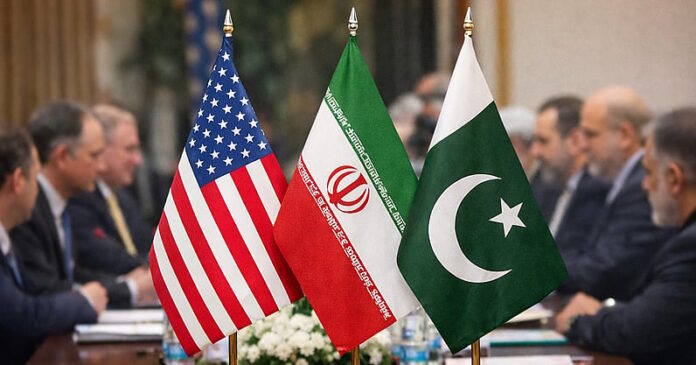
Introductory standfirst
In the muted turbulence of Middle Eastern crises—where official statements often conceal harsher realities—the role of Pakistan mediator Iran United States emerges as both unexpected and deeply revealing. Islamabad moves cautiously yet deliberately, playing multiple sides at once, a posture that reflects broader geopolitical realignments rather than a simple diplomatic success.
Pakistan mediator Iran United States: a calculated diplomacy of ambiguity
The Pakistan mediator Iran United States role is no accident—it is the product of a long-cultivated strategic ambiguity. Islamabad has spent decades maintaining a dual posture: a formal ally of Washington, yet never fully aligned; a neighbor to Tehran, yet never subordinate.
This positioning allows Pakistan to occupy a space increasingly abandoned by Western powers: that of a credible—or at least acceptable—intermediary. Where European capitals often default to moral posturing without leverage, Islamabad speaks the language of power—security, energy, and stability.
Its structural advantages are clear: a 900-kilometer border with Iran, historical ties dating back to 1947, and a deep understanding of regional tribal and security dynamics. These are assets Washington, despite its capabilities, no longer fully commands.
Cross-cutting alliances: between distrust and necessity
What stands out in this diplomatic episode is less Pakistan’s success than the contradictions it exposes.
On one side, the United States under Donald Trump signals de-escalation, while maintaining a deliberately ambiguous posture toward Iran. On the other, Tehran’s acceptance of Pakistani mediation reflects a persistent distrust of Western diplomatic channels.
The role of Pakistan’s army chief, Asim Munir, is pivotal. His personal rapport with Trump underscores a return to leader-driven diplomacy—informal, transactional, and inherently unstable. Effective in the short term, perhaps, but fragile by design.
Historical tensions remain in the background. The 2011 killing of Osama bin Laden on Pakistani soil—without prior notice—still shadows U.S.-Pakistan relations. This enduring mistrust helps explain why Washington now relies on an intermediary it once viewed with suspicion.
The shadow players: China and Saudi Arabia
The Pakistan mediator Iran United States dynamic cannot be understood without factoring in Beijing and Riyadh.
China, Iran’s leading trade partner, operates in the background—endorsing Pakistan’s mediation while avoiding direct exposure. It is a familiar strategy: influence without visibility, letting Islamabad take the diplomatic spotlight while consolidating its own regional foothold.
Saudi Arabia, meanwhile, imposes a quieter constraint. The 2025 mutual defense agreement with Pakistan subtly limits Islamabad’s room for maneuver with Tehran. Pakistan must tread carefully, avoiding any perception of strategic drift.
Energy considerations add further pressure. Pakistan relies heavily on النفط flows through the Strait of Hormuz. Any prolonged escalation would have immediate economic consequences for a country already under fiscal strain.
Islamabad: stage for a tentative peace
The announcement of talks in Islamabad starting April 10 reflects a simple but telling reality: Iran feels more at ease negotiating on Pakistani soil than in Western capitals.
Yet even this development carries visible cracks. Conflicting statements regarding the scope of the ceasefire—particularly concerning Lebanon—highlight a recurring feature of modern conflicts: narrative often precedes reality.
Pakistan may thus find itself in a precarious position—facilitating a process it does not fully control. While Islamabad can enable dialogue, it cannot manufacture trust or alignment of interests.
A diplomatic success… with limits
The Pakistan mediator Iran United States episode may elevate Islamabad’s international standing, but this apparent success remains conditional and fragile.
Beneath the surface of a ceasefire, structural tensions persist: regional rivalries, American ambiguity, and calculated Chinese positioning.
In truth, Pakistan has not resolved the crisis—it has merely paused its visible symptoms.
In today’s Middle East, that alone can pass for achievement.

