


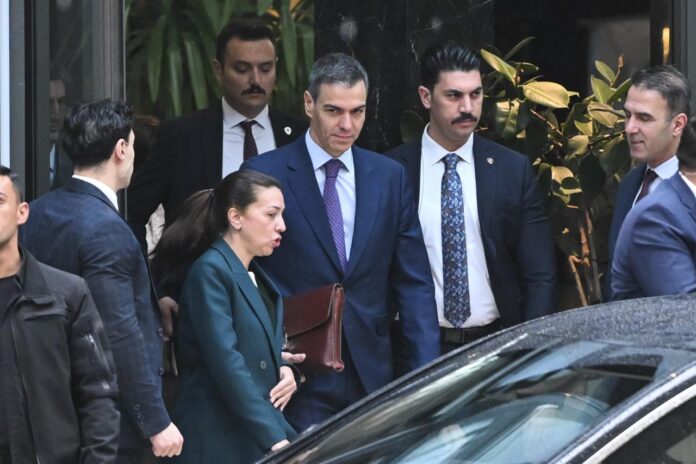
What was officially described as a mere “technical issue” quickly revealed something more unsettling: the fragility of European power projection, the opacity of diplomatic movements, and the quiet tensions surrounding a continent that pretends stability while drifting into strategic ambiguity
Pedro Sanchez emergency landing in Ankara: accident or signal?
The Pedro Sanchez emergency landing in Ankara on the night of May 3rd is, on paper, a banal aviation incident. The aircraft carrying Pedro Sanchez, en route to Yerevan for the summit of the European Political Community, was forced to divert due to what Spanish authorities cautiously labeled an “unforeseen technical problem.”
And yet, the silence surrounding the nature of this malfunction is telling.
No details. No technical report. No urgency in clarification.
In an era where airspace closures, flight deviations, and logistical disruptions often precede broader geopolitical tremors, such opacity invites interpretation rather than reassurance.
A summit under tension, not unity
The destination itself matters. Armenia is not a neutral stage. It is a fault line—between Russian influence, European ambition, and regional instability. The European Political Community, presented as an informal forum, increasingly resembles a fragile attempt at cohesion in a continent losing strategic clarity.
The presence of non-European actors, including Mark Carney, signals a shift. Europe, once confident in its autonomy, now leans outward—toward transatlantic reinforcement—while paradoxically attempting to distance itself from the volatility associated with figures like Donald Trump.
This contradiction defines the current European posture: dependent yet defiant, unified in discourse but fragmented in action.
Ankara: a revealing stopover
That the Pedro Sanchez emergency landing occurred in Turkey is not insignificant. Ankara remains a strategic hinge—NATO member, regional power, and increasingly autonomous actor navigating between Western expectations and its own national priorities.
Sanchez himself enjoys a relatively favorable image in Turkey, largely due to his positions on Middle Eastern conflicts. His vocal stance against U.S.-aligned interventions and his support for Palestinian causes have earned him cautious respect in Ankara’s corridors of power.
Still, this episode underscores a deeper reality: European leaders travel through a geopolitical landscape that is no longer predictable, where even logistical incidents carry symbolic weight.
The art of saying nothing
The official narrative insists on technical failure. Perhaps it is true.
But in modern geopolitics, what is not said often matters more than what is declared. A grounded aircraft, an unscheduled stop, a delayed arrival—these are not merely operational inconveniences. They are signals, sometimes unintended, of a system under strain.
The Pedro Sanchez emergency landing thus becomes more than an anecdote. It is a reminder that Europe, for all its summits and statements, operates within an increasingly unstable architecture—one where sovereignty, security, and credibility are constantly negotiated, often behind closed doors.
A minor incident, a major symptom
This incident will likely be forgotten in official records, reduced to a footnote in diplomatic scheduling. Yet it reveals a broader truth: Europe projects order, but navigates uncertainty.
And in that gap—between narrative and reality—events like this take on a significance far beyond their immediate cause.

