


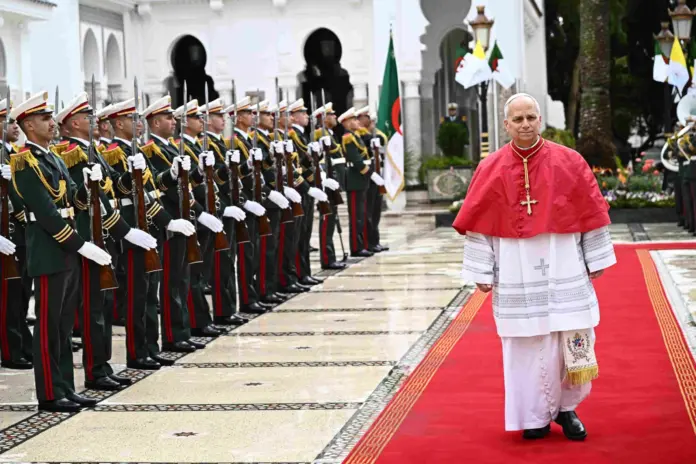
A calculated arrival under heavy skies
The first signals were subtle, almost atmospheric — a grey sky over Algiers, a restrained استقبال, and then, almost immediately, the words: “tendances néocoloniales.” With this carefully chosen expression, the Pope Algeria neocolonialism narrative imposed itself from the very first hours of Léon XIV’s visit, revealing less a pastoral journey than a geopolitical intervention disguised in liturgical language.
The Vatican, often accused of diplomatic ambiguity, here chose clarity — or at least a form of it. Because behind the moral posture lies a familiar tension: Rome positioning itself as a counterweight to what it perceives as Anglo-Saxon unilateralism, particularly from Washington.
A message aimed beyond Algiers
There was little doubt as to the implicit target. Without naming the United States, Léon XIV evoked “continuous violations of international law,” a formulation too precise to be accidental. In diplomatic language, omission often speaks louder than accusation.
The timing is equally telling. As Washington escalates its posture in the Middle East — notably through its alignment with Israeli operations against Iran — the Vatican appears to be reclaiming a moral high ground, one increasingly abandoned by Western chancelleries.
Yet this posture invites skepticism. The same institutions now condemning “neocolonial tendencies” have historically coexisted, if not cooperated, with them. The Pope’s rhetoric, while morally coherent, sits uneasily within a broader Western architecture that has rarely renounced power projection.
Algeria: a symbolic yet constrained मंच
Algeria, for its part, is not an innocent backdrop. The choice of Algiers is steeped in historical symbolism — a land marked by anti-colonial संघर्ष, still haunted by its unresolved memory with France, and increasingly wary of foreign influence.
But here too, contradictions emerge.
While Léon XIV calls for “a vibrant, dynamic, and free civil society,” the Algerian political landscape remains tightly controlled. Since the Hirak protests of 2019, السلطة has reasserted its grip, limiting precisely the kind of civic dynamism the Pope now encourages.
This dual خطاب — condemning external domination while maintaining internal rigidity — reflects a broader pattern across parts of the Global South: sovereignty invoked outwardly, restraint imposed inwardly.
The Pope’s balancing act
The Pope Algeria neocolonialism discourse is therefore not merely a critique of Washington; it is an attempt to redraw moral خطوط in a fragmented world.
Léon XIV walks a narrow path:
- On one side, distancing himself from American militarism
- On the other, avoiding direct confrontation with regimes whose democratic deficits are evident
His refusal to engage directly with Donald Trump’s provocations reinforces this strategy — maintaining elevation, but also ambiguity.
Yet ambiguity has limits. In a world increasingly shaped by hard power, moral appeals risk sounding like echoes unless backed by coherent alliances or tangible influence.
Between faith and realpolitik
The visit’s interreligious dimension — particularly the stop at the Great Mosque of Algiers — offers a softer counterpoint. Dialogue, coexistence, shared spiritual heritage: these are the Vatican’s enduring instruments.
But even here, one senses a tension between aspiration and reality.
Interfaith harmony, while symbolically powerful, does little to address the structural fractures — economic stagnation, youth disenchantment, geopolitical rivalries — that define the region.
A conclusion without illusions
In the end, this visit leaves behind more questions than certainties.
The Pope Algeria neocolonialism narrative resonates because it touches a real fault line in contemporary geopolitics: the վերադարձ of influence politics under new guises. Yet it also exposes the limits of moral diplomacy in a world where power remains the ultimate arbiter.
Algeria, like many nations navigating between autonomy and control, reflects this ambiguity. And the Vatican, for all its historical depth, seems caught between prophetic voice and institutional caution.
The words have been spoken. Whether they will translate into anything more than diplomatic friction remains, as always, uncertain.

