


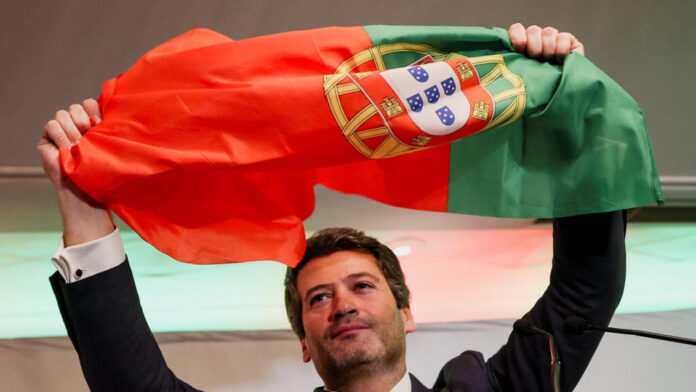
A major political fracture is emerging at the top of the Portuguese state, with André Ventura—controversial yet rising—qualifying for the presidential runoff. An institutional shock looms.
On February 8, Portuguese voters will face a stark choice between two conflicting visions of their nation: the worn, maneuvering leftism of Antonio José Seguro, a veteran of European socialism, and the radical, unsettling challenge of André Ventura, the outspoken leader of Chega. This runoff—unseen since 1986—is a political earthquake that confirms the meteoric rise of the nationalist right in Portugal.
According to near-complete results, Seguro secured 31% of the vote, with Ventura close behind at 23.5%. A result that alone is enough to signal the collapse of traditional political landmarks. Ventura is no longer a fringe candidate—he is now the alternative. And he has arrived here despite the usual media exorcisms and ritualistic invocations of “democracy” and “progress.”
“I call on all democrats (…) to unite against extremism,” Seguro declared, clinging to the tired rhetoric of a fatigued left.
But it’s precisely this kind of empty rhetoric that fuels electoral insurrection against the old order. Ventura speaks to the real Portugal—the overtaxed middle class, the forgotten elderly, the youth forced abroad. And he does so without euphemism:
“The right has fragmented like never before, but the Portuguese gave us the leadership.”
A paralyzed establishment right
Prime Minister Luis Montenegro, recently re-elected, refused to take a stand between the two finalists. This evasive neutrality reveals a deeper paralysis: a traditional right unable to choose between the ideological safety of the center-left and the unsettling winds of Ventura’s movement. “No voting guidance,” he announced. Translation: no backbone.
Chega—loathed by the elites but now the leading opposition party—continues to shape a coherent national alternative. While the political class hesitates, part of the country is awakening—electorally, without shame, without filters.
Polls misfire, analysts fumble
As usual, the media oracles got it wrong. Polls failed to foresee Ventura’s momentum, much like they underestimated past populist uprisings across Europe. Analyst Paula Espirito Santo, quoted by AFP, called it a “defeat for the government,” yet she avoids the core truth: this Portuguese presidential election is not just a vote—it’s a geopolitical signal.
Ventura’s rise cannot be understood in isolation. It reflects broader continental trends: distrust of the EU, latent immigration crises, rising insecurity, industrial decline. The Ventura vote is a weak signal—but a clear one. And it’s unsettling precisely because it refuses to conform to what’s politically acceptable.
A shattered field, revealing fractures
Among eleven candidates, it was liberal MEP Joao Cotrim Figueiredo who placed third with nearly 16%, while retired admiral Henrique Gouveia e Melo—known for leading the COVID-19 vaccine rollout—finished fourth. The government-backed candidate, Mendes, crashed with less than 12%. In short, there was no “useful vote”—only a rupture vote.
Though the Portuguese president has no executive powers, he can dissolve parliament and trigger snap elections. Amid chronic political instability, that prerogative could soon prove critical. Ventura, a man of order, understands this better than anyone.
The rise of a dark-suited outsider
The Portuguese presidential election of 2026 marks a turning point. For the first time since the Carnation Revolution, an overtly patriotic figure, hostile to the Eurocratic consensus and deeply attuned to the real concerns of ordinary people, could ascend to the presidency. Whatever happens on February 8, Portugal’s political landscape has changed.
This is not just a vote. It is the beginning of a realignment.

