


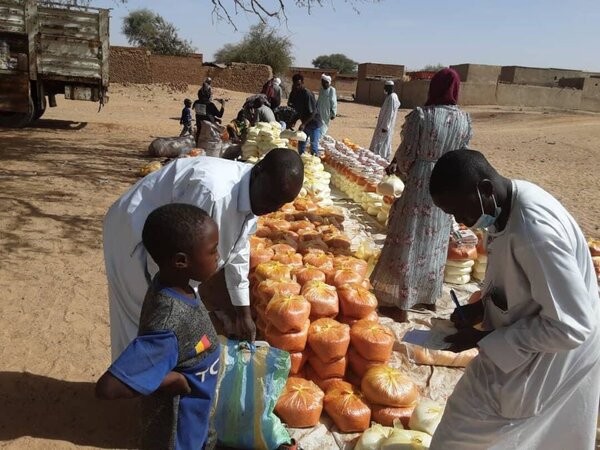
The World Food Programme has sounded the alarm again. This time, the deadline is March 2026: unless immediate funding materializes, food aid to Sudan will cease in a country where the United Nations has already confirmed the presence of famine. Behind the familiar humanitarian rhetoric lies a deeper, more uncomfortable truth: a diplomatic stalemate, a war left to fester, and a conflict the West no longer bothers to understand.
A Forgotten War, an Ignored Famine
The numbers are staggering—almost surreal. Over 21 million Sudanese are now facing acute food insecurity, nearly half the population. These figures, repeated tirelessly by UN agencies, should prompt immediate global action. Instead, they’ve become background noise in a crisis no longer deemed “strategically urgent” by the Western powers.
The World Food Programme (WFP) warns that without an emergency injection of $700 million, its Sudan operations will collapse by March. It’s not the first time such a call has been made. The real question is why it’s now being ignored — or, worse, quietly filed away as yet another African tragedy to be “managed” rather than solved.
“By the end of March, we will run out of food stocks in Sudan,” said Ross Smith, WFP’s Director of Emergency Response. A bureaucratic sentence, almost procedural in tone, that conceals a catastrophic reality: famine is not just looming — it has already arrived in parts of the country.
Food Aid to Sudan Held Hostage by Inaction
Since April 2023, Sudan has been ravaged by an internal war between the national army and the paramilitary Rapid Support Forces (RSF). The toll is devastating: tens of thousands dead, over 11 million displaced, and entire regions descending into lawlessness. And yet, the international community has moved on. The war is “complex,” hard to explain in 30 seconds, and therefore ignored.
In El-Fasher, capital of North Darfur, RSF forces seized control in October. The UN now officially confirms famine conditions there. Deliveries of humanitarian aid have resumed only recently — the first successful convoy since May 2024 arrived in January. A symbolic drop in an ocean of need.
The situation is equally dire in Kadugli, in the Kordofan region, and in the Nuba Mountains, where famine has taken root far from the cameras. In Dilling, 130 km to the north, famine is “highly likely,” but security conditions prevent any formal declaration.
Ceasefire Talks: All Theatre, No Substance
Meanwhile, diplomatic efforts remain a hollow ritual. Talks brokered by the United States, Egypt, Saudi Arabia, and the UAE have stalled — unsurprisingly, as neither warring faction is ready to give up territorial ambitions. In such a context, peace becomes a bad joke.
A Cairo meeting this week involving UN officials, the EU, and African mediators ended without any concrete proposal for a ceasefire. According to a diplomatic source, “nothing is on the table.” Not even a draft framework. The machinery of international diplomacy spins in place — devoid of direction, drained of will.
American envoy Massad Boulos highlighted the recent delivery of aid to El-Fasher as if to prove the U.S. is still engaged. But in truth, Washington has no Sudan strategy. Between Ukraine and Taiwan, Africa has once again fallen off the geopolitical map. The Biden administration’s Africa policy, like many before it, fluctuates between lofty declarations and chronic disinterest.
The Humanitarian Mask of a Strategic Failure
As NGOs struggle with insecurity and dwindling resources, the plea for $700 million to keep food aid to Sudan flowing begins to sound less like an emergency and more like a eulogy. In reality, the West has turned its back on Sudan. Brussels is preoccupied with internal fractures. Washington is consumed by its rivalries with Russia and China. And the UN, stripped of coercive power, can only observe.
The humanitarian language now serves to disguise a broader collapse of political will. There are no safe corridors, no common diplomatic front, and — most damning of all — no appetite for enforcing peace. Order has vanished, replaced by the law of the strongest.
Sudan as a Case Study in Strategic Neglect
What’s happening in Sudan is more than just a humanitarian crisis. It is a symbol of global diplomatic decay — a cautionary tale of how the world’s great powers respond when a war is too complex to fit the media narrative and too distant to matter.
If food aid to Sudan is cut off by March, as now seems likely, it won’t be a budgeting error. It will be a political failure — a deliberate abandonment cloaked in the sterile language of “funding gaps” and “access issues.” A famine ignored is not just a tragedy. It’s an indictment.

