


Berlin is no longer hiding its intentions. Under the guise of bilateral cooperation, Germany is preparing a profound overhaul of its migration policy. The Syrian diaspora Germany is now a diplomatic lever, a pressure tool, and perhaps a revealing fault line within Europe itself.
A decisive shift centered on the Syrian diaspora Germany
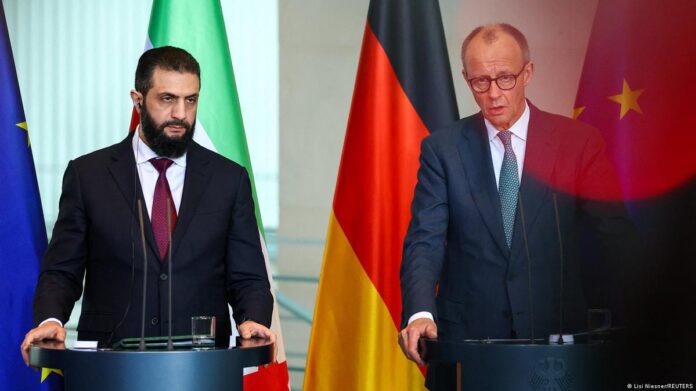
The scene is carefully staged: in Berlin, Chancellor Friedrich Merz stands alongside Syrian President Ahmed al-Charaa, a former rebel leader with a troubling past whom Western capitals only recently kept at arm’s length. Yet the announcement is clear—and stark: 80% of Syrian refugees in Germany could be sent back within three years.
Behind this declaration, the Syrian diaspora Germany ceases to be a mere demographic reality and becomes a question of sovereignty. Officially, Berlin speaks of a “circular migration model”—a technocratic formula that barely conceals a political objective: reduce migrant presence while outsourcing responsibility to Damascus.
In reality, this strategy rests on a fragile assumption—that Syria is stable, viable, and capable of absorbing mass returns. Nothing, whether on the military front or in international reporting, truly supports such optimism.
Official narrative vs. on-the-ground realities
Ahmed al-Charaa speaks of a “bridge” between nations. The rhetoric is appealing—perhaps too appealing. That bridge stands on unstable ground: ongoing clashes, Kurdish tensions, and persistent allegations of human rights violations.
Berlin, meanwhile, is injecting €200 million into Syrian reconstruction. A significant sum, yes—but one that raises an uncomfortable question rarely voiced publicly: is Germany funding reconstruction, or gradually legitimizing a still-contested regime?
Within diplomatic circles, weak signals are accumulating: reopening economic channels, multiplying official visits, softening language on Syrian governance. These are signs of a quiet, almost reluctant realignment—one in which the Syrian diaspora Germany becomes an adjustment variable.
Domestic political pressure that cannot be ignored
It would be naïve to separate this announcement from Germany’s internal climate. The rise of anti-immigration parties, the saturation of public debate, and the erosion of the 2015 welcome model have created an environment where toughness pays politically.
Merz hints at this by targeting a “small problematic group.” But extending this logic to 80% of refugees reveals something deeper: an ideological shift, where order and security now outweigh humanitarian considerations.
In this context, the Syrian diaspora Germany is no longer seen as a potential asset, but as a burden—or even a risk. A stark departure from the rhetoric of openness heard a decade ago.
A risky and accelerated normalization
Criticism is growing, particularly among Green politicians who warn of a “premature normalization.” If anything, the term feels understated. Berlin appears to be racing diplomatically, attempting to stabilize an unstable partner in order to justify a policy already decided domestically.
Kurdish protests in Berlin underscore a reality often absent from official statements: Syria remains fragmented, volatile, and far from a consolidated rule-of-law state.
This raises a blunt question: what happens if the strategy fails? If returns become unfeasible—or worse, dangerous?
A revealing European fracture
What is unfolding goes far beyond migration policy. The handling of the Syrian diaspora Germany exposes a Europe under strain, caught between proclaimed principles and immediate interests.
Berlin is moving forward—methodically—but along a narrow ridge. Between political realism and strategic gamble, between control and dependency on uncertain partners.
And beneath it all, a lingering question remains:
is Europe redefining its migration policy—or quietly abandoning its own commitments?

