


When the Masks Fall
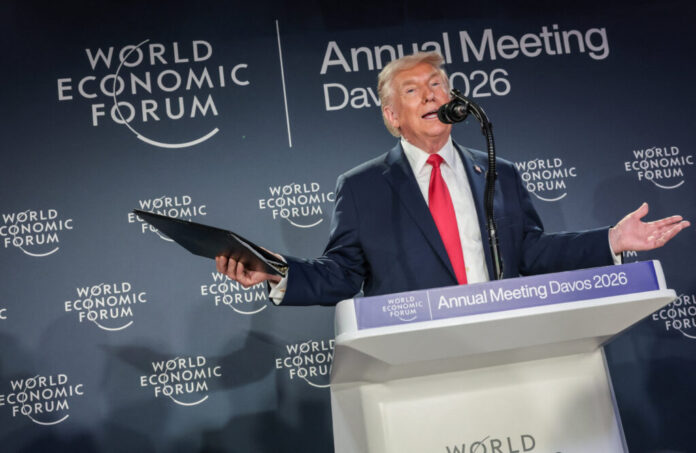
Donald Trump did not come to Davos to talk—he came to dominate. His speech, delivered on January 21, 2026, at the World Economic Forum, will go down in history not for its subtlety, but for its unapologetic geopolitical brutality. Europe, the designated target of a president perpetually on campaign mode, was publicly scorned, accused of ingratitude, weakness, and strategic blindness. The backdrop: the burning issue of Greenland, the autonomous Danish territory now openly coveted by Washington.
“We want a piece of ice to protect the world”
The tone was set within minutes. Trump demanded “immediate negotiations” for the acquisition of Greenland, which he described as a vital strategic asset. He added, with thinly veiled irony: “I will not use force.” A declaration worth more for what it implies than what it says—force was clearly considered. The very idea of an American president in 2026 expressing his desire to buy a European territory—at a multilateral summit—reveals an imperial logic no longer constrained by diplomatic conventions.
Behind the scenes, according to Reuters, preparatory documents outlined a conditional purchase offer tied to economic concessions. The U.S. Treasury reportedly drafted a legal framework for acquisition. Meanwhile, markets responded nervously: the Danish krone fell, and European stocks exposed to transatlantic trade took a hit.
Europe Painted as a Free Rider of History
“I love Europe, but it’s going in the wrong direction.” What sounds like a moderate statement masks a direct assault: the EU, in Trump’s eyes, is a force of inertia—incapable of securing its energy, borders, or sovereignty. Most importantly, it’s blind to the new grammar of power. He cited Venezuela as proof of American strength, hinting that order today is projected only through power.
Macron quickly responded, denouncing Trump’s diplomacy as bullying, claiming to prefer “respect over force.” But this tired moral posture sounded more like an admission of helplessness. Trump, meanwhile, pressed on. Weak signals abound: according to Al Jazeera, a “framework for agreement” with NATO was outlined on the Forum’s sidelines. Nothing signed, but enough to fuel speculation about a partial Greenland deal.
NATO, Ukraine, Canada: The Red Lines Fade
More than a speech, Trump delivered a warning: Europe must own its conflicts. On Ukraine, he was blunt: “It’s not our war. America is far away. Europe should pay.” On NATO, he condemned what he sees as a parasitic alliance. This is not new, but in Davos—before an audience of Western elites—it was a strategic explosion.
Even Canada wasn’t spared: “It exists because of the United States,” Trump declared. Humiliated, Ottawa is reportedly examining scenarios of a “symbolic invasion,” according to local press. Surreal? Perhaps. But it reflects a world where old rules no longer apply.
Greenland: Keystone of a New World Order
What Trump seeks in Greenland isn’t a colony—it’s a forward base in the Arctic. The island is a staging ground for future polar trade routes, rare earth resources, and geopolitical influence. By rejecting cooperative offers, Trump sends a message: the United States no longer negotiates, it acquires. Danish resistance, backed by the EU, is seen merely as a tactical nuisance.
Beneath the rhetoric, the stakes are clear: America wants to anchor its presence in a zone where Russia and China are expanding. Europe, meanwhile, dithers, invoking international law—without fleets, without leverage, without vision.
A Ridiculed Europe
Trump in Davos is the performance of a reversed power dynamic. Europeans speak of climate, ethics, regulation. Trump speaks of territory, resources, domination. The contrast is striking. His mockery of Macron—”I saw him playing tough with his sunglasses”—was not just a jab at the man, but at the attitude: that of an elite convinced language alone can govern the world.
But Davos 2026 reveals another reality: the era of declarations is over. The era of acquisitions has begun.

