


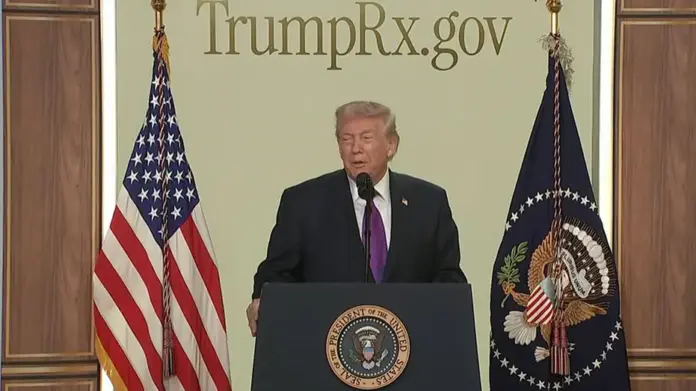
In a political move as bold as it is calculated, Donald Trump unveiled TrumpRX, a government-affiliated website promising cheap prescription drugs for the American public. With inflation devouring household budgets and healthcare costs still suffocating middle-class families, this latest initiative is both a symbolic gesture and a strategic masterstroke, one that speaks more to political timing than pharmaceutical innovation.
Behind TrumpRX: Subsidy or spectacle?
Trump’s announcement came Thursday night, with all the hallmarks of a campaign rollout. He described the site — TrumpRx.gov — as a place where Americans can access major discounts (up to 80%) on dozens of widely used medications. But the reality is more modest: no drugs are sold directly. The site provides printable coupons to use at pharmacies, a low-tech solution dressed in populist digital rhetoric.
“Americans have been subsidizing the world’s medicine for too long,” Trump declared, laying the blame for inflated prices on global freeloaders and past U.S. administrations.
The statement fits into a familiar narrative: the American taxpayer exploited, the global order rigged, and Trump as the lone negotiator willing to break with pharmaceutical orthodoxy. It is a striking message, particularly in a country where insulin can cost more than a month’s rent.
TrumpRX cheap prescription drugs: a campaign in disguise?
The launch is clearly timed to address growing discontent over the cost of living. With the 2026 midterms approaching, Trump’s base — middle-class, overburdened, and increasingly distrustful of elites — is a key target. His move repositions the Republican message around pocketbook issues, effectively stealing thunder from Democrats who’ve long claimed healthcare as their domain.
Standing beside Trump was Dr. Mehmet Oz, a media doctor turned politician, now overseeing the national health insurance program. He echoed Trump’s message:
“Don’t ever pay full price again without checking TrumpRX first.”
In tone and substance, it was less a health policy rollout than a sales pitch — the kind of populist marketing Trump excels at, and one that resonates in a country where many still ration their medications.
Ozempic as a symbol: real discounts or short-term bait?
The example brandished by Trump, Ozempic, a diabetes drug now popular off-label for weight loss, is telling. He claimed the price would drop from $1,000 to $199 under the TrumpRX scheme. The question, of course, is: for how long?
No terms of the agreements with the ten unnamed pharmaceutical firms have been disclosed. No enforcement mechanism has been outlined. Meanwhile, the stock prices of several drugmakers jumped on Asian markets shortly after the announcement, a market signal suggesting insiders see this as good for business, not a threat.
Trump’s relationships with major industries are transactional, not ideological. The pharmaceutical giants may well be playing along for optics, while securing quiet benefits in parallel. Once again, the spectacle may outpace the substance.
Tactical relief, not structural reform
In classic Trumpian fashion, TrumpRX cheap prescription drugs offers a fix, not a reform. It is a consumer-facing solution that skirts the deeper systemic rot of the U.S. healthcare system. There is no mention of price caps, insurance reform, or supply-chain regulation. Instead, the administration offers discounts as defense, a way to manage public anger without touching corporate power.
And yet, the brilliance of TrumpRX lies in its perception: for a large part of the electorate, it will appear as decisive action where others only delivered bureaucracy. In a country where trust in institutions is collapsing, a coupon from Trump may inspire more faith than any Democratic policy paper.
A placebo? Perhaps. But politically, it’s potent.

