


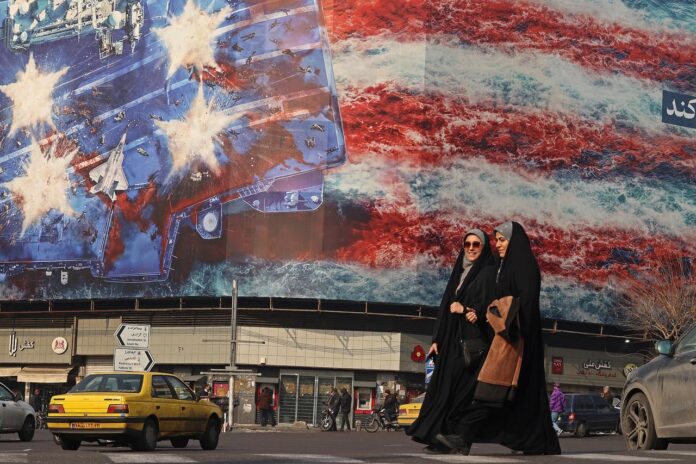
Tensions across the Middle East are at a breaking point as the USS Abraham Lincoln and its carrier strike group have officially entered the region. In response, Iran-backed militias in Iraq and Yemen have issued new threats of retaliation, escalating fears of a broader conflict. President Donald Trump has ordered the carrier group into position as the U.S. evaluates a potential military strike over Tehran’s deadly crackdown on nationwide protests.
Regional Militias Signal Escalation
Yemen’s Houthi rebels and Iraq’s Kataib Hezbollah, both long-time proxies of Iran, are warning they will strike U.S. and allied targets if Iran is attacked. The Houthis, who previously attacked over 100 ships during the 2024 Gaza conflict, released a new video titled “Soon,” featuring a ship engulfed in flames. Kataib Hezbollah issued a separate statement warning of a “total war” across the region should U.S. forces strike Iranian territory.
Ahmad “Abu Hussein” al-Hamidawi, a Kataib Hezbollah commander, threatened, “The war on the Islamic Republic will not be a picnic; rather, you will taste the bitterest forms of death, and nothing will remain of you in our region.”
Iran Responds with Warnings and Symbolism
Iran’s military officials have downplayed the deterrent value of the Lincoln, calling it an “exaggeration” and asserting that its presence merely offers a more convenient target. A newly unveiled banner in Tehran’s Enghelab Square shows a graphic depiction of the Lincoln streaked with blood and strewn with corpses, bearing the ominous message: “If you sow the wind, you will reap the whirlwind.”
Gen. Reza Talaei-Nik, spokesperson for Iran’s Defense Ministry, warned that any U.S. or Israeli strike would be “met with a response that is more painful and more decisive than in the past.” Iran has also issued airspace restrictions, banning small private aircraft except for oil and medical emergency operations, a move signaling heightened alert.
Hezbollah Hesitant, UAE Rejects Involvement
While Hezbollah expressed general readiness to confront “aggression,” its leadership refrained from detailing any specific action it might take. In a video address, Sheikh Naim Kassem stated that Hezbollah’s response would depend on the nature of the conflict, leaving its potential involvement ambiguous.
Meanwhile, the United Arab Emirates announced it would not allow its territory, airspace, or territorial waters to be used for any military action against Iran. The UAE reiterated its support for diplomatic solutions.
U.S. Red Lines and Protest Crackdown
President Trump has identified two red lines that would trigger U.S. military intervention: the killing of peaceful protesters and the mass execution of detainees following Iran’s crackdown. Since the protests began on Dec. 28 in response to the collapsing rial, over 5,973 people have reportedly been killed, and more than 41,813 arrested, according to the Human Rights Activists News Agency.
The scale of repression remains difficult to verify due to a two-week nationwide internet blackout. Iran’s government admits to 3,117 deaths but categorizes many as “terrorists,” a label it has historically used to dismiss civilian casualties.
Risk of Broader Regional War
The U.S. deployment is officially framed as a mission to “promote regional security and stability,” but with proxy forces mobilizing, Gulf airspace tightening, and global shipping routes at risk, the region remains one miscalculation away from a new war.
Iran’s regional network of militant groups, once seen as a strategic buffer, is now a volatile force threatening to ignite a regional inferno. As both sides dig in, the margin for diplomacy narrows — and the world watches for the next move.

