


A forceful PR operation barely conceals a deeper strategy of influence: under the guise of security assistance, Washington is inserting itself more deeply into African affairs—with the Islamic State as a convenient pretext.
Military Support with Strategic Motives
At first glance, the announcement might appear reassuring: the U.S. military is increasing logistical support and intelligence sharing with Nigeria, portrayed as a bulwark against the advance of the Islamic State in West Africa. In reality, this US-Nigeria cooperation, highlighted by the United States Africa Command (Africom), signals a new stage in America’s long-term strategy of entrenchment on the continent—far more than a sincere desire for regional stabilization.
General John Brennan, a senior Africom official, half-admits this in an interview with AFP: the Trump administration (let’s call it what it is—a return to doctrine, if unofficial) has adopted a “more aggressive” posture against the Islamic State, notably through joint operations with local militaries, including Nigeria’s. Yet this familiar rhetoric of force raises persistent doubts about both the effectiveness and sincerity of American intentions.
Symbolic Strikes, Uncertain Results
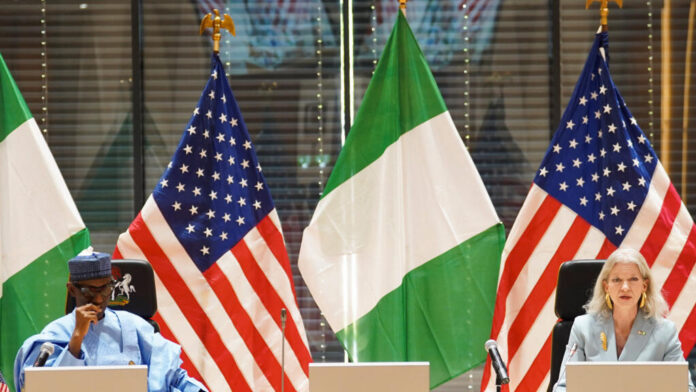
The military cooperation—relaunched with fanfare during bilateral talks in Abuja—comes just weeks after joint airstrikes against jihadist positions in Sokoto State on Christmas Day. Officially, the targets were linked to the Islamic State in the Sahel Province (ISSP). Unofficially, little has been disclosed about the actual damage inflicted.
This opacity only fuels skepticism. Local analysts remind us that jihadist groups have long adapted to Western strike tactics by embedding themselves in rural civilian populations. In this context, these operations appear less like decisive blows and more like diplomatic signals aimed at assuring Abuja that Washington remains a player—despite its troop withdrawal from Niger.
A Quiet Comeback of American Military Influence
More broadly, Washington’s posture in Africa resembles a quiet reconquest. In Burkina Faso, Mali, and Niger—all led by military juntas—security cooperation was never entirely severed. General Brennan openly admits, “We’ve even shared intelligence with some of them to hit key terrorist targets.”
Such declarations directly contradict official U.S. narratives about “democratic values” as a condition for military support. In practice, America has little problem working with authoritarian regimes—so long as they allow for continued strategic access. The supposed disinterest in replacing the drone base in Agadez, Niger, is merely optics: the military footprint is evolving, not vanishing—less visible, more fragmented, yet no less real.
The Religious Card: A Tactical Narrative
Another sensitive layer in this US-Nigeria cooperation is the instrumentalization of religious tensions. During her speech in Abuja, U.S. Deputy Secretary of State Allison Hooker urged Nigeria to “protect Christians”—a selective demand, conspicuously ignoring the Muslim victims of the same armed groups.
This rhetorical choice is no accident: the moral imperative of defending Christian minorities offers a palatable cover for a contested military presence, while subtly exacerbating sectarian divides in a country already fractured by identity conflicts. General Brennan tried to soften the impact, stating that U.S. intelligence “does not focus only” on Christians. But the damage was done: in its quest for mobilizing narratives, U.S. diplomacy leans into a barely veiled civilizational axis.
The Lingering Failure of Counterterrorism Strategy
Since 2009, Nigeria has grappled with the insurgency of Boko Haram and its breakaway faction, the Islamic State in West Africa Province (ISWAP). Despite years of Western support, the situation in the northeast remains volatile.
This latest phase of US-Nigeria cooperation appears to be a continuation—or perhaps a repackaging—of already failed strategies. Intelligence sharing, targeted strikes, weapons transfers: all have been tried, yet none have dismantled the insurgent networks whose resilience is rooted in the structural abandonment of Nigeria’s peripheries.
Behind the public display of a renewed partnership lies the quiet admission that the security-first approach is faltering—masked only by polished messaging and pseudo-civilizational overtones.
A Security Pretext for Continued U.S. Presence
The weak signals are multiplying: surveillance flights, moralistic speeches, symbolic strikes, sustained cooperation with coup-installed regimes. All signs point to an American presence that is not fading—but simply evolving. The counterterrorism pretext conceals a reshaped, more diffuse military presence.
Africa—and Nigeria in particular—once again becomes a stage for a geopolitical contest where the logic of power outweighs local realities. As for the concrete outcomes of this cooperation, they remain—still—out of reach.

