


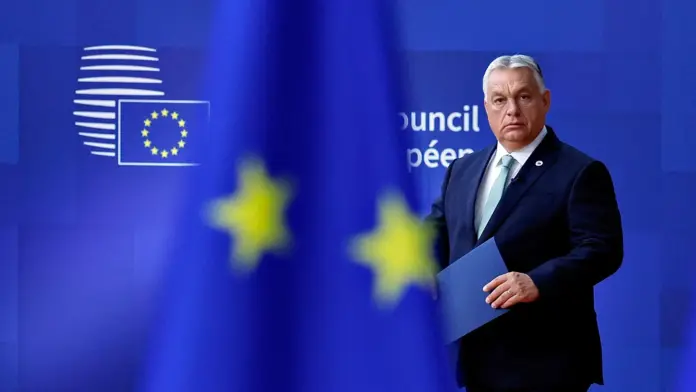
Another summit, another deadlock
Ukraine EU loan blocked — the phrase now circulates through Brussels corridors less as a policy issue than as a quiet admission of systemic weakness. On Thursday, European leaders gather once again, performing a familiar ritual: projecting unity while bracing for Viktor Orbán’s calculated defiance.
The €90 billion loan intended for Kyiv has become more than a financial instrument. It now lays bare a deeper fracture — one that carefully crafted communiqués and rehearsed indignation can no longer conceal.
Orbán, the deliberate lock in a divided Europe
For months, the Hungarian prime minister has executed a methodical resistance, neither impulsive nor erratic, but deliberate. In December, he accepted a minimal compromise — endorsing the loan in principle while opting out — only to reverse course, exposing what Brussels prefers not to confront: European unity on Ukraine rests on precarious, reversible arrangements.
Now the message is blunt: no Russian oil, no financial agreement.
Behind this stark formula lies an uncomfortable truth. The European Union, eager to project energy sovereignty, remains entangled in supply chains it does not fully control. The Druzhba pipeline — damaged in late January — has become a geopolitical lever. Budapest accuses Kyiv of dragging its feet on repairs, while Kyiv, unsurprisingly, operates under wartime priorities that rarely align with Hungarian domestic concerns.
Ukraine EU loan blocked: a revealing confrontation
This Ukraine EU loan blocked standoff reveals more than a temporary dispute — it exposes structural contradictions at the heart of the European project. On one side, capitals proclaim unwavering support for Ukraine; on the other, they struggle to enforce coherence when a member state openly diverges.
Official reactions oscillate between frustration and denial. Some diplomats still cling to the idea of a compromise, as though past experience had not already demonstrated Orbán’s consistency in leveraging maximal pressure. Others, more candid in private, admit that Hungary’s electoral calendar effectively freezes any immediate resolution.
Because this is, unmistakably, domestic politics projected onto the European stage. Facing electoral pressure, Orbán reframes the Ukrainian conflict as a national risk, warning against entanglement and invoking sovereignty — a narrative that resonates beyond Hungary’s borders.
Beyond Kyiv: Europe’s sovereignty dilemma
What is at stake extends far beyond Ukraine’s war financing. The European Union confronts a structural limitation: it seeks to act as a strategic power while remaining bound by unanimity.
Declarations of solidarity with Kyiv ring hollow when contrasted with this institutional reality. Washington encourages, nudges, occasionally pressures — yet it is Europe that exposes its divisions. In that sense, Orbán appears less an outlier than a symptom of a deeper European malaise.
The irritation voiced by certain ministers barely masks a more profound impotence. Hungary is not breaking the system — it is using it exactly as designed.
A delayed outcome, a persistent crisis
In the short term, urgency is contained: Ukraine reportedly has sufficient funding until spring, conveniently overlapping with Hungary’s elections. In Brussels, some hope — cautiously, almost reluctantly — that a renewed mandate for Orbán might ease the standoff.
But that assumption rests on fragile logic. Leaders who weaponize leverage during campaigns rarely abandon it once victorious.
Europe and the illusion of power
This latest episode of the Ukraine EU loan blocked saga confirms a broader trajectory: the European Union advances less through strategy than through inertia, constrained by its own contradictions.
Viktor Orbán, often dismissed or caricatured, operates here as a cold strategist, exploiting every institutional weakness. Brussels, meanwhile, continues to believe that moral pressure can override national interest calculations.
As the war in Ukraine drags on, a more fundamental question emerges — one Europe can no longer indefinitely postpone: does it truly intend to act as a power, or merely to simulate one?

