


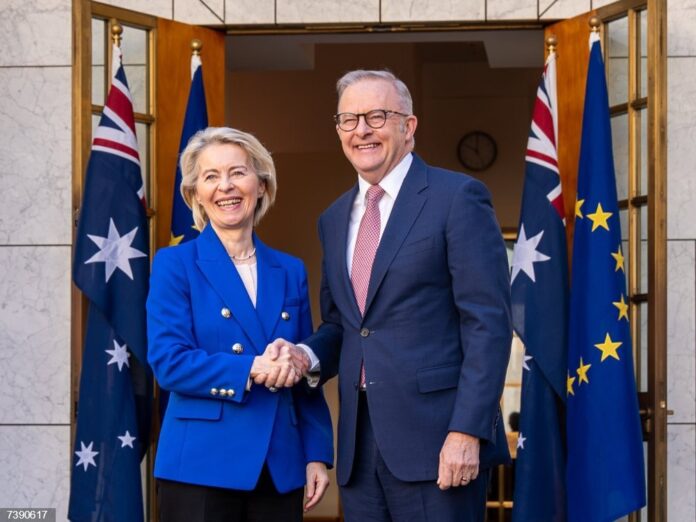
There are agreements that claim to open markets—and others that quietly close wounds without ever healing them. The newly signed EU–Australia trade agreement belongs unmistakably to the second category, emerging in the long shadow of a diplomatic rupture that European officials have not forgotten, even if they pretend otherwise.
EU Australia trade agreement geopolitical tensions: a fragile rapprochement
The EU Australia trade agreement geopolitical tensions frame cannot be ignored: behind the smiles in Canberra, one detects a certain stiffness, a diplomatic choreography too controlled to be entirely sincere.
After eight years of negotiations, Brussels and Canberra have signed a free trade agreement aimed at boosting bilateral exchanges and securing access to strategic resources, particularly critical minerals. The official narrative insists on convergence—shared values, mutual interests, a “common vision of the world.” Yet such formulations often conceal more than they reveal.
As noted in the original report , both parties are seeking to diversify away from growing pressure exerted by the United States and China. That alone should raise an eyebrow: diversification is rarely proclaimed so loudly unless dependence has become uncomfortable.
Exports are expected to rise, quotas expanded, tariffs eased. European automakers gain regulatory breathing room, while Australian agricultural exports—beef notably—secure greater access to European markets. But beneath these concessions lies a deeper question: is this truly a partnership of equals, or a recalibration forced by strategic unease?
The unspoken fracture: the submarine betrayal still lingers
It would be naïve—almost willfully so—to analyze this agreement without recalling the 2021 submarine crisis, when Australia abruptly canceled its multi-billion-euro contract with France in favor of a security pact with the United States and the United Kingdom (AUKUS).
Yes, the facts are clear:
- France lost a €56 billion submarine deal.
- Australia pivoted toward Anglo-Saxon military alignment.
- The decision was announced with a level of diplomatic discourtesy that Paris openly described as a “stab in the back.”
To suggest that this episode has been fully digested would be to misunderstand the nature of strategic memory. States do not forget humiliation—they compartmentalize it.
Today’s agreement, therefore, reads less like a fresh start and more like a cautious re-engagement. The European Commission speaks of partnership; yet one senses a desire to anchor Australia economically, perhaps as a counterweight to its increasingly exclusive military alignment with Washington and London.
In other words, Europe trades where it no longer fully trusts.
Signals beneath the surface: energy fears and strategic hedging
Another layer complicates the picture. The agreement comes amid warnings of a looming global energy crisis linked to instability in the Middle East. European leaders, including Ursula von der Leyen, have emphasized the urgency of securing supply chains.
This is not incidental.
Australia’s role as a supplier of critical minerals—essential for energy transition technologies—places it at the center of a new kind of geopolitical competition. The EU’s outreach is therefore not merely commercial; it is defensive, even anticipatory.
At the same time, both Canberra and Brussels appear increasingly wary of overexposure to American strategic priorities. The irony is striking: Australia leans militarily toward Washington while economically hedging with Europe; the EU, for its part, seeks autonomy while remaining structurally tied to the same Anglo-Saxon sphere.
Contradictions accumulate. Markets rise, but trust remains discounted.
EU Australia trade agreement geopolitical tensions: agriculture, industry, and quiet resistance
Within Europe itself, resistance simmers. Agricultural unions have already warned against disproportionate concessions, particularly in beef and livestock imports.
Their concern is not merely economic—it is civilizational in tone: standards, sovereignty, and the slow erosion of domestic production capacity.
The EU Australia trade agreement geopolitical tensions thus extend inward, exposing fractures within the European bloc itself. Brussels negotiates globally, but must constantly negotiate legitimacy at home.
And one might ask: how many such agreements can Europe sustain before its internal cohesion begins to fray?
A deal signed, but not settled
This agreement will be presented as a success—inevitably so. Trade will increase, headlines will stabilize, and diplomatic language will smooth over the rough edges.
But the deeper reality is less reassuring.
The shadow of the submarine betrayal has not disappeared; it has merely been absorbed into a colder, more transactional relationship. Europe engages with Australia not out of trust, but out of necessity. Australia, for its part, continues to balance between economic pragmatism and strategic dependence on Anglo-Saxon alliances.
In the end, this is not reconciliation. It is coexistence under constraint.
And in geopolitics, that is often the most fragile arrangement of all.

