


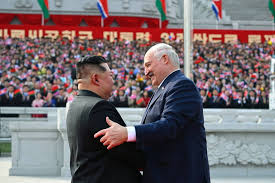
The relationship between North Korea and Belarus has quietly crossed a strategic threshold. In Pyongyang, under tightly controlled optics, Kim Jong-un and Alexander Lukashenko signed what is officially described as a treaty of friendship and cooperation—but the substance suggests something far more consequential.
What matters here is not the announcement itself, but the timing—and the silences surrounding it.
North Korea Belarus: a treaty with broader strategic implications
The choreography was familiar: military honors, rigid symbolism, carefully staged smiles. Yet the real significance lies beneath the surface.
Officially, Minsk and Pyongyang speak of cooperation in agriculture, information, and economic exchange. In reality, this likely formalizes already active parallel networks—sanctions evasion mechanisms, technological transfers, and indirect coordination with Moscow.
Lukashenko’s gesture—laying flowers in the name of Vladimir Putin—was not ceremonial excess. It was a signal. Russia may not be on the document, but it is clearly embedded in its logic.
A bloc taking shape against the Western order
This alignment is no longer tentative. It reflects a shared posture: not negotiation with the West, but deliberate distance from it.
Pyongyang is already supplying troops and weapons to Russia’s war effort in Ukraine. Belarus continues to function as a strategic rear base. The treaty does not create this reality—it acknowledges it.
Meanwhile, quieter indicators deserve attention: unusual movements in strategic commodities markets, tightening airspace controls, and ambiguous military patterns. None decisive alone, but together they form a pattern that is difficult to ignore.
Washington’s ambiguity as a strategic accelerant
The American position, as often, appears conflicted.
On one hand, Washington maintains its rhetoric on human rights and sanctions. On the other, it has cautiously reopened channels with Minsk, easing pressure in what looks like a transactional recalibration.
This dual approach weakens Western coherence. It sends mixed signals—precisely the kind that reinforce the confidence of regimes seeking alternatives to Western dominance.
Moscow as the silent architect
It is difficult to interpret this development without placing Russia at its center.
Since 2022, Moscow has been methodically building a network of aligned states capable of resisting Western pressure. Belarus acts as a logistical extension. North Korea, once heavily dependent on China, is now emerging as an active contributor to this evolving architecture.
What is taking shape is not an alliance in the traditional sense, but a strategic continuum stretching from Eastern Europe to East Asia.
From isolation to structured opposition
This treaty is not an isolated gesture. It marks a transition—from fragmented resistance to coordinated alignment.
Neither Pyongyang nor Minsk is seeking Western approval anymore. They are constructing an alternative framework, with its own rules and its own partnerships.
The real question is no longer whether such a bloc exists—but how far it is willing, and able, to go.
And once again, Europe watches—without a clearly defined position.

