


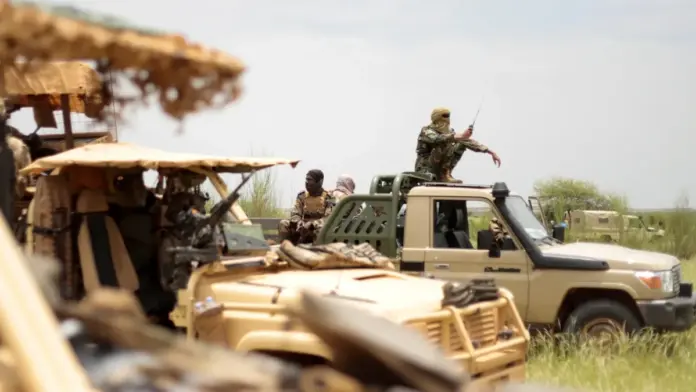
The Russia Mali partnership weakened is no longer a speculative diplomatic narrative but a military reality brutally exposed by the fall of Kidal. Behind reassuring statements and staged displays of strength, a pattern of strategic failure is emerging—one that reveals the limits of an alliance built hastily, largely in opposition to the West, yet lacking depth and coherence.
Kidal, symptom of a weakened Russia Mali partnership
The fall of Kidal on April 26 acts as a brutal revelation: the Russia Mali partnership weakened under the weight of contradictions accumulated since 2021. That day, it was not only military positions that collapsed, but an illusion carefully maintained by Russia and the ruling junta of Mali.
The death of the defense minister—architect of the rapprochement with Moscow—adds an almost terminal tone to the sequence. Events unfolded too quickly, too densely, not to raise deeper questions.
Officially, the men of Africa Corps—direct heirs of Wagner—withdrew for tactical reasons. Unofficially, within Malian ranks, the word “betrayal” circulates with increasing insistence.
An asymmetric alliance eroding from within
Behind the rhetoric of sovereign partnership lies a harsher truth: a deeply unbalanced alliance.
Malian soldiers—underpaid and under-equipped—watch with growing resentment as Russian counterparts enjoy significantly better pay and conditions. This disparity is not anecdotal; it feeds structural mistrust.
But the discomfort runs deeper. Reports point to latent, sometimes explicit contempt. A cultural and operational divide that weakens cohesion on the ground.
In this context, the loss of Kidal was less an accident than an inevitability.
Moscow in narrative control mode
Faced with military reality, the Kremlin falls back on familiar reflexes: aggressive communication, targeted disinformation, and recycled anti-Western rhetoric.
Thus, France once again becomes the convenient scapegoat—accused of covert manipulation. A predictable strategy, almost mechanical, yet revealing an unusual level of nervousness.
The more uncomfortable truth is this: Russia lacks the means it claims to possess in the Sahel.
No air superiority.
Limited intelligence capabilities.
Stretched logistics.
Where Western forces once built surveillance and strike architecture, Moscow improvises.
The airpower gap: a strategic blind spot
One detail, often overlooked, deserves closer scrutiny: the aerial vacuum.
Since the Western withdrawal, a kind of gray zone has emerged over the Sahel. Not an official no-fly zone, but a largely abandoned airspace where jihadist groups operate with increased freedom.
Turkish drones acquired by Bamako offer the illusion of control—but not its substance.
In such a vast theater, without credible air coverage, any counterinsurgency strategy is doomed to attrition.
Toward a discreet Russian pullback?
The question is no longer taboo: is Moscow preparing a partial withdrawal?
Weak signals are accumulating:
Abandoned positions.
Rumors of evacuations from Timbuktu.
Unusual silences in official channels.
Nothing spectacular—and that is precisely what makes it telling.
True to its pragmatic doctrine, Russia may opt for a minimal presence: protect the regime without becoming trapped in an unwinnable conflict.
A cold, calculated approach, consistent with its priorities elsewhere—particularly in Ukraine.
A junta increasingly dependent
The paradox is stark: the more the partnership weakens, the more dependent the junta becomes.
Assimi Goïta understands this. Behind calls for national mobilization lies a simple reality: without external support, the regime falters.
Yet that very support is eroding.
A classic geopolitical trap—replacing one dependency with another, without fully grasping its limits.
The end of a strategic illusion
The Russia Mali partnership weakened now appears for what it truly is: an opportunistic construct born from rejection of the West, yet incapable of delivering lasting stability.
Kidal is not an accident.
It is a signal.
A signal that Moscow, despite its African ambitions, cannot—or will not—bear the real cost of asymmetric warfare in the Sahel.
And a signal that the Malian junta, despite its sovereign rhetoric, may soon face the consequences.
In this shadow game of narratives and positioning, one constant remains: on the ground, local dynamics always prevail—far removed from the promises crafted in distant capitals.

