


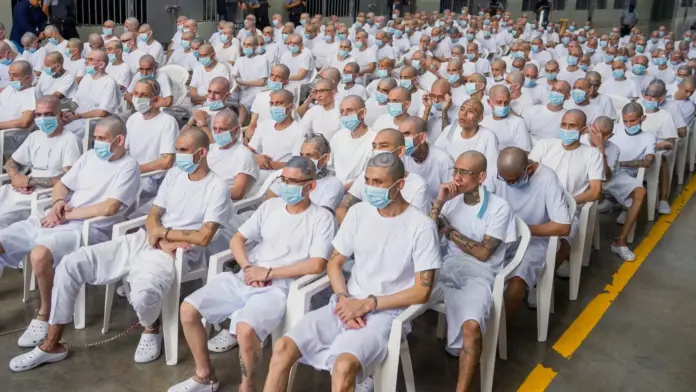
The MS-13 El Salvador mass trial opens less as a judicial proceeding than as a calculated display of power: behind the 486 defendants stands a political doctrine, embodied by Nayib Bukele, determined to eradicate gangs at the cost of a profound redefinition of the rule of law.
MS-13 El Salvador Mass Trial: Justice at Scale, Politics in Command
Shaved heads, shackled bodies, choreographed imagery—Salvadoran authorities have staged the opening with near-clinical precision. The message is unmistakable. This trial targeting the Mara Salvatrucha (MS-13) covers tens of thousands of alleged crimes—murders, extortion, trafficking—but it clearly transcends the legal domain.
Authorities cite over 47,000 criminal acts. A staggering figure, yet one that primarily serves to justify a sweeping approach where individual responsibility dissolves into collective command logic. The comparison—explicitly invoked by Bukele—to historical tribunals is telling.
In this narrative, gang members are no longer mere criminals. They are reframed as internal enemies, almost military targets.
A Security Strategy Turned National Doctrine
Since 2019, Nayib Bukele has methodically built a war narrative. El Salvador is no longer combating crime—it is portrayed as a nation under siege, engaged in an existential struggle.
The indirect backing of Donald Trump—who designated MS-13 a terrorist organization—fits into a broader Anglo-American security framework, often exported with little regard for local institutional balance.
Yet ambiguity persists. Washington applauds, cautiously. As often, today’s ally can quickly become tomorrow’s cautionary tale.
Undeniable Effectiveness… at a Structural Cost
The numbers are difficult to dispute. Homicide rates have plummeted. El Salvador, once synonymous with extreme violence, now presents a level of public safety that many Western states struggle to achieve.
On the ground, the shift is tangible. Territories once controlled by gangs have been reclaimed. Fear has changed sides.
But this success comes at a cost.
The state of emergency, imposed in 2022, suspended fundamental rights. Mass arrests, prolonged detention without judicial oversight, warrantless surveillance—this is the toolkit of a state at war with its own internal threat.
Criticism from Human Rights Watch highlights a central risk: wrongful convictions in a system where speed overtakes due process.
MS-13 El Salvador Mass Trial and the Erosion of Checks and Balances
What is unfolding goes far beyond security policy. The MS-13 El Salvador mass trial signals a deeper institutional shift.
Parliament aligns. Courts fall in line. The executive decides.
In this configuration, checks and balances appear largely neutralized. The system functions—but vertically, where efficiency overrides structural safeguards.
The model attracts attention. Across Latin America, leaders increasingly reference it. The appeal of a strong state, unapologetically enforcing order, resonates in societies fatigued by chronic insecurity.
But the question remains: can a democracy endure a permanent state of internal war?
Restored Order or Dangerous Precedent?
The El Salvador of Nayib Bukele imposes a troubling reality: security can indeed be restored swiftly—provided the rules themselves are rewritten.
The MS-13 El Salvador mass trial is not merely judicial. It is a political signal, almost civilizational. That of a state prioritizing order above all else, even if it means approaching its own limits.
Whether this model represents a sustainable solution—or the beginning of a more profound drift—remains the unanswered question.

