


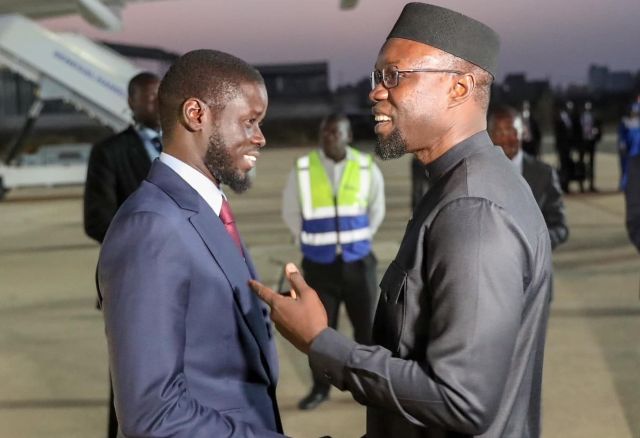
After the breakup, the electoral confrontation begins
The Faye-Sonko duel is no longer a matter of speculation. It has become the defining fault line of Senegalese politics. Barely two years after their joint victory under the banner of political renewal, President Bassirou Diomaye Faye and his former Prime Minister Ousmane Sonko are now heading in opposite directions. Publicly, both men still avoid direct attacks, yet behind the scenes each camp is already preparing for the 2027 local elections, which could serve as the first major test ahead of the presidential race in 2029.
Faye-Sonko Duel: Two Competing Visions of the Pastef Project
During the 2024 campaign, the slogan “Diomaye is Sonko, Sonko is Diomaye” symbolized an inseparable partnership. Today, that slogan looks more like a relic of a political alliance that could no longer survive its own contradictions.
The dismissal of Ousmane Sonko as Prime Minister on May 22 officially exposed tensions that had been building for months. On one side stands Bassirou Diomaye Faye, increasingly associated with a pragmatic form of sovereignty, one willing to adapt ideology to economic realities. On the other stands Sonko, who continues to embody the movement’s original doctrine and insists that political realities must conform to the principles that brought Pastef to power.
The divide is especially visible over the issue of public debt. While President Faye appears ready to seek solutions involving the IMF, Sonko rejects any restructuring process that could be interpreted by his supporters as a retreat from the sovereignty agenda promised during the campaign.
Beyond economics, the split reflects two very different political temperaments. Faye favors compromise and broader alliances. Sonko, meanwhile, remains the champion of ideological purity and grassroots mobilization.
Parliamentary Majority Becomes a Source of Uncertainty
Senegal finds itself in an unusual situation. Ousmane Sonko now presides over the National Assembly, which remains dominated by lawmakers from Pastef, even as he increasingly assumes the role of the president’s main political challenger.
Some observers fear institutional paralysis. Yet neither camp appears eager to push the country toward open confrontation. The political cost would be considerable. The wave of hope generated by the 2024 election has not completely vanished, and neither side wants to be blamed for dismantling what they built together.
Constitutionally, President Faye retains the option of invoking exceptional powers should a severe crisis emerge. But such a move would carry significant risks and could easily transform Sonko into a political martyr.
For now, both men seem to understand that the ultimate verdict will come from voters rather than institutions.
2027 Local Elections: The First Round of the Faye-Sonko Duel
The Faye-Sonko duel is expected to face its first electoral test during the local elections scheduled for 2027. Speaking at the Pastef congress in Dakar Arena, Sonko urged his supporters to begin mobilizing immediately and warned that any attempt to postpone the vote would be unacceptable.
On paper, Sonko appears to hold the advantage. Pastef secured an overwhelming majority in parliament, winning 130 out of 165 seats. But local elections obey a different logic, driven less by ideology than by regional dynamics and local alliances.
Many municipalities remain under the control of figures linked to the former establishment. Some of these actors may seek accommodation with President Faye, whose more moderate posture could attract support from parties that have been marginalized since the 2024 political earthquake.
Faye also possesses a potentially decisive asset: his ability to broaden his coalition beyond the traditional Pastef base.
Sonko Still Commands Powerful Political Capital
The Faye-Sonko duel is also a battle of symbolism. Ousmane Sonko retains enormous personal appeal. In the eyes of many Senegalese, his inability to run in 2024 and his decision to endorse Bassirou Diomaye Faye gave him the image of a leader who sacrificed his own ambitions for the movement.
His subsequent dismissal has strengthened this perception. Among supporters, the narrative of betrayal resonates deeply, giving Sonko what could become a powerful victimhood advantage ahead of future elections.
However, this position comes with vulnerabilities. As the former Prime Minister and one of the architects of government policy, Sonko cannot entirely distance himself from the frustrations that have emerged over economic difficulties, student unrest, troubles in the construction sector, and controversial eviction campaigns affecting informal businesses.
Whether voters ultimately hold him accountable remains one of the biggest uncertainties facing Senegalese politics.
A Rivalry That Could Shape the Decade
Senegal has entered a new political era. The days of the united Faye-Sonko ticket are over. What has emerged instead is a contest between two interpretations of sovereignty, two styles of leadership, and two competing visions for the country’s future.
Unless early parliamentary elections intervene, the local elections of 2027 are likely to become the first chapter of a much larger confrontation culminating in the presidential election of 2029.
Despite repeated assurances that the country faces no institutional crisis, one reality is becoming increasingly difficult to ignore: the partnership that once embodied Senegal’s promise of change has evolved into the central source of uncertainty in the nation’s political landscape.

