


A gathering of traditionalists, provocateurs, and geopolitical opportunists
As the Russian Davos Forum 2026 opens in Saint Petersburg, the Kremlin once again seeks to project the image of a confident and indispensable global power. Yet beneath the polished stages, carefully choreographed speeches, and international delegations lies a more revealing reality: a Russia increasingly reliant on controversial Western influencers, fringe political figures, and anti-establishment personalities to validate its narrative of resistance against what it describes as a decadent and declining West.
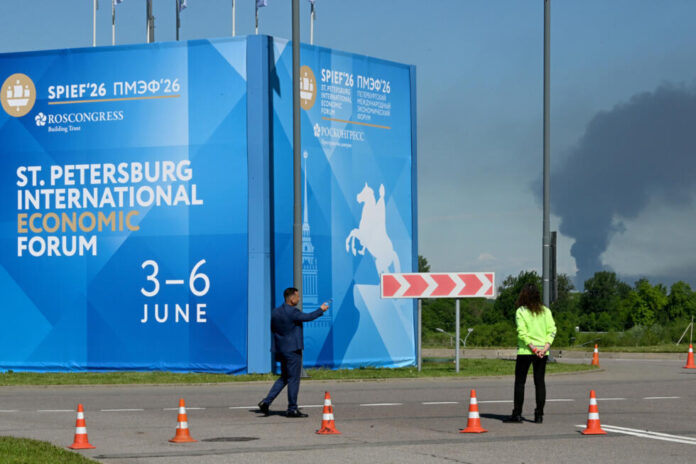
The contrast could hardly have been sharper. While thousands of delegates arrived in Russia’s former imperial capital, a Ukrainian drone strike targeted a fuel facility on the outskirts of Saint Petersburg. Visible reminders of the war pierced the carefully crafted image Moscow hoped to present to foreign visitors.
Russian Davos Forum 2026 and the Kremlin’s search for legitimacy
For nearly three decades, the Saint Petersburg International Economic Forum (SPIEF) has been marketed as Russia’s answer to the World Economic Forum in Davos. Before the Ukraine conflict, it attracted major Western corporations, investment banks, and political leaders.
Those days are gone.
Today, the Kremlin’s priority is no longer convincing Western investors. Instead, it seeks to demonstrate that Russia remains influential across Asia, Africa, and the Global South despite unprecedented sanctions and diplomatic isolation.
The attendance list reflects that strategy. Chinese Vice President Han Zheng, senior Vietnamese officials, African ministers, and representatives from Gulf states all provide Moscow with evidence that it has not been excluded from international affairs. The Middle East crisis has further strengthened Russia’s position as an energy power whose influence remains relevant in global oil and gas markets.
From the Kremlin’s perspective, every foreign delegation serves a symbolic purpose: proving that Western efforts to isolate Russia have not fully succeeded.
A curious American delegation
Russian media eagerly highlighted what they described as the return of an American delegation to SPIEF.
The reality appears far less impressive.
Rather than a senior figure from the Trump administration, the most visible American participant is Rodney Cook Jr., an architect and chairman of the U.S. Commission of Fine Arts. His recent notoriety stems primarily from his involvement in the controversial White House ballroom project rather than from any major diplomatic role.
His presence nevertheless reveals an increasingly fragmented Western approach toward Russia. Washington officially maintains a hard line, yet individual figures continue to engage with Moscow in various capacities, creating ambiguity that Russian media outlets are quick to exploit.
The Kremlin understands the value of symbolism. Even a relatively minor American official attending the forum can be presented domestically as evidence that dialogue with the United States remains alive.
From the AfD to Andrew Tate
The most striking aspect of the Russian Davos Forum 2026 may not be the attendance of foreign dignitaries but rather the unusual collection of ideological fellow travelers gathered around the event.
Among them is German politician Jörg Urban, one of the more hardline figures associated with Alternative für Deutschland (AfD). Urban has repeatedly praised Russia as a stabilizing force in Europe and advocates policies centered on national identity and cultural cohesion.
Hollywood actor Steven Seagal, a long-time supporter of Moscow and defender of Russia’s annexation of Crimea, also returns to familiar territory. His appearances at Russian events have become almost ritualistic.
More controversial still is American commentator Candace Owens, whose criticism of progressive cultural trends and establishment narratives has earned her both devoted supporters and fierce critics. Her participation in discussions on family values aligns closely with Moscow’s ongoing effort to portray itself as the defender of traditional social norms.
Yet the most explosive name remains Andrew Tate.
The British-American influencer arrived in Moscow shortly before the forum, fueling speculation about his involvement. Tate’s legal troubles and highly polarizing public image immediately sparked criticism, including from some prominent Russian nationalist commentators who questioned whether he genuinely embodies the traditional values the Kremlin claims to champion.
That criticism is revealing. Even among pro-Kremlin circles, there appears to be growing concern that Moscow’s search for sympathetic Western voices is leading it toward increasingly controversial figures.
Moscow’s anti-West coalition has limits
The Kremlin’s broader message remains consistent: Russia presents itself as a refuge for those disillusioned with liberal Western institutions, progressive social movements, and globalization.
There is undoubtedly an audience for that argument.
Many of the forum’s Western guests share a skepticism toward mainstream media, international institutions, and modern cultural trends. Their presence allows Russian officials to claim that opposition to liberal orthodoxy is becoming a global movement rather than merely a Russian position.
However, the quality of the guest list also highlights Moscow’s limitations.
While Russia continues attracting dissidents, influencers, activists, and ideological outsiders, it struggles to draw the most influential business leaders, policymakers, and opinion-makers from the Western world. The result is an event that increasingly resembles a gathering of political contrarians rather than the elite economic summit it once aspired to be.
The Russian Davos Forum 2026 illustrates both Russia’s resilience and its constraints. Moscow can still gather foreign leaders, energy executives, and ideological allies under one roof. It can still present itself as a center of an alternative international order.
Yet the composition of this year’s attendees also reveals an uncomfortable truth. The Kremlin’s appeal in the West increasingly rests not on mainstream influence but on a coalition of populists, anti-establishment commentators, cultural conservatives, and controversial internet personalities.
For Vladimir Putin, the forum remains a valuable showcase. Whether it truly demonstrates Russia’s growing global influence—or merely its ability to attract the West’s most provocative outsiders—is a far more complicated question.

