


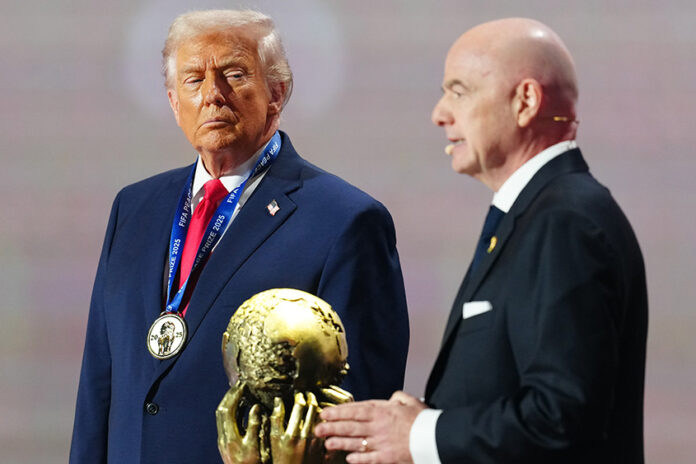
Gianni Infantino scandal: when a red card became a matter of state
The Gianni Infantino scandal is no longer merely a disciplinary quarrel over a red card, nor one of those dressing-room controversies that modern football produces every week. It now touches something deeper, and more disturbing: FIFA’s real ability to enforce its own rules when political pressure comes from above, when Washington picks up the phone, and when the global spectacle of the World Cup begins to look like a diplomatic showcase under influence.
Folarin Balogun, the United States forward, had been sent off against Bosnia and Herzegovina. Under normal circumstances, the mechanism is simple, almost administrative: red card, automatic suspension, absence from the next match. Except this time, the mechanism jammed. Or rather, it was reinterpreted.
Before the round-of-16 match against Belgium, FIFA ultimately converted the sanction into a suspended ban, allowing the American player to take the field. The decision immediately caused astonishment in Belgium, but also a wider unease across European football. In the meantime, Donald Trump had publicly boasted that he had asked Gianni Infantino to “review” the red card.
That is where the affair changed nature.
Officially, FIFA can still invoke its disciplinary regulations. Officially, a competent committee can still decide that a sanction deserves to be adjusted. Officially, nothing proves that a direct order came down from the FIFA president’s office to the disciplinary apparatus. But institutional scandals almost never begin with a smoking gun placed neatly on the table. They begin with a disturbing timeline, with an exception arriving at precisely the right moment, with silence lasting too long, with a decision that may be legally possible but politically indefensible.
And here, the timeline is devastating.
An American player is suspended. The American president intervenes. The FIFA president is contacted. The suspension disappears into the mist of a suspended sanction. Belgium, which could logically have expected to benefit from the absence, then discovers that the rules may not be exactly the same depending on whether one wears the shirt of the United States or that of a country less central to the tournament’s economic and diplomatic architecture.
That is the core of the Gianni Infantino scandal: not only the Balogun decision itself, but the impression that FIFA has once again become that old house where rules exist, certainly, but where power still knows which door to enter through.
European lawmakers want answers, FIFA answers with fog
Seventy-two members of the European Parliament have called for an investigation into Gianni Infantino’s possible role in lifting Folarin Balogun’s suspension. Their request also seeks to determine whether pressure from the U.S. administration may have influenced the decision.
The wording is careful, but the message is clear: European lawmakers suspect a breach of FIFA’s principle of political neutrality. And that principle, so often repeated in official speeches, suddenly becomes very concrete when a head of state publicly claims involvement in a disciplinary case concerning his own national team.
FIFA, meanwhile, remains faithful to its traditional art of fog. It speaks of procedure, regulations and disciplinary competence. But it does not provide the clear explanation that would cut suspicion short. It does not demonstrate, point by point, why Balogun was entitled to such exceptional leniency. It does not clearly answer the simplest question: would the same treatment have been granted to a Belgian, Serbian, Iraqi, Polish or Tunisian player after a comparable political intervention?
As long as that answer does not exist, suspicion will grow.
In football, order is not a luxury. It is the condition of competition itself. Nations agree to face one another because they believe, at least formally, that the rules apply to everyone. That belief can survive a refereeing error. It survives far less easily the idea that disciplinary decisions may be bent by the diplomatic weight of a host nation or by personal proximity between leaders.
Belgium now finds itself at the centre of an affair larger than itself. Sportingly, it could legitimately have expected to face a U.S. team deprived of a player sent off in the previous round. Politically, it discovers that the World Cup is not played only on the pitch, but also in the hushed corridors where leaders speak to one another.
This is not a detail. It is one of the major lessons of the affair. Small and medium-sized football powers must now ask themselves whether they can still count on equal treatment against the great political and economic machines of world sport.
The Iraq lead: a quieter but more explosive second front
It is in this already heavy climate, after the Balogun affair, that another lead has begun to circulate. It is less visible, less media-driven, but potentially more serious if the elements transmitted were ever confirmed.
According to our sources, several elements gathered in recent weeks could implicate, at least indirectly, Gianni Infantino and Graham Arnold, the coach of the Iraqi national team, in sensitive discussions around certain Iraq matches. According to those same sources, this would not have taken the form of a formally written agreement or a crude arrangement, but rather a cluster of exchanges, signals and intermediaries suggesting that a particular management of certain matches may have been considered.
Let us be precise: at this stage, no sporting or judicial authority has established that Gianni Infantino concluded an agreement with the Iraqi coach to deliberately lose matches. No public document currently allows anyone to state that an Iraq match was fixed. But the elements described by our sources are troubling enough to raise a question FIFA will not be able to dodge forever: could political pressure or arrangements have touched other files beyond Balogun?
According to the information reported to us, the discussions would not have concerned a spectacular defeat, visible and impossible to defend. The scenario described is more subtle, more consistent with modern methods of sporting influence: unusually cautious tactical choices, management of certain senior players, restrictive playing instructions, late substitutions, team selections officially justified by fatigue, rotation or internal group balance. In other words, not “giving away a match” in a caricatural manner, but approaching it with controlled intensity, in a direction favourable to certain external interests.
That is precisely what makes the Iraq lead so troubling. International football is not always manipulated through a clear order, an envelope or a written instruction. It can be steered through promises, protection, invitations, influence networks, future guarantees or institutional pressure understood by everyone but never publicly formulated.
According to a source close to the matter, one sensitive point concerns the role of intermediaries moving between federal and diplomatic circles, capable of transmitting messages without the main actors appearing directly. This is where Gianni Infantino’s name returns — not as established proof, but as a political shadow inside a system he increasingly embodies: a FIFA close to heads of state, attentive to power relations, officially neutral, yet rarely far from the powerful.
Graham Arnold, for his part, appears in the elements transmitted as a possible piece in a broader mechanism. Not necessarily as the architect of an arrangement, but as someone who may have received, interpreted or applied certain signals from a higher environment. Here again, caution is necessary. But at the highest level of football, the line between sporting decision, federation pressure and political influence is often much thinner than official statements suggest.
One of the most sensitive elements, according to our sources, concerns the real room for manoeuvre available to the Iraqi coach. Officially, a coach chooses his squad, his starters, his substitutions and his game plan. In reality, a national team rarely operates in an institutional vacuum. Some players may be protected by internal balances. Some young talents may be delayed. Some senior figures may become difficult to remove. And some choices, presented as tactical, may also respond to constraints the public cannot see.
That is what makes the Iraqi hypothesis particularly explosive. If a coach keeps contested players, delays renewal or adopts an unusually cautious approach, it is always possible to see it as a sporting mistake. But when those decisions occur in a climate of pressure, intermediaries and external interests, the sporting mistake becomes something else: a symptom.
This lead must not overshadow Balogun. On the contrary, it must be read through Balogun.
Because the Balogun affair opened a breach. It showed that an automatic suspension could become negotiable after a political intervention at the highest level. It planted the idea that FIFA, under Infantino, could adapt its rules when the right power knocked on the right door. From that point on, every other grey area takes on a new dimension.
Had FIFA been beyond reproach in the Balogun affair, the Iraq lead might have been seen as a peripheral rumour. But after Donald Trump’s claimed intervention, after the suspension was converted into a suspended ban, after Zurich’s embarrassed silence, doubt changes nature. It becomes systemic.
The question, therefore, is not to state today that Iraq deliberately lost this or that match. The more disturbing question is this: do circuits of influence exist around FIFA that are capable of weighing on sporting, disciplinary or tactical decisions without leaving a direct trace?
That is what European federations should demand. Not only an explanation on Balogun, but a broader inquiry into how FIFA handles political pressure, unofficial requests, state interventions and the grey zones between sports diplomacy and competitive manipulation.
Balogun remains the central case. It is the file that triggered European anger. It is the file that exposes the uncomfortable link between Trump and Infantino. It is the file that forces FIFA to face its contradictions. But the Iraq lead adds an even more worrying depth: the possibility of an international football system in which visible decisions are only the acceptable surface of a much more discreet form of power.
Infantino and FIFA’s old reflex: smiling at power
Gianni Infantino likes the powerful. It shows. He meets them, accompanies them, celebrates them, invites them into the grand theatre of world football. He has that very contemporary talent of international leaders: speaking of universality while cultivating the most political forms of proximity.
This contradiction sits at the centre of the Gianni Infantino scandal. FIFA claims to embody a higher, almost Olympian neutrality. Yet it increasingly behaves like a parallel diplomatic institution, sensitive to power relations, host countries, dominant markets and presidents capable of turning a match into an operation of national communication.
This is not about saying everything is corrupt. That would be too easy, too crude. The problem is subtler, and therefore more dangerous. Modern FIFA no longer even needs to openly break its own rules. It only needs to soften them, at the right moment, for the right actor, with the right words.
A suspension is not cancelled: it is adjusted.
A political intervention is not pressure: it is a conversation.
A favour is not a favour: it is an independent disciplinary decision.
That is how institutions die: not in noise, but in semantics.
What FIFA must publish
If FIFA truly wants to extinguish the fire, it must stop responding with administrative formulas. It must publish the full reasoning behind the Balogun decision. It must explain the exact regulatory basis for the suspended ban. It must identify the people involved in reviewing the case. It must clarify the contacts between Donald Trump, Gianni Infantino, the U.S. administration and the disciplinary bodies.
It must also explain why this leniency was granted in this specific case, and not in other comparable files.
And now, it must go further. It must demonstrate that its integrity circuits are not merely there to reassure sponsors, but to genuinely protect the competition. It must say how it handles weak signals, political interventions, unofficial relays, federation pressure and the suspicions surrounding certain national teams exposed to influence games.
Everything else will be communication.
And communication is no longer enough in this affair. International football does not need a lukewarm press release. It needs an act of authority. A demonstration of rules. A restoration of order.
Conclusion: the red card that cracked the display window
The Balogun affair began as a disciplinary episode. For now, it ends as an X-ray of power inside FIFA.
It reveals an institution too close to heads of state, too attentive to host nations, too skilled at speaking the language of neutrality while navigating pure politics. It reveals an America that understands perfectly the strategic value of sport. It reveals a Europe that, belatedly but lucidly, is beginning to understand that the world sporting order can derail very quickly when great powers get involved.
Gianni Infantino may still emerge from this sequence unharmed. FIFA presidents often have a remarkable capacity for survival. But surviving is not convincing. Remaining in office is not political exoneration.
The real danger for him is not only the investigation demanded by European lawmakers. The real danger is that the public has seen the machine move.
And when an institution claims to be neutral, sometimes one visible movement is enough for the entire scenery to begin collapsing.

