


Pyongyang is taking another step in its military strategy, aiming to transform its fleet into a nuclear force capable of operating far beyond coastal waters.
North Korea is methodically pursuing its military modernization program. On Tuesday, Kim Jong-un confirmed that the country’s navy is being equipped with nuclear weapons, a move that forms part of a broader strategy to project power. Behind the regime’s dramatic announcements lies a gradual shift in the security balance across the Asia-Pacific region.
North Korea Pushes Ahead with Nuclear Naval Capabilities
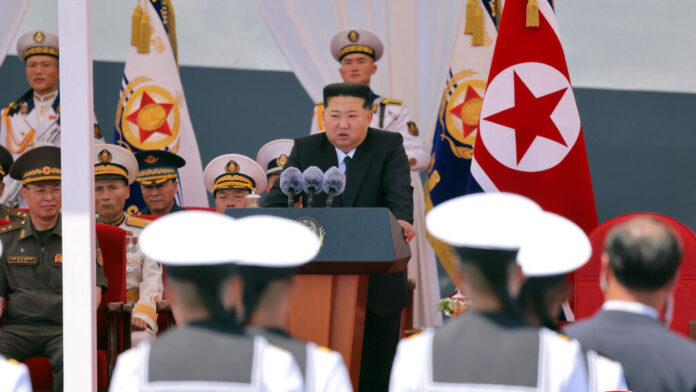
According to the state-run KCNA news agency, Kim Jong-un made the remarks in Nampo during the commissioning ceremony of the Choe Hyon, a 5,000-ton destroyer unveiled last year. The North Korean leader declared that “the program to equip the navy with nuclear weapons is proceeding steadily and without deviation from its intended course.”
Far from being mere propaganda, the statement reflects a pattern that has been unfolding for months. Pyongyang has intensified military inspections and weapons tests. The Choe Hyon had previously been described as carrying the “most powerful weapons,” while Kim personally oversaw a cruise missile launch from the vessel earlier this year.
The regime now appears determined to develop naval capabilities that go well beyond the traditional defensive posture that long characterized the North Korean fleet.
10,000-Ton Warships Mark a New Ambition
Kim Jong-un announced that the Kang Kon destroyer will soon enter service, followed by the construction of strategic warships displacing 10,000 tons. According to the North Korean leader, the country plans to build two major surface combatants annually, including a 10,000-ton cruiser.
“The era when our navy merely defended coastal waters has clearly become a thing of the past,” Kim declared.
Such ambitions suggest that Pyongyang is seeking to extend its maritime reach. Although many questions remain regarding the actual capabilities of these future vessels, the consistency of North Korea’s announcements points to a long-term strategy aimed at strengthening its influence across regional waters.
Pyongyang Blames Washington and Seoul for Rising Tensions
During a plenary meeting of the Workers’ Party that concluded on Monday, Kim Jong-un accused the United States and South Korea of pushing the Korean Peninsula “to the brink of nuclear war” through their expanding military cooperation and modernization efforts.
The rhetoric is familiar, yet it fits into a broader cycle in which every American or South Korean military exercise is used by Pyongyang to justify another stage of its own military buildup. The resulting action-reaction dynamic continues to deepen mistrust, while diplomatic channels remain largely frozen.
Since the collapse of the 2019 summit with Donald Trump, North Korea has repeatedly described its nuclear status as irreversible. The promises of denuclearization that once accompanied negotiations have faded, while years of sanctions have failed to halt the country’s military ambitions.
A Strategy Extending Beyond Coastal Defense
The latest announcement by North Korea comes at a time when the Asia-Pacific region is already witnessing growing strategic rivalry between China and the United States, alongside steadily rising defense budgets. Beyond the fiery rhetoric, a more significant signal is emerging: Pyongyang is attempting to transform its navy into a credible instrument of nuclear deterrence rather than a force confined to coastal defense.
This evolution could compel Washington, Seoul, and Tokyo to reassess their maritime posture. While the true capabilities of North Korea’s future cruisers remain uncertain, the strategic intent behind them appears increasingly clear.
Pyongyang Continues Its Steady Military Rise
Beyond the regime’s often theatrical messaging, North Korea appears to be following a precise and consistent roadmap that many Western capitals have repeatedly underestimated. While international attention remains focused on conflicts in the Middle East and tensions in Europe, Pyongyang continues to strengthen its military capabilities without showing any intention of abandoning its nuclear ambitions.
And behind Kim Jong-un’s frequently caricatured image, one reality remains impossible to ignore: the Korean Peninsula continues to rank among the world’s most dangerous flashpoints, where each new display of military power raises the stakes of a confrontation whose consequences no one can truly predict.

