


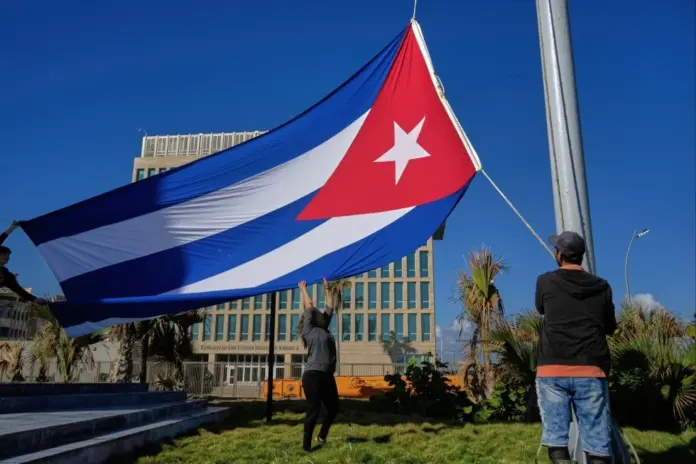
Havana confirms recent discussions with Washington in what is described as a professional and respectful setting. Yet beneath this carefully staged diplomatic sequence lies a harsher reality: an enduring power struggle, an openly enforced energy blockade, and a US strategy whose political objectives remain unmistakably unchanged.
Cuba US talks conducted under strict discretion
Cuba has confirmed that Cuba US talks recently took place in Havana at a high diplomatic level, even as Washington continues to exert direct economic pressure on the island. The announcement is anything but trivial. It comes at a moment of peak tension, where the United States claims to engage in dialogue while simultaneously tightening an energy chokehold designed, in practice, to weaken the Cuban regime over time.
Alejandro Garcia, deputy director for bilateral relations with the United States at Cuba’s Foreign Ministry, acknowledged in the state newspaper Granma that a meeting had indeed occurred. He emphasized the sensitive nature of the discussions, insisting on discretion, and clarified that both sides were represented at senior levels—US State Department officials and Cuban vice ministers.
Such cautious wording deserves attention. When Havana confirms a meeting without fully disclosing its contours, it is rarely accidental. It signals, simultaneously, to Washington, to domestic audiences, and to external partners who are closely watching the island’s progressive economic suffocation.
Dialogue under the weight of an energy blockade
The core issue remains unchanged. Washington talks, but Washington sanctions. The United States not only maintains the long-standing embargo dating back to 1962 but has, since January, intensified restrictions on Cuba’s access to fuel imports. In other words, while diplomacy adopts a polished tone, the machinery of coercion continues to operate with precision.
According to Garcia, lifting what he described as an “energy siege” was the Cuban delegation’s absolute priority. The phrase is not merely rhetorical. Without fuel, Cuba’s economy stalls; with energy rationed, the entire national system slows—from transportation to agriculture, from production to food distribution. Diplomatic language cannot obscure this structural vulnerability.
American sources, particularly in the media, have suggested that demands were raised, notably regarding political prisoners. Yet the Cuban official rejected claims of ultimatums, maintaining that the exchanges were conducted in a respectful and professional manner. This divergence is not insignificant. It illustrates the informational fog surrounding these discussions, where each side attempts to shape the narrative without fully revealing its hand.
Strategic ambiguity and the American dual-track approach
This is perhaps the most revealing aspect. These Cuba US talks do not occur in isolation. They unfold within a broader framework in which Washington signals openness to negotiation while consistently maintaining the long-term objective of political change in Havana.
Reports from Axios indicated that US officials met on April 10 in Havana with Cuban figures, including Raul Guillermo Rodriguez Castro, the grandson of Raul Castro. This detail matters. The involvement of such actors suggests that these exchanges extend beyond formal diplomacy into more opaque channels, where internal power dynamics, security considerations, and succession issues intersect.
In such negotiations, what matters is often what is not said. Who truly speaks? Under which mandate? With what room for maneuver? The United States has long mastered this dual-track approach: projecting firmness publicly, negotiating quietly, and selectively leaking information to influence perception and pressure counterparts. This is not an anomaly—it is a method.
Prisoners, symbolic gestures, and narrative warfare
The issue of prisoners has emerged as a focal point in this phase of dialogue. Havana recently announced the release of 51 detainees as a gesture of goodwill toward the Vatican, followed by the pardon of more than 2,000 prisoners during Holy Week.
On the surface, the signal is clear: Cuba seeks to demonstrate flexibility. In practice, however, skepticism quickly followed. Human rights organizations have denounced a lack of transparency, arguing that the actual number of political prisoners released remains uncertain. The Miami-based group Cubalex claimed it could verify only a fraction of the announced releases.
This battle over figures is far from neutral. It defines the moral framing of the crisis. For Washington, emphasizing political prisoners legitimizes continued pressure. For Havana, challenging these claims allows it to denounce what it sees as political instrumentalization. Between these competing narratives, clarity is often sacrificed—almost by design.
A constrained island searching for strategic breathing space
Amid this pressure, Cuba is visibly attempting to carve out limited room for maneuver. The arrival of a Russian oil tanker in late March, despite US pressure, underscored Havana’s ongoing search for alternative lifelines. At the same time, the government announced new measures allowing Cubans abroad to invest in the island and own businesses in key sectors, including agriculture and banking.
This is not ideological liberalization; it is pragmatic adaptation. When a state begins reopening tightly controlled economic spaces, it is rarely out of conviction—it is out of necessity. The existing model no longer suffices.
US Secretary of State Marco Rubio, a staunch critic of the Cuban government, dismissed these measures as insufficient, calling for radical political and economic change. His position is instructive. For parts of the American establishment, the objective is not reform, but transformation. Under such conditions, any appearance of diplomatic détente should be treated with caution.
What the Havana sequence really reveals
It would be naïve to interpret these discussions as the beginning of genuine normalization. What the Havana sequence reveals instead is a carefully managed ambiguity: enough tension to sustain pressure, enough dialogue to avoid rupture, and enough secrecy to allow competing interpretations.
In reality, both sides appear to be buying time. Cuba seeks energy, economic, and diplomatic relief. The United States, meanwhile, probes the system’s vulnerabilities without abandoning its strategy of constraint. And in between, the Cuban population continues to bear the cost of a confrontation in which the language of dialogue often masks a far more asymmetrical balance of power.
The recent Cuba US talks in Havana should not be overstated. They signal neither normalization nor genuine détente. Rather, they reflect a tactical phase in an ongoing confrontation—one where diplomatic gestures coexist with sustained economic pressure, and where Washington continues to speak of engagement while tightening its grip.
At this stage, one conclusion stands firm: as long as the energy blockade remains central to US strategy, dialogue will appear less as a path to resolution than as a calculated pause in a conflict that remains fundamentally unresolved.

