


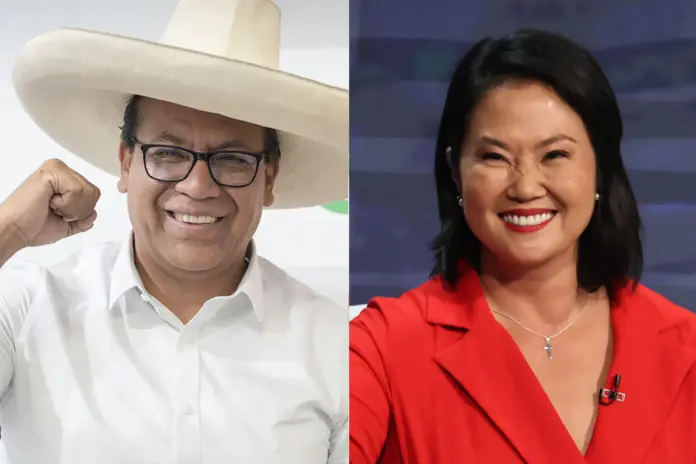
A deeply divided Peru heads toward a decisive confrontation
The Roberto Sanchez Peru runoff is no longer a hypothetical political scenario but a reality unfolding in an atmosphere of distrust, institutional fragility, and mounting ideological polarization. According to near-final results released by Peru’s electoral authorities, left-wing candidate Roberto Sanchez will face Keiko Fujimori in the second round of the presidential election scheduled for June 7. Yet behind the official figures lies a far more troubling landscape: accusations of electoral irregularities, judicial pressure, and a political establishment increasingly incapable of restoring national cohesion.
Peru once again appears trapped in the same cycle that has haunted the country for nearly a decade — fractured legitimacy, permanent crisis management, and leaders governing under constant suspicion. Since 2016, the country has cycled through eight presidents, a statistic that alone reveals the exhaustion of the Peruvian political model.
Roberto Sanchez Peru runoff raises tensions across the political spectrum
With 99.94% of ballots counted, Roberto Sanchez secured approximately 12% of the vote, narrowly ahead of ultraconservative candidate Rafael Lopez Aliaga, who obtained 11.9%. Keiko Fujimori, daughter of former president Alberto Fujimori, finished first with 17.1%.
The margin separating Sanchez from Lopez Aliaga — around 18,800 votes — now exceeds the number of ballots left to process. Political analyst Fernando Tuesta declared that “there is nothing left to resolve” regarding the identity of the two finalists.
Still, the atmosphere remains unusually tense. Lopez Aliaga has spent weeks denouncing what he describes as an “electoral coup,” pointing toward logistical failures that prevented more than 50,000 Peruvians from voting on election day. Authorities were ultimately forced to extend voting by an additional day after delays in transporting electoral materials.
European Union observers acknowledged “serious deficiencies” in the electoral process while simultaneously insisting that they had found “no objective evidence” of fraud. Such carefully calibrated language, increasingly common in international election monitoring missions, leaves room for interpretation and inevitably fuels skepticism among voters already distrustful of institutional narratives.
In Latin America, where political legitimacy often collapses not through tanks in the streets but through gradual erosion of public confidence, perception matters nearly as much as legal reality.
Judicial pressure clouds Roberto Sanchez’s campaign
The Roberto Sanchez Peru runoff now unfolds under the shadow of criminal proceedings that could dramatically reshape the campaign.
Peruvian prosecutors have requested a sentence of five years and four months in prison against Sanchez, accusing him of submitting false financial declarations to electoral authorities between 2018 and 2020. According to prosecutors, Sanchez allegedly failed to report more than $57,000 in contributions linked to political activities conducted through his party, Juntos por el Peru.
The accusations center on inconsistencies in party financing reports during regional and municipal campaigns. Prosecutors argue that Sanchez bears responsibility for “false declaration in administrative procedures and falsification of information regarding political contributions and revenues.”
Timing, in politics, is rarely innocent.
The judicial escalation arrives precisely as Sanchez consolidates his position as the principal anti-establishment figure capable of mobilizing Peru’s fragmented left. Whether the legal proceedings reflect genuine institutional accountability or a broader attempt to weaken a disruptive candidate before the runoff is now becoming part of the political debate itself.
This ambiguity is unlikely to disappear before the June election.
Roberto Sanchez denies wrongdoing as institutional mistrust deepens
Roberto Sanchez has firmly rejected all allegations of fraud. On social media, he argued that political opponents had spent years attempting to “impose a lie” in order to destroy his credibility.
He further stated that previous accusations concerning alleged personal misuse of party funds had already been dismissed by the courts, insisting that “there was never any fraud or embezzlement.”
An important hearing is scheduled for May 27, during which Peru’s judiciary will determine whether the case proceeds to a full oral trial.
The sequence is politically explosive. Peru now faces the possibility of entering a presidential runoff while one of the two finalists simultaneously battles criminal prosecution. In many Western capitals, such a scenario would trigger immediate concerns about democratic stability. In Peru, it increasingly feels almost routine.
Keiko Fujimori returns to the center of Peru’s political battlefield
Keiko Fujimori enters the runoff carrying both undeniable political resilience and considerable historical baggage. For years, Fujimorismo has remained one of Peru’s most disciplined political forces, built around promises of authority, economic order, and state control.
Yet the Fujimori name continues to divide Peru profoundly. Supporters remember Alberto Fujimori as the man who crushed insurgency and stabilized the economy during the 1990s. Critics remember authoritarian excesses, corruption scandals, and democratic erosion.
This runoff therefore becomes more than a simple left-versus-right contest.
It is rapidly evolving into a referendum on Peru’s exhausted institutions, on public trust in electoral mechanisms, and on whether the country still possesses the political coherence necessary to avoid another prolonged cycle of paralysis.
Meanwhile, international actors continue to issue cautious statements emphasizing democratic continuity, even as the contradictions become increasingly visible. Financial markets remain attentive, regional diplomatic channels unusually discreet, and domestic political rhetoric progressively more confrontational.
Such signals rarely emerge in isolation.
Conclusion
The Roberto Sanchez Peru runoff illustrates the deeper crisis consuming modern Peru: a democracy formally intact yet politically unstable, electorally functional yet socially fragmented. Behind the official announcements and procedural reassurances lies a country struggling to restore authority, legitimacy, and public confidence.
Whether Peru ultimately chooses Roberto Sanchez or Keiko Fujimori on June 7, the structural crisis itself will remain unresolved. And as so often in Latin America, the real danger may not come from a dramatic institutional collapse, but from the slow normalization of permanent instability.

