


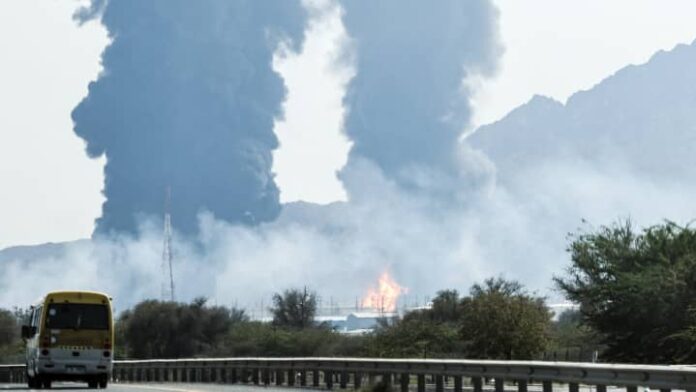
Strait of Hormuz tensions are once again reaching a boiling point, and behind the carefully crafted diplomatic statements, a harsher reality is emerging. On Monday, the United Arab Emirates reported Iranian-linked strikes just as Washington claimed it was restoring “freedom of navigation.” The timing is too precise to ignore — less a coincidence than a signal that control in the Gulf is slipping from official narratives
A controlled escalation in Strait of Hormuz tensions
The facts, insofar as they can still be separated from propaganda, point to a coordinated escalation. The UAE claims it intercepted multiple cruise missiles launched from Iran, while a drone strike hit an oil installation in Fujairah — a strategic site designed specifically to bypass the chokepoint of the Strait of Hormuz.
Three injuries, limited structural damage — but the real impact lies elsewhere. The message is unmistakable: the April 8 ceasefire was never a resolution, merely a pause. In truth, Strait of Hormuz tensions never subsided; they evolved into more ambiguous, deniable forms of confrontation.
Tehran, staying true to its doctrine of calculated ambiguity, denies targeting the UAE while simultaneously condemning what it calls American “military adventurism.” A familiar dual language: deny the act, justify the escalation.
Washington’s show of force meets strategic doubt
The administration of Donald Trump insists its naval operation is working. According to US officials, merchant vessels have successfully crossed the strait under American protection — a claim immediately rejected by Iran.
This contradiction is not trivial. It reflects a broader pattern in recent US interventions: confident messaging often detached from operational reality. While Washington projects control, oil markets suggest otherwise — Brent prices surge, signaling persistent risk.
In this environment, Strait of Hormuz tensions become a theatre of competing illusions: American displays of power, Iranian asymmetric pressure. Neither side appears to fully command the escalation ladder.
A region trapped in narrative warfare
European reactions, led by Ursula von der Leyen, follow a predictable script — condemnation, legal framing, expressions of solidarity. Yet beneath the rhetoric lies strategic irrelevance.
Meanwhile, incidents multiply: an explosion on a South Korean vessel, strikes in Oman, thousands of sailors stranded. These are not isolated events but weak signals pointing to a broader reality — a region drifting toward systemic instability.
At its core, this crisis extends beyond nuclear disputes or maritime security. It is a test of global power projection: Iran probing boundaries, the United States attempting to maintain a credibility already strained on multiple fronts.
Diplomatic paralysis and shifting priorities
Negotiations remain stalled. Tehran demands US military withdrawal, sanctions relief, and a redefinition of Gulf security architecture. Notably, the nuclear issue — once central — appears absent from immediate priorities.
This omission is telling. Control over flows — oil, trade, military access — now outweighs ideological disputes. The battlefield is no longer purely strategic; it is structural.
Within this framework, Strait of Hormuz tensions emerge as a defining variable of global equilibrium. Each intercepted missile, each denied strike, each contradictory statement contributes to a slow but steady erosion of stability.
A fragile order on the brink
What stands out is not just the violence, but the fragility of the system meant to contain it. The ceasefire lasted barely a month. The American operation, presented as decisive, is already contested in both narrative and effect.
Caught in the middle, the UAE — wealthy yet exposed — faces a harsh geopolitical truth: in a Gulf once again shaped by direct confrontation, security is no longer guaranteed by alliances alone, but by the ability to absorb and retaliate.
The Strait of Hormuz remains what it has always been: a lock on global energy flows. But today, no single actor truly holds the key.

