


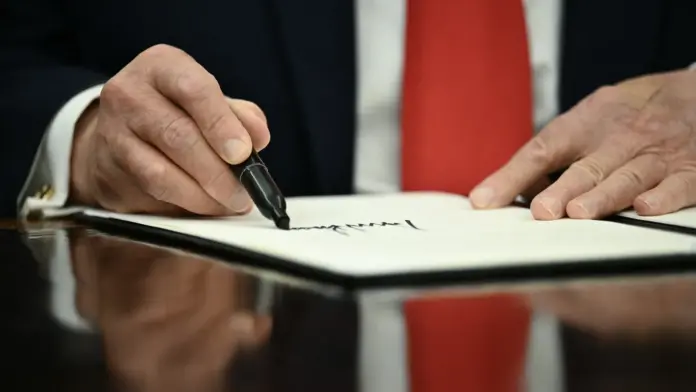
The US-Iran agreement, hailed by Donald Trump as a diplomatic breakthrough, has officially been signed according to the White House. Yet the full text will not be released until after Friday’s ceremony in Geneva. Behind the triumphant rhetoric, conflicting interpretations and unresolved disputes suggest that the much-celebrated peace may still be more fragile than advertised.
The US-Iran Agreement Still Leaves Many Questions Unanswered
Arriving at the G7 summit in Évian, Donald Trump presented the deal as a major success. According to the American president, the agreement is signed, the Strait of Hormuz will soon be fully reopened, and tensions across the Middle East are beginning to ease.
However, a closer examination reveals a more complex picture.
Vice President J.D. Vance admitted that the memorandum amounts to little more than a brief one-and-a-half-page framework, with most contentious issues postponed to future technical negotiations. In other words, the political announcement appears far ahead of the actual substance.
The Strait of Hormuz Remains at the Center of Strategic Calculations
Washington insists that the Strait of Hormuz will be completely reopened by Friday. Tehran, meanwhile, is already discussing maritime service fees and emphasizing Iranian-Omani sovereignty over the waterway.
The contrast between the two narratives is striking.
Financial markets welcomed the announcement immediately. Oil prices dropped sharply and global stock exchanges rallied. Yet only a handful of vessels have actually crossed the Strait since the agreement was announced, suggesting that shipping companies remain cautious.
The divergence between market optimism and operational reality may be one of the most revealing signals to watch in the coming days.
Israel Shows No Intention of Scaling Back
Prime Minister Benjamin Netanyahu used the occasion to reaffirm that Israeli forces would remain deployed in Gaza, Lebanon, and Syria “for as long as necessary.”
Such statements underline a reality often overlooked amid diplomatic celebrations: Israel’s strategic priorities do not necessarily align with the objectives proclaimed by Washington and Tehran.
Meanwhile, Hezbollah reported clashes in southern Lebanon despite the ceasefire framework. Lebanese authorities continue to urge displaced residents to delay returning home, highlighting the gap between diplomatic declarations and conditions on the ground.
Iran’s Distrust Toward Washington Has Not Disappeared
Iranian officials continue to emphasize their deep mistrust of the United States. Tehran insists that frozen assets should be released and compensation paid, while senior American officials maintain that no funds have been unfrozen so far.
These contradictory statements reveal the fragility of the process.
On one side, Washington is eager to present a rapid diplomatic victory. On the other, Iranian leaders appear determined not to repeat what they view as the mistakes of previous agreements and are demanding concrete guarantees.
The US-Iran agreement therefore looks less like a definitive peace settlement and more like a temporary truce in which every actor seeks to maximize its own strategic gains.
Trump Secures a Political Victory, but Peace Is Far From Guaranteed
Donald Trump’s announcement has brought immediate relief to financial markets and several regional capitals. Yet the differing interpretations of the agreement, continued fighting in Lebanon, and Israel’s refusal to withdraw from key fronts suggest that instability remains deeply rooted.
The US-Iran agreement may indeed open a new diplomatic chapter. But, as often in the Middle East, grand declarations tend to precede realities that are far more complicated.
When the full text is finally released on Friday, it will likely be the details—not the headlines—that determine whether this agreement marks a genuine turning point or simply another pause in a region where truces rarely survive first contact with reality.

