


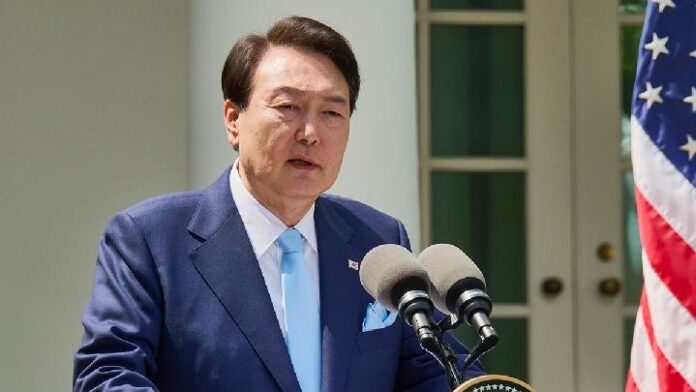
South Korea continues dismantling the legacy of former president Yoon Suk-yeol. Already serving a life sentence for his failed attempt to impose martial law in December 2024, the ousted leader has now received an additional 30-year prison term for allegedly ordering military drone operations against North Korea in an effort to manufacture a crisis and justify extraordinary powers.
According to special prosecutors, Yoon Suk-yeol authorized the dispatch of drones carrying propaganda leaflets over Pyongyang in October 2024. Investigators argue that the operation was designed to provoke a military response from North Korea and create the conditions necessary to declare martial law.
Prosecutors Say Yoon Tried to Create Wartime Conditions
South Korean prosecutors concluded that the operation deliberately sought to manufacture a wartime atmosphere, thereby endangering national security. Several drones reportedly crashed inside North Korean territory, raising concerns over the exposure of sensitive military information.
Ironically, Pyongyang reacted with unexpected restraint. Instead of escalating tensions, North Korea merely warned that further drone incursions would trigger retaliation, stopping short of any military response.
That absence of escalation, however, did not prevent Yoon from attempting his controversial power grab two months later.
The Failed Martial Law Attempt Remains Central
In December 2024, Yoon declared martial law, citing vague threats posed by alleged “anti-state forces” linked to North Korea and accusing the opposition-controlled parliament of obstructing his budget.
The move quickly collapsed. Despite troops surrounding the National Assembly, enough lawmakers managed to enter the chamber and vote against martial law, forcing Yoon to reverse course. The emergency regime lasted only six hours, but it triggered South Korea’s deepest political crisis in decades.
His impeachment in April 2025 opened the door to a succession of criminal cases that continue to expand.
Defense Lawyers Claim Legitimate Self-Defense
Yoon’s legal team strongly denies the accusations. His lawyers argue that he neither ordered nor approved the drone missions and insist the operations were a legitimate response to North Korea’s repeated launches of trash-filled balloons into South Korean territory.
According to the defense, the missions constituted lawful self-defense and had no connection to the subsequent declaration of martial law.
Yoon, 65, who is already imprisoned, has appealed his life sentence for insurrection, maintaining that he acted “solely for the good of the nation.”
A Historic Political Downfall
Few South Korean leaders have experienced such a dramatic collapse. In less than two years, Yoon Suk-yeol has gone from president to inmate facing multiple convictions.
The drone case adds an especially sensitive dimension to his downfall: the allegation that tensions with North Korea may have been manipulated for domestic political purposes. Yet the broader crisis also demonstrated the resilience of South Korea’s democratic institutions. Despite the attempted suspension of civilian rule, parliament, the judiciary, and constitutional mechanisms ultimately held firm, preventing a lasting rupture of the country’s democratic order.

