


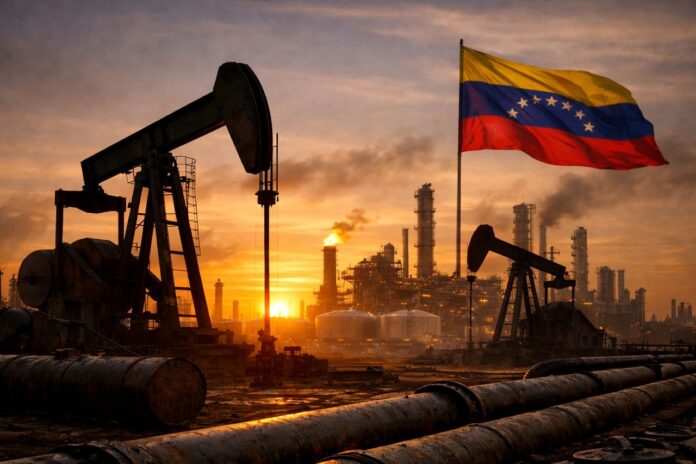
A historic oil reform in Venezuela coincides with a strategic gesture from the United States, lifting part of its sanctions. The global economic order, shaped in Washington, claims a new outpost in Latin America.
Less than a month after the U.S. military operation that—beyond any clear legal framework—ended Nicolás Maduro’s reign, Venezuela has taken a decisive step toward rejoining the Washington-led economic order: on Thursday, January 29, the National Assembly approved a reform of its oil law, opening the sector to private actors. Almost simultaneously, the United States announced a partial suspension of the sanctions imposed on state oil giant PDVSA since 2019.
The timing was too perfect to be merely coincidental. In Caracas, interim President Delcy Rodriguez hailed the moment as a “historic leap,” declaring at a pro-government oil workers rally that she had received a call from U.S. President Donald Trump and Secretary of State Marco Rubio. The message was unmistakable: reform accepted, sanctions eased.
Washington Endorses Venezuelan Reform
The newly adopted law allows private companies to extract, distribute, and sell oil without mandatory state participation—a sharp departure from the Chavista model of 2006, which mandated public majority ownership and imposed heavy taxes. Now, taxation is simplified to a single contribution capped at 15%, with royalties reaching up to 30% of gross revenues.
This new Venezuela oil law introduces contractual flexibility: tax rates can be adjusted project by project, based on profitability. It’s effectively a red carpet rolled out for U.S. oil majors, eager to secure new reserves in a resource-hungry world.
Mere minutes after the reform passed, the U.S. Treasury declared that commercial transactions with PDVSA and its subsidiaries (over 50% ownership) were now authorized. In the same breath, Trump promised to reopen Venezuela’s airspace to commercial flights, vowing a swift return to “normalcy” under American oversight.
A Dismantled Industry, A Forced Reform
The sequence of events speaks plainly: Caracas is no longer the one calling the shots—Washington is. The Venezuela oil law reform is the price paid by a bankrupt state, once nicknamed “Saudi Venezuela” and now barely producing 1.2 million barrels per day—a third of its early 2000s output.
Ambitions are high: to shift from being resource-rich to being a global producer. “It’s time to stop bragging about our reserves and start acting like a real oil power,” said National Assembly President Jorge Rodriguez.
Yet beneath the official enthusiasm lies a growing chorus of dissent. Oil expert Francisco Monaldi, while optimistic about foreign investment, warns that legal and operational conditions remain under tight state control. Meanwhile, exiled former oil minister Rafael Ramirez condemned the law as a “massive setback,” rushed through without proper debate and breaking entirely with the nationalization legacy of 1976.
Liberalization Without Sovereignty?
Is this liberalization truly an economic victory, or a strategic submission? From a hard geopolitical perspective, the reform appears to be the toll demanded for re-entry into the dollar-dominated system—at a time when the BRICS bloc still fails to provide a viable monetary alternative.
Weakened and diplomatically isolated, Caracas had little choice. Between hyperinflation, poverty, and crumbling infrastructure, the lifeline had to come from Houston. But it came at the cost of what little remained of national sovereignty.
Workers may dream of better wages and revived operations. But the truth is more bitter: this reform was born under foreign pressure, within a stage-managed spectacle of state-led propaganda and choreographed demonstrations. Beneath triumphant press releases, a starker truth emerges—Venezuela’s oil belongs less and less to Venezuelans.
A Controlled Shift
This oil law reform is not just an economic adjustment—it is a diplomatic surrender. Venezuela’s reintegration into the Western fold is not happening through democratic renewal or economic prosperity, but through the forceful opening of its resources to foreign interests, in exchange for a few dollars and a promise of calm. Once again, law follows power, and sovereignty yields to imposed pragmatism.

