


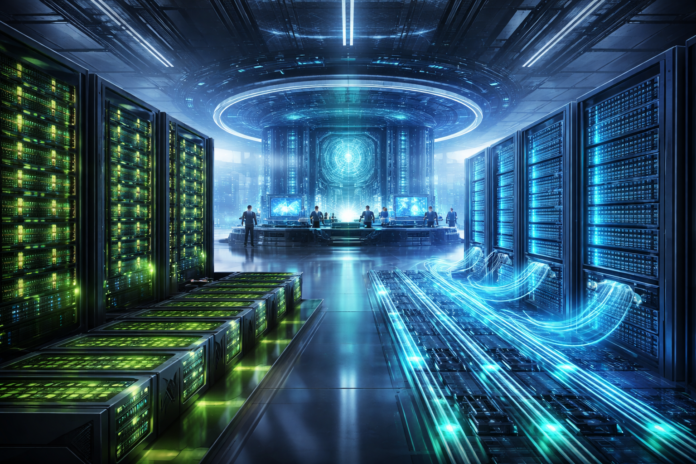
The quiet industrial turn of artificial intelligence
For years, artificial intelligence has been presented to the public through a steady stream of spectacular announcements. New models, ever larger datasets, increasingly impressive demonstrations : the narrative has been carefully cultivated, often led by the major American technology companies.
Yet behind this carefully staged technological theater, a far more decisive transformation is underway. The real battle is no longer taking place solely in algorithms or model design. It is unfolding in something far less glamorous but infinitely more strategic: AI infrastructure.
Artificial intelligence is entering an industrial phase. A phase where the decisive question is not simply how intelligent the models are, but whether the physical and digital systems capable of running them at scale actually exist.
In practice, the performance of modern AI systems now depends on three pillars: computational power, high-speed data management, and the architecture capable of orchestrating both.
This is precisely where a new technological trio is emerging: NVIDIA for computing power, DDN for data infrastructure, and Aleria for the orchestration of AI factories.
AI infrastructure: the new strategic frontier of artificial intelligence
For decades, artificial intelligence remained largely confined to laboratories, research centers and experimental environments. Progress was remarkable, but deployment remained limited.
That era is ending.
Modern AI models now require staggering computational resources. Thousands of GPUs must operate simultaneously, fed continuously by massive streams of data and coordinated by complex architectures capable of maintaining operational stability.
Without AI infrastructure, even the most sophisticated models remain theoretical.
In reality, the effectiveness of artificial intelligence systems increasingly depends on three fundamental variables:
- raw computing capacity
- speed of data access
- architectural efficiency linking both layers
This shift marks the transformation of artificial intelligence from a software breakthrough into something closer to an industrial system — comparable, in its scale and strategic implications, to energy networks or telecommunications infrastructure.
And as history repeatedly demonstrates, infrastructure ultimately determines power.
NVIDIA: the engine of global AI computing
Over the past decade, NVIDIA has positioned itself at the very center of the global AI computing landscape.
Its GPUs now power the overwhelming majority of large-scale AI systems, from research laboratories to hyperscale cloud providers and government computing centers. In financial markets, the company’s meteoric rise has been interpreted as a signal of something deeper than a temporary technological trend.
In the architecture of modern AI infrastructure, NVIDIA’s GPU clusters function as the engines of the system.
But engines alone are not enough.
Even the most powerful processors become inefficient if they are not supplied with data quickly enough. And in large-scale AI systems, data flows are not merely a technical detail, they are a structural constraint.
DDN: the invisible backbone of AI data
The public narrative surrounding artificial intelligence tends to focus on models and computing chips. Data infrastructure, however, often remains hidden behind the scenes.
Yet in industrial AI environments, data moves like fuel through a high-pressure pipeline. If that pipeline slows down, even the most advanced GPUs become underutilized, an expensive inefficiency in systems costing billions of dollars.
This is where the American company DDN plays a critical role.
Specialized in high-performance data storage and large-scale data management systems, DDN has become one of the key components of modern AI infrastructure. Its technology ensures that massive volumes of information can move rapidly enough to keep computational clusters operating at full capacity.
In practical terms, data infrastructure has become as strategic as computing power itself.
A reality that rarely appears in simplified narratives about the future of AI.
Aleria and the emergence of AI factories
Between these two pillars, computing and data, lies a third dimension that is often overlooked: orchestration.
Complex infrastructures do not operate efficiently without an architecture capable of integrating their components into a coherent system.
This is precisely the position occupied by Aleria.
The Emirati company focuses on designing and orchestrating architectures capable of transforming computing power and data infrastructure into what are increasingly described as AI factories.
The term is not merely metaphorical.
Artificial intelligence is gradually following a familiar technological trajectory: experimentation first, industrialization later. The objective is no longer simply to develop models, but to produce them continuously, train them at scale and deploy them across entire economic sectors.
In this industrial chain, NVIDIA provides the engines, DDN ensures the flow of data, and Aleria builds the operational architecture that allows the entire system to function.
Infrastructure as the new arena of global technological competition
This transition toward infrastructure may represent one of the most significant shifts in the history of artificial intelligence.
The technological race is no longer limited to models or applications. It is increasingly defined by the ability to build and control the industrial systems capable of sustaining AI development.
Across the world, subtle signals are multiplying: massive government investments, national supercomputing projects, new technological hubs emerging far beyond the traditional centers of Silicon Valley.
Behind the public announcements and carefully crafted narratives, a colder reality is taking shape.
Control over AI infrastructure is rapidly becoming a central component of technological sovereignty.
The invisible machinery of technological power
As artificial intelligence moves deeper into its industrial phase, the real transformation is happening far from public demonstrations or corporate marketing.
It is unfolding inside data centers, computing clusters and the complex architectures that bind them together.
Companies like NVIDIA, DDN and Aleria illustrate this transition clearly. Artificial intelligence is no longer merely a software revolution.
It is becoming a global industrial infrastructure.
And in the history of power, infrastructure has always mattered more than promises.

